Liturgical Music for Band, Op. 33: E-flat Baritone Saxophone Sheet Music Preview

Liturgical Music for Band, Op. 33: E-flat Baritone Saxophone

By Martin Mailman

Grade: 3.5 (Medium Easy to Medium)

Item: 00-PC-0015174_BTX

Digital Download
$3.00
Description
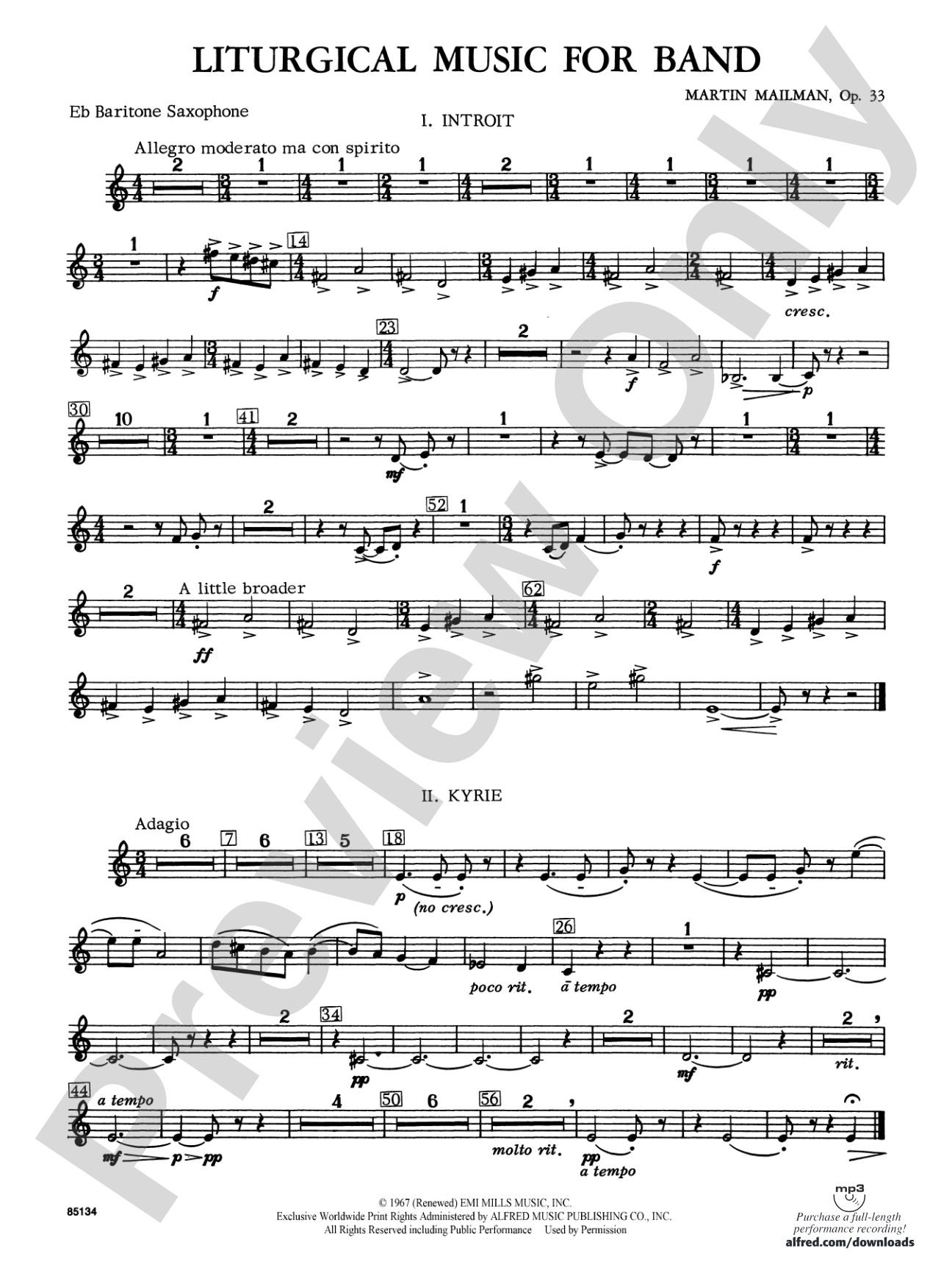
Liturgical Music for Band, Op. 33, was completed in 1963. Since then, the piece has become a landmark work in the band repertoire with countless performances by several generations of students. The piece is based on four movements selected from the Mass "Proper" and "Ordinary." The band plays in a chime-like style to announce the opening movement, "Introit." The second movement has the same three sections as the "Kyrie" from the Mass (Kyrie eleison -- Christe eleison -- Kyrie elieison). The theme of the third movement is the same rhythm as the word "Gloria," and the style is jubilant, just like the Mass text ("Glory to God in the highest . . . "). The fourth movement, "Alleluia," features an energetic fugue and an exciting climax.

Liturgical Music for Band, Op. 33: E-flat Baritone Saxophone isn't in MakeMusic Cloud just yet...but it could be. Let us know you'd like to see it, and you'll help shape what comes next. In the meantime, start a free trial and dive into thousands of interactive titles your students can play along with today.

Sample Audio
0:00
0:00
Sample Video
Additional Details
Series: Belwin Classic Band
Publisher: Alfred Music
Page Count: 294
SKU: 00-PC-0015174_BTX

More about this title

About the Composer: Martin Mailman

Martin Mailman (1932-2017) was a prolific American composer and educator whose works span concert band, orchestra, and choral literature. His compositions are known for their accessibility, memorable thematic material, and pedagogical clarity, making them staples in school and community band programs across the United States.

Mailman's gift for writing idiomatically for young musicians earned him recognition as a composer who understood the developmental needs of student ensembles. His works have been performed thousands of times by student musicians and continue to be programmed at festivals and concerts nationwide.

Why we love this

Liturgical Music for Band strikes an uncommon balance: it carries genuine spiritual weight while remaining entirely accessible to Grade 3.5 ensembles. The four-movement structure gives students exposure to large-scale form and thematic development without overwhelming them, and the piece has proven itself across generations as both rewarding to teach and genuinely moving to hear.

What to expect

The music unfolds with liturgical dignity, moving from the hushed, bell-like opening of the Introit through contemplative supplication in the Kyrie, then suddenly bursting into radiant celebration in the Gloria. The closing Alleluia crackles with energy and complex inner voices before resolving into a triumphant finish.

Who it's for

This score and parts set is essential for concert band directors programming music that deepens students' understanding of large form, sacred traditions, and ensemble blend. It works equally well for advanced middle school bands and younger high school ensembles seeking substantial repertoire with genuine artistic merit.

How to get the most out of it

  • Shape the opening 'Introit' with clarity and restraint; the chime-like quality depends on precise articulation and controlled dynamics rather than volume.
  • In the 'Kyrie,' distinguish the three sections (Kyrie eleison, Christe eleison, Kyrie eleison) through tempo and textural shifts so the liturgical structure becomes audible.
  • Lock the rhythmic unison passages in the 'Gloria' movement; the jubilant character relies on the ensemble moving as one unit, not as individual sections.
  • Build the fugue in the 'Alleluia' carefully so each voice entry registers clearly; transparency here makes the final climax land with maximum impact.

How to use it

Liturgical Music for Band works beautifully as the centerpiece of a concert exploring sacred music across cultures and styles, or as the anchor of a concert celebrating American band classics. Its four-movement structure and approximately 12-15 minute duration make it ideal for programming after lighter openers or as the closing work of a concert.

Skills your students will build

  • Multi-movement form and thematic unity across contrasting sections
  • Articulation control and dynamic subtlety in hymn-like passages
  • Ensemble blend and balance in layered textures
  • Fugal writing and independent voice leading
  • Musical interpretation of text-inspired imagery and liturgical structure

You May Also Like