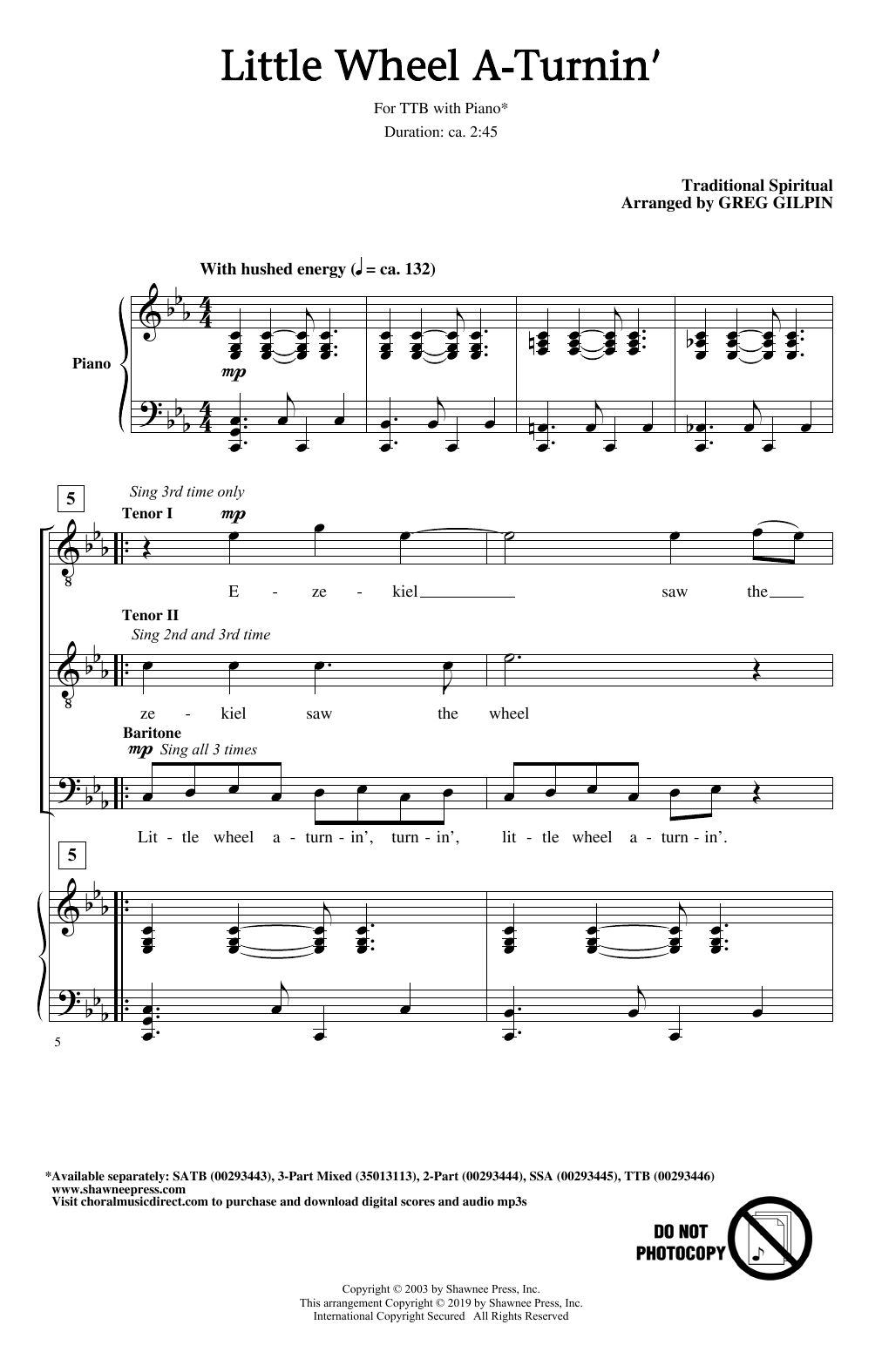
Little Wheel A-Turnin' (arr. Greg Gilpin) Sheet Music Preview

Little Wheel A-Turnin' (arr. Greg Gilpin): TTBB Choral Octavo

Arranged by Greg Gilpin

Item: 35-DS00446526

Digital Download
$2.99
Description

Little Wheel A-Turnin' (arr. Greg Gilpin): TTBB Choral Octavo isn't in MakeMusic Cloud just yet...but it could be. Let us know you'd like to see it, and you'll help shape what comes next. In the meantime, start a free trial and dive into thousands of interactive titles your students can play along with today.

Sample Audio
No sample audio found.
Sample Video
Additional Details
Publisher: Hal Leonard
Page Count: 14
SKU: 35-DS00446526

More about this title

About the Arranger: Greg Gilpin

Greg Gilpin

Greg Gilpin brings ASCAP recognition and decades of conducting experience to his work as one of America's most prolific choral arrangers. His performances have graced major venues including Carnegie Hall, Lincoln Center, the Sydney Opera House, and London's Royal Festival Hall, establishing him as a conductor of considerable artistry and reach. Beyond the concert hall, Gilpin serves as Director of Educational Choral Publications for Shawnee Press, where he shapes the choral repertoire that reaches thousands of singers annually.

When the pandemic redirected his path, Gilpin pursued training in professional organizing and financial coaching, eventually appearing on national television programs including "Hoarders." His creative scope extends further still: he composed the award-winning score for the short film "Rosie's Rescue" and collaborated with opera singer Angela Brown to create a world premiere arrangement of "What Child is This?" Gilpin holds membership in ACDA, NAfME, SAG-AFTRA, and maintains Life Loyal standing in Phi Mu Alpha Sinfonia.

Why we love this

Gilpin's arrangement captures the soul of this spiritual with textures that feel both intimate and powerful, giving men's voices space to dig into the emotional core of the material. The voicing options (TB through TTBB) mean you can use this whether you're working with smaller ensembles or full sections, making it genuinely flexible for real-world programming. What elevates this beyond a standard spiritual arrangement is how Gilpin builds harmonic interest while keeping the tune accessible and the message clear.

What to expect

A deeply rooted spiritual that reminds us why this music endures. The arrangement holds both the quietness of private faith and the strength of communal voice, creating moments where the ensemble can feel genuinely connected to the text and to each other.

Who it's for

Men's choirs and mixed ensembles seeking authentic spiritual arrangements with real melodic integrity and harmonic depth. This works for directors who want to program meaningful repertoire that engages singers at multiple voicing levels without dumbing down the artistry.

How to get the most out of it

  • Layer the parts gradually during rehearsal rather than jumping into full four-part textures immediately. Start with melody and bass, then add inner voices one at a time so singers can hear how their line supports the whole.
  • Pay attention to the text painting in the arrangement. Gilpin likely uses harmonic or rhythmic choices to emphasize key spiritual imagery, so discussing the meaning of each phrase helps singers perform the words with intention rather than just singing notes.
  • Consider how you want to approach dynamics across the full arc. Spirituals often benefit from quiet, intimate passages that build to moments of power; let the arrangement guide you but make choices that suit your ensemble's character.
  • Invest time in releasing consonants crisply as a section. Men's voices can sometimes blur word endings, but clear articulation makes the text land and prevents the arrangement from feeling muddy.

How to use it

Pair this with other spirituals or American hymn-tune material for a thematic concert segment, or position it as a powerful programming choice that gives the second half of a concert emotional ballast. The 14-page score and accessible voicing options make it substantial enough to anchor a portion of your season without requiring specialized vocal ranges or excessive rehearsal time.

Skills your students will build

  • Blending and balancing in close harmony (TTBB voicings)
  • Performing spiritual style with appropriate vocal color and phrasing
  • Text clarity and diction in ensemble context
  • Harmonic listening (tracking inner voice movement and function)
  • Musical interpretation of sacred and cultural material with respect

You May Also Like