Little Turtle Dove: Piano Sheet Music Preview

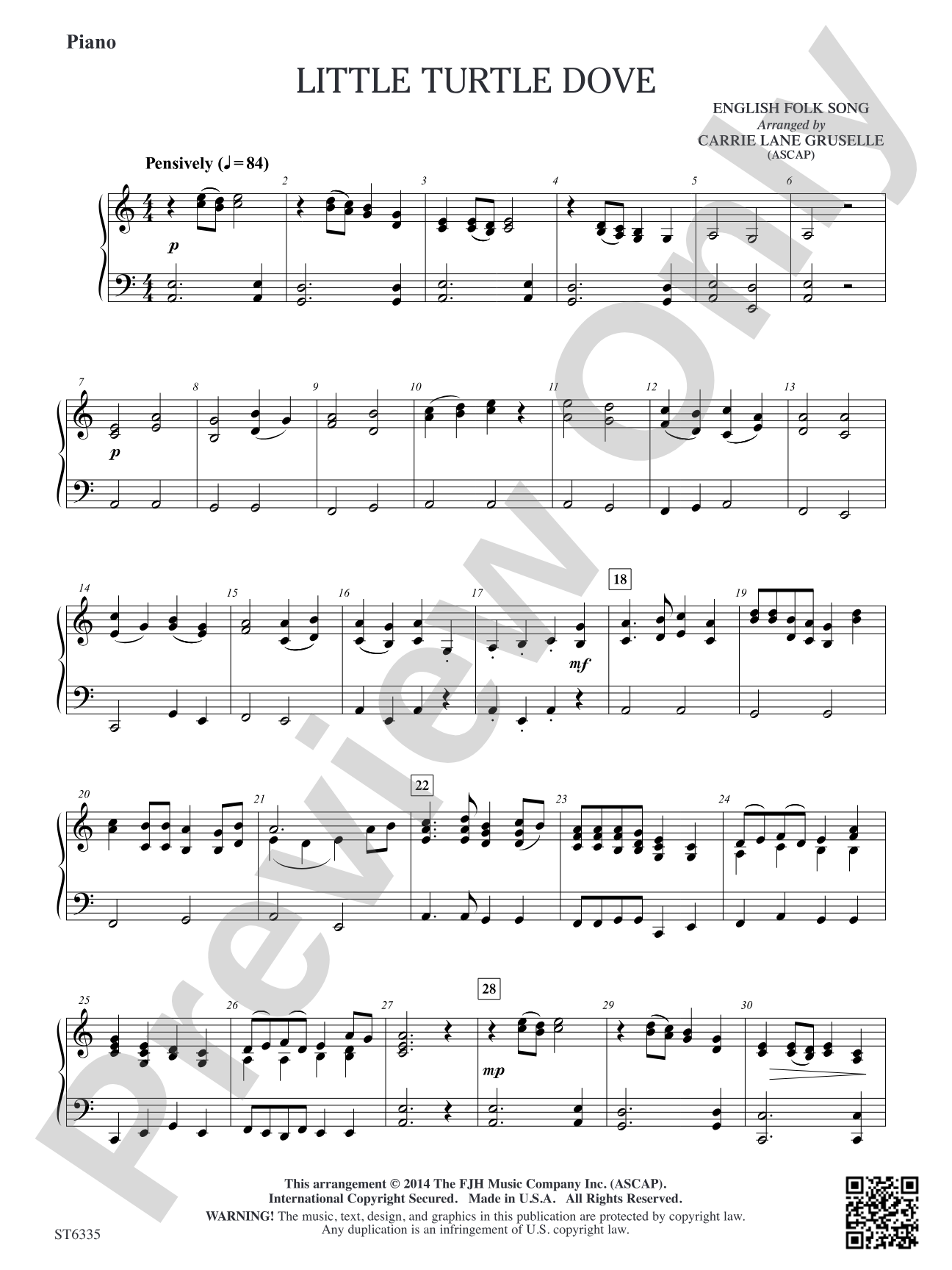
Little Turtle Dove: Piano

Arranged by Carrie Lane Gruselle

Grade: 2

Item: 98-PC-DST6335_K

Digital Download
$7.00
Description
This tender and enduring traditional English melody is arranged to help your students learn to be independent in their parts, to be comfortable in A minor and C major, and to refine their legato technique, slurs and dotted rhythms. A bittersweet beauty with a wealth of teaching and musical opportunities!

Don't just read it, hear it, play along with it, and watch your students grow with it. In MakeMusic Cloud, Little Turtle Dove: Piano comes alive with professional accompaniment, adjustable tempo, and built-in practice tools that turn solo practice into real progress.

Sample Audio
0:00
0:00
Sample Video
Additional Details
Series: FJH Developing Strings
Publisher: The FJH Music Company, Inc.
SKU: 98-PC-DST6335_K

More about this title

About the Arranger: Carrie Lane Grusell

Carrie Lane Grusell is an arranger and composer committed to creating accessible yet musically substantive repertoire for developing string orchestras. Her work in the FJH Developing Strings series demonstrates a keen understanding of how to scaffold technical growth while keeping students engaged with material that sounds mature and rewarding.

Grusell approaches arranging with a teacher's perspective, building pieces that isolate specific learning objectives without sacrificing musical integrity. Her arrangements consistently appear on festival and contest lists, earning recognition from conductors who value both pedagogical clarity and genuine artistic merit.

Why we love this

Grusell's arrangement treats this English folk melody with genuine respect while remaining firmly focused on pedagogy. The writing distributes independence across all parts without sacrificing the piece's inherent warmth, and the choice to work in A minor and C major gives students real harmonic substance to explore without overwhelming them.

What to expect

A quiet lullaby tinged with longing. The minor key gives the melody a reflective, bittersweet quality that deepens when the harmony shifts to C major, creating a moment of gentle hope before returning to the original melancholy. The dotted rhythms add rhythmic grace without false sentimentality.

Who it's for

String orchestras in grades 2-3 who are ready to work on part independence and refined articulation. This piece suits ensembles that have built basic rhythmic security and are prepared to tackle longer lyrical phrases with attention to intonation.

How to get the most out of it

  • Shape the legato phrases by thinking of the melody as one long vocal line. Have students breathe together at phrase ends and sustain through the dotted rhythms to avoid choppiness.
  • Balance the inner parts carefully so they support rather than overshadow the melody. A minor resonates easily in lower voices; remind cellists and lower violas that their sustained notes anchor the harmonic foundation.
  • Use the key change to C major as a chance to lighten the texture. Encourage a slight shift in tone quality when the arrangement modulates, helping students hear and feel the brightness of the relative major.

How to use it

This works beautifully as a contrasting encore after a brighter opening work, or as the emotional centerpiece of a concert focused on folk traditions. Its modest length and transparent orchestration also make it ideal for a festival program where you want to showcase both technical growth and musicality.

Skills your students will build

  • Part independence and secure tuning in A minor and C major
  • Legato playing with controlled bow pressure through sustained passages
  • Reading and executing dotted rhythms with rhythmic precision
  • Phrase shaping and long-line singing across multiple bars
  • Dynamic control and balanced ensemble voicing in a transparent texture

You May Also Like