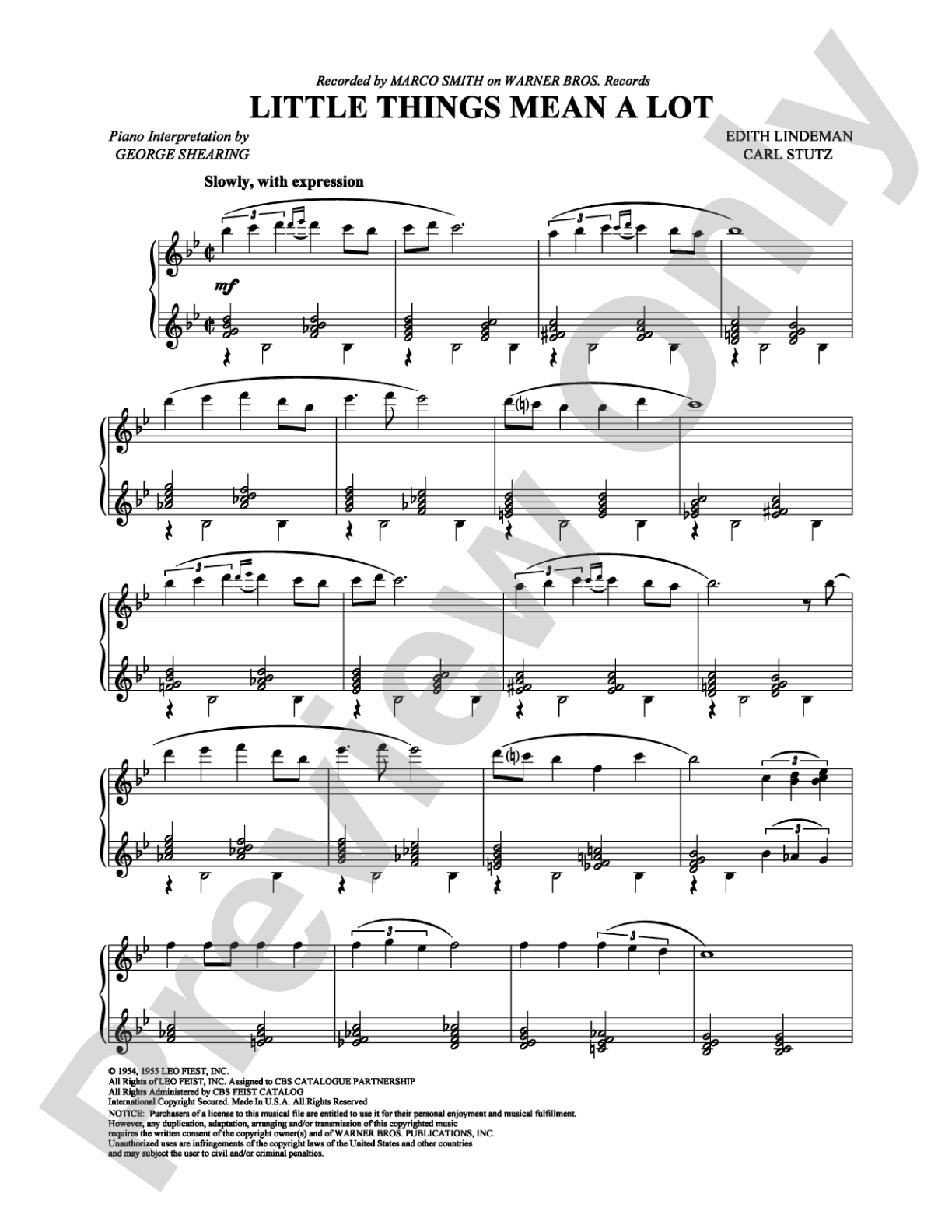
Little Things Mean a Lot: Piano Digital Sheet Music

Little Things Mean a Lot: Piano Digital Sheet Music

George Shearing, Edith Lindeman, Carl Stutz

Item: 00-PS-0007230

Digital Download
$3.99
Description

Little Things Mean a Lot: Piano Digital Sheet Music isn't in MakeMusic Cloud just yet...but it could be. Let us know you'd like to see it, and you'll help shape what comes next. In the meantime, start a free trial and dive into thousands of interactive titles your students can play along with today.

Sample Audio
No sample audio found.
Sample Video
Additional Details
SKU: 00-PS-0007230

More about this title

About the Artist: George Shearing

George Shearing (1919-2011) was a British jazz pianist and composer who became one of the most influential voices in cool jazz and standards interpretation. Blind from birth, Shearing developed an unmistakable harmonic sophistication and a light, precise touch that made him a natural interpreter of the Great American Songbook. His arrangements and performances defined an era of accessible, elegant jazz that appealed to both serious musicians and general audiences.

Why we love this

Shearing's arrangement sensibility shines in this standard, offering pianists a window into how a master approached voicing and touch. The piece rewards both technical facility and interpretive restraint, students can hear exactly what happens when you prioritize clarity over flash.

What to expect

Warm and conversational, with a gently swinging rhythm that never rushes. The harmonic textures are luminous but intimate, creating an atmosphere of quiet confidence and understated elegance. There's a sense of ease throughout, as if Shearing is thinking through the changes in real time while keeping the listener's ear always on the melody.

Who it's for

Jazz pianists developing their interpretive voice in standards repertoire will find Shearing's approach invaluable. Advanced students studying jazz voicing and arranging benefit from the clarity of his harmonic choices. This recording also works well for pianists seeking models of how to balance sophistication with accessibility.

How to get the most out of it

  • Listen closely to Shearing's use of dynamic restraint in the opening phrases; his touch is never heavy, allowing each harmony to bloom without overstatement.
  • Study how he phrases the melody across the bar lines rather than squaring off at measure boundaries, creating a conversational quality that brings the lyric to life.
  • Pay attention to his comping approach and chord voicings; Shearing favors quartal and clustered voicings that feel fresh while remaining grounded in standard changes.
  • Note the subtle use of dynamics and pedal to create depth without muddiness, especially in passages where the harmonic density increases.

How to use it

Program this alongside other jazz standards in a recital to show multiple interpretive approaches to the same repertoire. It serves as a reference recording in jazz history or standards study units, demonstrating how a master pianist approaches voicing and phrasing.

Skills your students will build

  • Jazz voicing and chord substitution in a standards context
  • Pedal control in jazz settings, balancing resonance with clarity
  • Melodic phrasing across bar lines in jazz performance
  • Left-hand comping and supporting harmonic movement
  • Balancing harmonic sophistication with melodic accessibility

You May Also Like