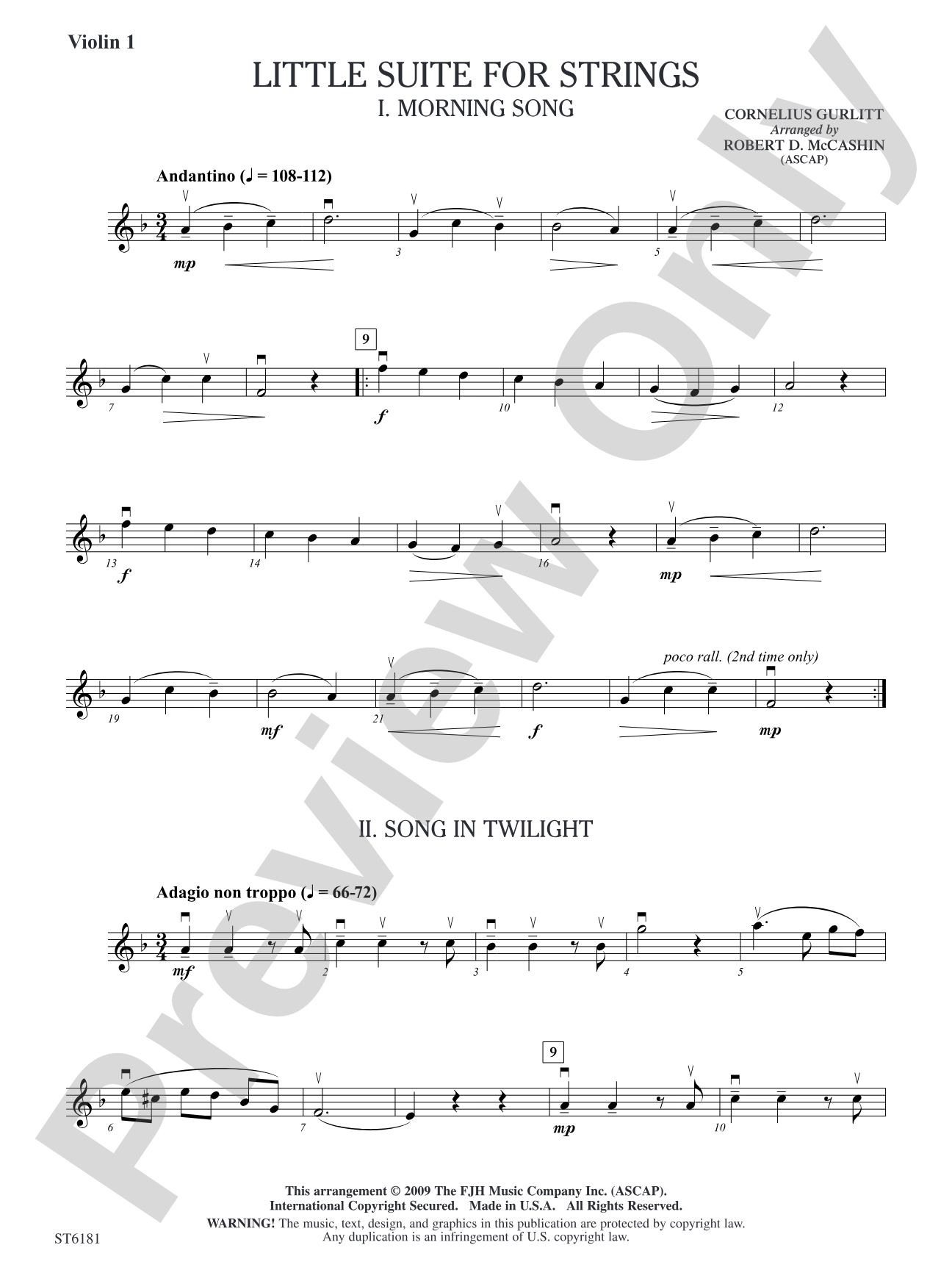
Little Suite for Strings: Violin 1 Sheet Music Preview

Little Suite for Strings: Violin 1

By Cornelius Gurlitt / arr. Robert D. McCashin

Grade: 2.5

Item: 98-PC-DST6181_VN1

Digital Download
$7.00
Description
This short three-movement work is the perfect choice to introduce your students to a multi-movement suite at the developing strings level. Drawn from two of Cornelius Gurlitt's well-known piano works, the movements include Morning Song, Song in Twilight, and March. Extremely well arranged, and a wonderful new gem to use for the classical portion of your program.

Little Suite for Strings: Violin 1 isn't in MakeMusic Cloud just yet...but it could be. Let us know you'd like to see it, and you'll help shape what comes next. In the meantime, start a free trial and dive into thousands of interactive titles your students can play along with today.

Sample Audio
0:00
0:00
Sample Video
Additional Details
Series: FJH Developing Strings
Publisher: The FJH Music Company, Inc.
SKU: 98-PC-DST6181_VN1

More about this title

About the Composer: Cornelius Gurlitt

Cornelius Gurlitt (1820-1901) was a prolific German composer and pedagogue whose enormous output of piano works remains a cornerstone of intermediate piano literature. His compositions balance musical substance with accessibility, making them ideal models for young musicians learning to recognize form and harmonic structure.

Gurlitt's gift for melody and his attention to character pieces made his work a natural fit for string adaptation. His piano compositions have educated generations of musicians, and this arrangement extends that legacy to the orchestra rehearsal room.

Why we love this

McCashin's arrangement preserves Gurlitt's melodic clarity while making excellent pedagogical use of divisi writing to maintain engagement across all sections. The three-movement structure gives developing ensembles a natural arc without requiring the stamina demanded by longer works, and the classical lineage of the material legitimizes it for contest or festival programming.

What to expect

The suite unfolds with the gentleness of a Romantic sketchbook. Morning Song opens with quiet lyricism, Twilight introduces reflective warmth through richer harmonies, and the March energizes the ensemble with rhythmic clarity and forward momentum. Together, the three movements create a complete journey that feels both intimate and structured.

Who it's for

Developing string orchestras ready to tackle a structured multi-movement work with historical substance. This suite works equally well for high school preparatory orchestras, middle school select ensembles, and community youth orchestras seeking accessible classical literature with real musical merit.

How to get the most out of it

  • Shape each movement's opening with clear phrasing in the first violin line; these melodies drive the architecture, so let them breathe naturally rather than pushing the tempo forward.
  • Balance the divisi sections carefully in the middle and lower strings. When inner voices sustain harmony, they should provide warmth, not weight; adjust bowing and vibrato to achieve transparency.
  • Use the march movement as an opportunity to refine articulation clarity across all sections. Uniform tonguing style and crisp bow attacks will give the ensemble cohesion and projection.
  • Record a sectional rehearsal of the slower movements to assess whether phrase endings feel resolved or pushed; young string players often rush the breath space between phrases.

How to use it

Schedule this as the classical selection on a concert featuring contrasting genres, or pair it with a contemporary work and a transcription to build a thematic program around adaptation and arrangement. Its moderate length and contest-ready polish make it an excellent choice for winter or spring festival participation when you want to showcase fundamental musicianship without stretching rehearsal resources.

Skills your students will build

  • Phrasing across multi-movement forms
  • Sustaining tone quality in divisi writing
  • Articulation consistency across sectional parts
  • Melodic responsibility in first violin passages
  • Harmonic balance between exposed inner voices and structural bass lines

You May Also Like