
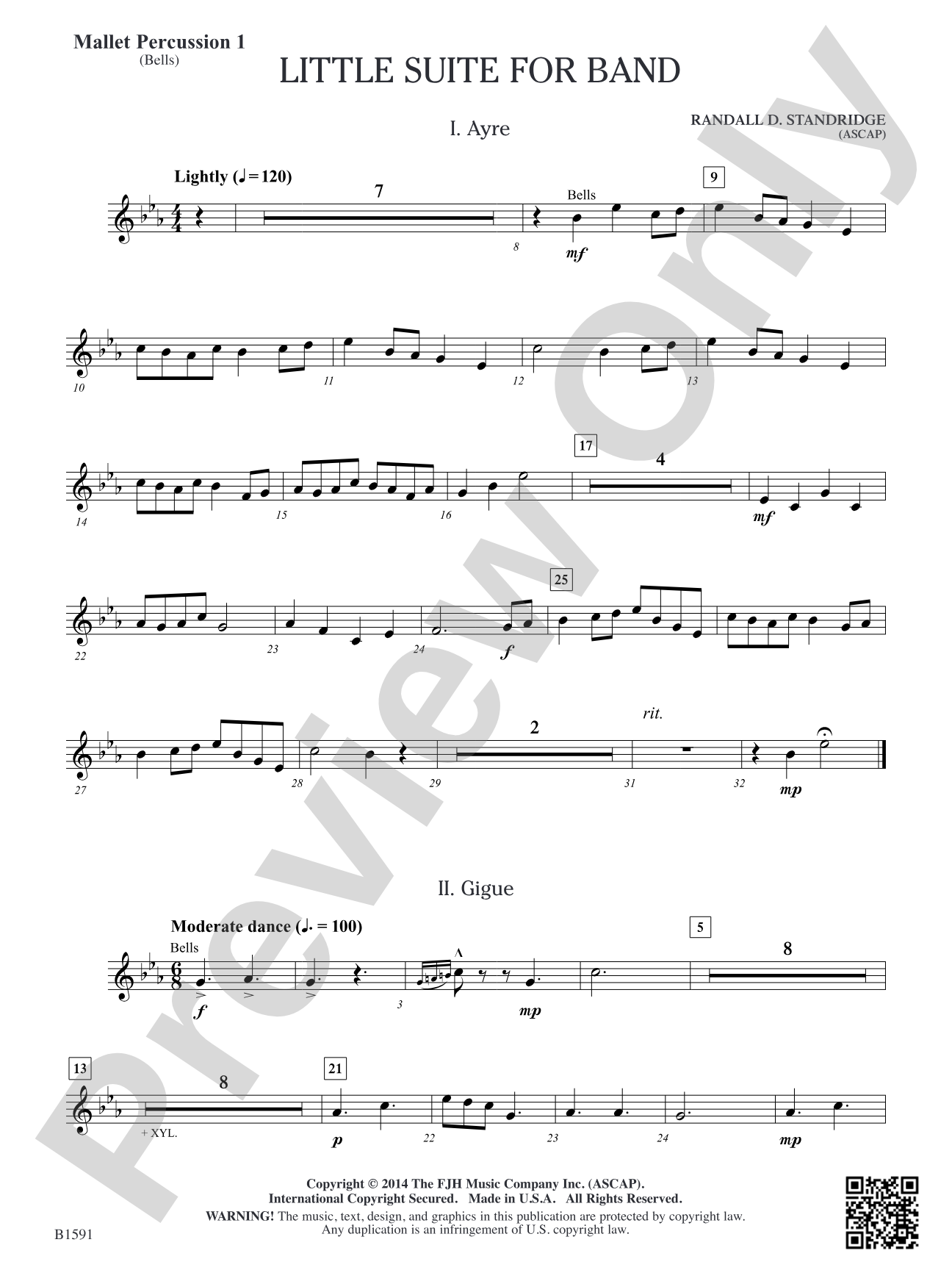

Little Suite for Band: Mallet Percussion 1
By Randall Standridge
Grade: 2
Item: 98-PC-DB1591_M1
$7.00
Pickup currently not available
Description
This wonderful, original suite has elements of folk melodies and is an ideal way to introduce students to multi-movement works. Students will learn multiple meters, key signatures, and styles in the four movements, titled Ayre, Gigue, Ballad, and March. Rewarding and extremely accessible, the music uses a careful instrumentation and range to make sure even smaller ensembles will sound full and confident.


Don't just read it, hear it, play along with it, and watch your students grow with it. In MakeMusic Cloud, Little Suite for Band: Mallet Percussion 1 comes alive with professional accompaniment, adjustable tempo, and built-in practice tools that turn solo practice into real progress.
Open in the Player
Jump straight in and assign it today.
Start Your Free Trial
Open this title and explore the full library in minutes.
Sample Audio
1
Audio File
--:--
0:00
0:00
Sample Video
No sample videos found.
Additional Details
Series:
FJH Young Band
Publisher:
The FJH Music Company, Inc.
SKU:
98-PC-DB1591_M1
More about this title
About the Composer: Randall Standridge

Randall Standridge earned his Bachelor of Music Education from Arkansas State University, where he studied composition under Dr. Tom O'Connor. He returned to complete his Master's degree in Music Composition at the same institution, continuing his studies with both O'Connor and Dr. Tim Crist.
Standridge served as Director of Bands at Harrisburg High School in Harrisburg, Arkansas from 2001 until 2013, when he transitioned to full-time composition and marching arts design. His works appear through Randall Standridge Music, Alfred Music, and FJH Music, and are performed internationally. Multiple compositions have earned J.W. Pepper's editor's choice recognition, while others have been included in the Teaching Music Through Performance in Band series and premiered at major conferences including the Midwest Clinic in Chicago and the CBDNA conference. Beyond composing, Standridge owns and edits Randall Standridge Music, LLC and Grand Mesa Marching, where he works as a drill designer, arranger, and colorguard designer. He lives in Jonesboro, Arkansas.
Why we love this
Standridge writes with Grade 2 ensembles in mind, never talking down to students or oversimplifying the musical content. Four distinct movements expose students to contrasting styles and meters without overwhelming them; the careful instrumentation ensures that even lean sections maintain musical presence and confidence. This is the kind of suite that makes emerging musicians feel like real musicians performing real music.
What to expect
Four short journeys through different musical worlds. The suite opens with an elegant Ayre, moves into the playful rhythmic life of the Gigue, settles into the emotional depth of the Ballad, and concludes with the ceremonial stride of the March. Throughout, folk melody roots keep the music grounded and human.
Who it's for
Band directors introducing students to multi-movement works and looking for repertoire that teaches structural thinking without sacrificing accessibility. This suite works well for developing ensembles that need to build confidence through carefully voiced parts and smaller instrumentation schemes.
How to get the most out of it
- Balance each movement's character shift during rehearsal sectionals. The rhythmic drive of the Gigue requires different energy than the legit phrasing of the Ballad, so isolate those transitions to mark the style change clearly for students.
- Let the folk melodies breathe naturally. Standridge voices these tunes across the ensemble, so encourage your first and second parts to listen across sections and support the melody line wherever it sits.
- Drill the meter changes in context, not isolation. Since students encounter multiple meters across the four movements, rehearse how the pulse feels in each new meter before working it into full sections.
- Use the range restrictions to your advantage during balance checks. Because this suite is written conservatively for Grade 2 players, register shifts are usually intentional for musical effect, not survival.
How to use it
Program this as a full suite at a festival or concert where you want to showcase musical growth within a single work, or use individual movements at different concerts to reinforce the concept that bands perform diverse repertoire. The four-movement structure also makes it a valuable teaching tool early in the school year to introduce ensemble members to varying styles and textures.
Skills your students will build
- Reading and performing multiple meters across a single work
- Identifying and responding to style changes (ayre, dance, ballad, march)
- Balancing part writing across varied instrumental combinations
- Sustaining musical phrases in lyrical contexts
- Maintaining rhythmic precision in metric shifts
- Understanding multi-movement form and structural contrast