Little Shooting Star - Piano Solo Sheet Music Preview

Little Shooting Star - Piano Solo: Piano

By June C. Montgomery

Level: Elementary

Item: 00-PB-0000761

Digital Download
$3.50
Description
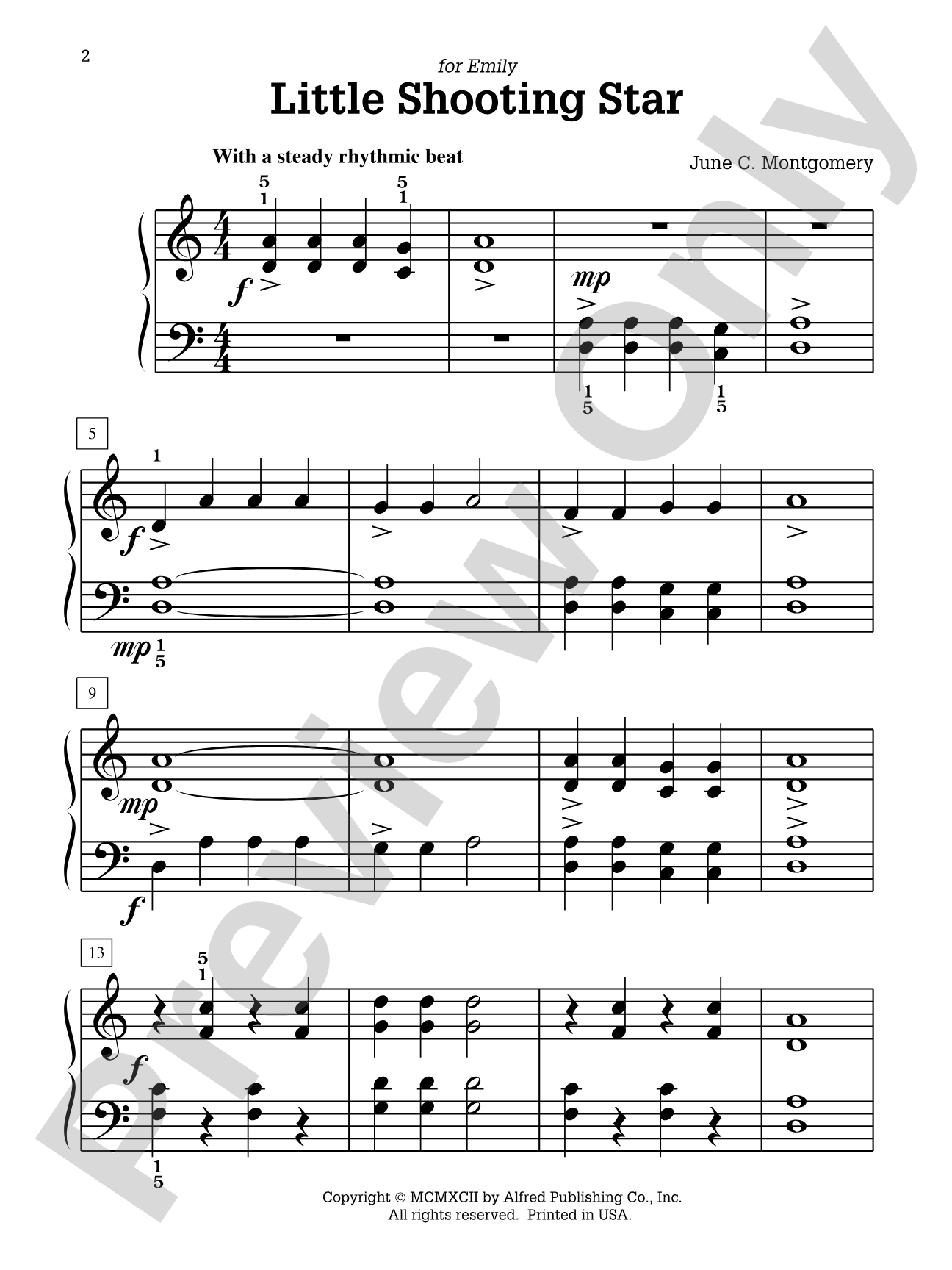
Open fifths and accents create an Indian drum beat in this elementary level piece which also features melody shifts between the right and left hands and a nice variety of dynamics. A Federation Festivals 2020-2024 selection. A Federation Festivals 2024-2028 selection.

Little Shooting Star - Piano Solo: Piano isn't in MakeMusic Cloud just yet...but it could be. Let us know you'd like to see it, and you'll help shape what comes next. In the meantime, start a free trial and dive into thousands of interactive titles your students can play along with today.

Sample Audio
No sample audio found.
Sample Video
Additional Details
Series: Signature Series
Publisher: Alfred Music
Page Count: 4
SKU: 00-PB-0000761

More about this title

About the Composer: June C. Montgomery

June C. Montgomery

June C. Montgomery earned her degree from Florida State University and has spent more than two decades teaching private piano students while also bringing music into elementary classrooms. Her work in schools earned her recognition as an Outstanding Elementary Teacher of America and membership in Delta Kappa Gamma, where she deepened her commitment to music pedagogy and student development.

Beyond the studio and classroom, Montgomery has written extensively for Alfred Publishing, including the FUNdamental Musicianship Skills series, the Piano Camp series, and contributions to Alfred's Basic Piano Library. She has collaborated with respected composers Maurice Hinson and Martha Mier, served as a clinician at state and national music education conferences, and maintained active roles as a church pianist and children's choir director. She currently serves as carillonneur at the Stephen Foster Memorial.

Why we love this

Montgomery writes with genuine understanding of what engages young pianists. The open fifths and Indian drum beat pulse make this piece immediately fun to play without requiring advanced technique, while the hand-switching melody keeps students thinking about voice leading and independence. It's earned selection in two consecutive Federation Festivals cycles for good reason: it sounds more sophisticated than it plays.

What to expect

Rhythmically alive and percussive, with a hypnotic quality that comes from those repeating open fifths. The melody dances across both hands in a way that feels playful and exploratory, never settling where you expect it, while dynamic contrasts give the piece surprising depth for its length.

Who it's for

Elementary pianists working toward independence and hand coordination. Students benefit most when they have solid single-hand technique and can read confidently in treble clef, making this ideal for late elementary or early intermediate preparation.

How to get the most out of it

  • Lock the open fifths rhythm steady in the left hand; let them anchor the Indian drum beat rather than wavering with the melody shifts above.
  • Experiment with the accents to shape the drum pattern. Some students will need to practice isolating those markings away from the full texture first.
  • Follow the dynamic variety carefully. The shifts between loud and soft sections define the piece's character as much as the rhythm does.
  • When the melody moves between hands, make sure the transition feels seamless by overlapping the sound slightly rather than creating a gap.

How to use it

Program this as a confident elementary showcase piece on a student recital, or use it as a stepping stone toward more complex rhythmic writing in intermediate repertoire. Its Federation Festivals selection makes it a natural choice for festival preparation, and the percussive character offers a refreshing contrast to lyrical ballads or Baroque arrangements in a mixed solo program.

Skills your students will build

  • Hand independence and melody shifting between right and left hands
  • Reading and maintaining open fifth patterns while managing textural changes
  • Rhythmic precision with accented eighth-note patterns
  • Dynamic contrast and phrasing across four pages of sustained interest
  • Performance confidence in a piece with contemporary, non-traditional sonority

You May Also Like