Little Red Robin Sheet Music Preview

Little Red Robin: Piano

By Timothy Brown

Item: 98-DW9225

Digital Download
$3.50
Description
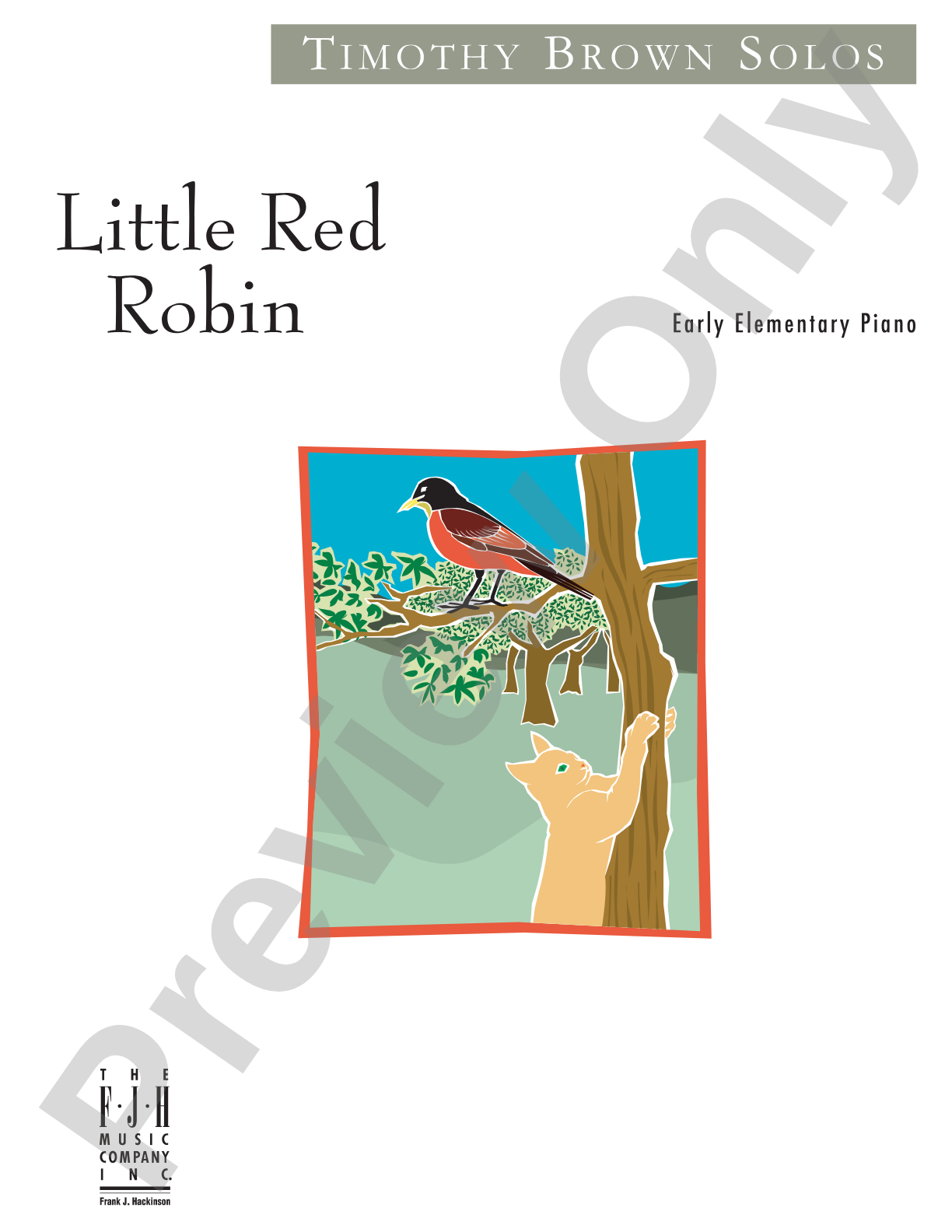
Based on the traditional English nursery rhyme Little Robin Red-breast, this piece has lyrics to tell the tale of a kitty chasing a robin. Uses 5-note finger patterns to effectively introduce one-, two-, and four-measure phrasing. An interesting teacher accompaniment adds to the story.

Little Red Robin: Piano isn't in MakeMusic Cloud just yet...but it could be. Let us know you'd like to see it, and you'll help shape what comes next. In the meantime, start a free trial and dive into thousands of interactive titles your students can play along with today.

Sample Audio
No sample audio found.
Sample Video
Additional Details
Series: Written For You
Publisher: The FJH Music Company, Inc.
SKU: 98-DW9225

More about this title

Why we love this

Timothy Brown's setting captures the charm of the nursery rhyme while building genuine musical literacy. The 5-note finger patterns work like a scaffold, letting early pianists experience authentic phrasing without reaching beyond their technical range. The teacher accompaniment transforms a simple student piece into a miniature story that feels complete and collaborative.

What to expect

Gentle and whimsical, with the simplicity of a familiar nursery rhyme meeting the gentle comedy of a cat-and-robin chase. The limited range and straightforward melody let young performers focus on expression and phrasing rather than technical struggle.

Who it's for

This piece suits early elementary pianists ready to play beyond single notes but still building hand position and finger independence. It works equally well for students in Suzuki or traditional lesson settings who want their first collaborative experience with a teacher accompaniment.

How to get the most out of it

  • Keep the student part flowing naturally even though the range is limited; this isn't an exercise, it's a performance.
  • Work with the teacher to coordinate the rhythm of the accompaniment during rehearsals so the student can feel supported rather than rushed.
  • Point out where the phrasing changes occur (one measure, then two, then four) so the student understands these moments aren't arbitrary but tell the story arc.
  • Use light, playful articulation to bring out the image of the kitty chasing the robin; let the accompaniment set the mood while the melody stays clear.

How to use it

Perfect for a studio recital where early-elementary students perform; the teacher accompaniment gives parents a satisfying musical moment while keeping the spotlight on the young pianist. It also fits naturally into a lesson sequence when introducing phrasing concepts, since the three phrase lengths give immediate, audible examples of how music can breathe differently.

Skills your students will build

  • Reading and sustaining one-measure, two-measure, and four-measure phrases
  • Playing within a 5-note hand position while maintaining steady tempo
  • Listening to and responding to an accompaniment layer
  • Connecting melodic shape to storytelling and character
  • Collaborating with a teacher partner in real time

You May Also Like