
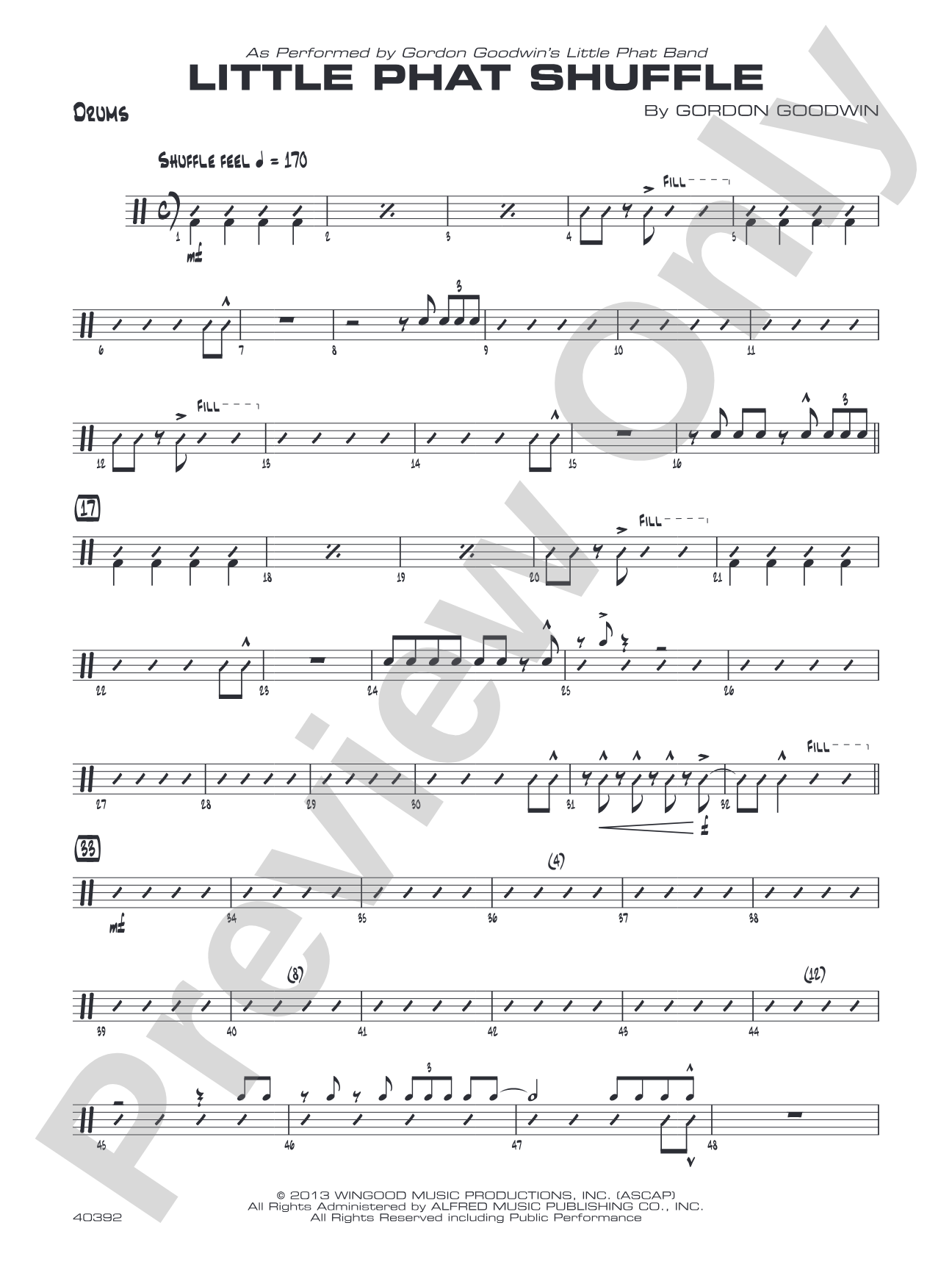

Little Phat Shuffle: Drums
As Performed by Gordon Goodwin's Little Phat Band
By Gordon Goodwin
Grade: 4.5 (Medium Advanced / Difficult)
Item: 00-PC-0017266_D
$3.00
Pickup currently not available
Description
As performed by Gordon Goodwin's Little Phat Band, the instrumentation is tenor sax, trumpet, trombone, piano, guitar, bass (acoustic), and drums. As the title suggests, this one is a shuffle at around 170 BPM. A catchy melody and nicely put together with solo space for all. A fun chart. (2:45) This title is available in MakeMusic Cloud.


Don't just read it, hear it, play along with it, and watch your students grow with it. In MakeMusic Cloud, Little Phat Shuffle: Drums comes alive with professional accompaniment, adjustable tempo, and built-in practice tools that turn solo practice into real progress.
Open in the Player
Jump straight in and assign it today.
Start Your Free Trial
Open this title and explore the full library in minutes.
Sample Audio
1
Audio File
--:--
0:00
0:00
Sample Video
No sample videos found.
Additional Details
Series:
Gordon Goodwin Little Phat Band Series
Publisher:
Alfred Music
Page Count:
34
SKU:
00-PC-0017266_D
More about this title
About the Composer: Gordon Goodwin

Gordon Goodwin has been composing music since childhood, writing complete compositions rather than fragments by the age of five. His first big band arrangement, Hang Loose, emerged when he was just thirteen, establishing a creative pattern that would define his career across television, film, and live performance. His film and television work has earned him three Emmy Awards and multiple Grammy nominations, with orchestrations featured in blockbusters including Bad Boys II, Con Air, Remember the Titans, and Star Trek: Nemesis.
Beyond Hollywood, Goodwin has collaborated with major artists including Christina Aguilera, Ray Charles, Quincy Jones, and David Foster as composer, arranger, and performer. Since 2000, he has led Gordon Goodwin's Big Phat Band, a Los Angeles-based big band ensemble that has released multiple Grammy-nominated albums. His reputation rests on a comprehensive skill set spanning composition, arrangement, orchestration, and ensemble leadership.
Why we love this
Goodwin writes charts that balance accessibility with genuine sophistication. The shuffle groove and catchy melody make this chart instantly engaging for audiences, while the solo space for every section and the Grade 4.5 difficulty demand real musicianship from your ensemble. It's the kind of piece that feels like a celebration rather than a slog through a difficult arrangement.
What to expect
Propulsive, playful, and accessible. The shuffle groove keeps everything moving forward with a rhythmic lift that recalls funk and R&B, while the melody stays memorable and singable. Solos emerge naturally from the arrangement's forward momentum, and the overall character feels like a conversation between friends rather than a formal recital.
Who it's for
Jazz ensembles with solid fundamentals and players comfortable with shuffle rhythms and section-specific improvisation. Directors seeking a contemporary chart that delivers both musical substance and audience appeal will find this ideal for a concert or festival setting where energy and musicality matter equally.
How to get the most out of it
- Lock the shuffle feel before anything else. The groove at 170 BPM needs to sit in the pocket between the drums and bass; clarity of intent from the rhythm section makes every other part land correctly.
- Balance the melody against the comping instruments so the horn line cuts through without the piano and guitar fighting for space. Goodwin's voice leading depends on hearing the intended harmonic layers.
- Give soloists adequate time during rehearsals to develop their individual voices and phrasing. The arrangement allocates space for improvisation, and the solo sections should sound lived-in, not rushed.
How to use it
Schedule this as a centerpiece on a jazz concert where you want to showcase both ensemble precision and individual soloist capability. The energy and recognizable groove make it an excellent closer or a high-energy piece early in a program; it works equally well in a more casual setting like a school jazz festival or community event.
Skills your students will build
- Shuffle groove feel and half-note triplet subdivisions
- Section-specific improvisation and solo development
- Comping and harmonic support for soloists
- Balance and blend in an ensemble with multiple simultaneous voices
- Reading and executing contemporary jazz articulation and dynamics
- Rhythmic coordination between rhythm section and horn lines