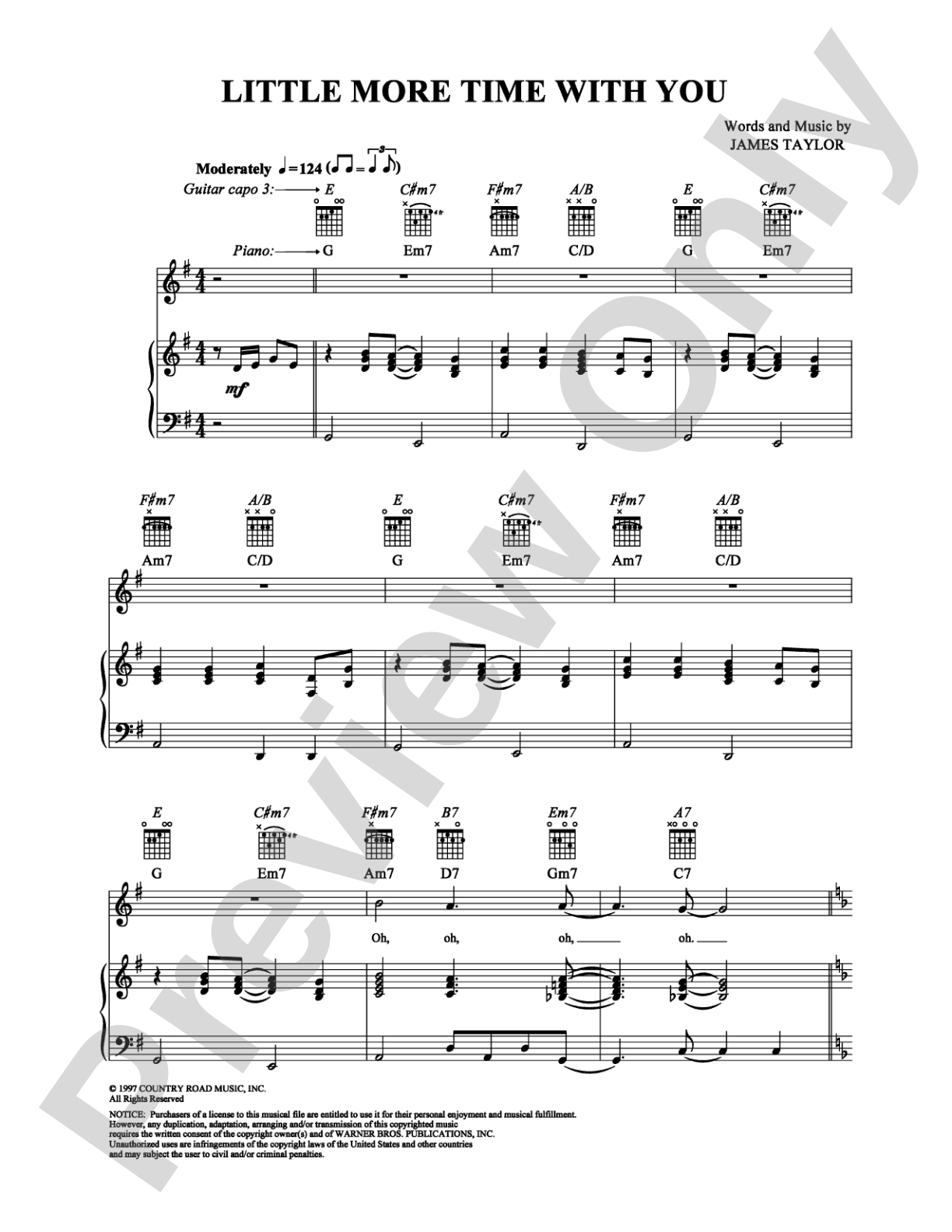
Little More Time With You: Piano/Vocal/Chords Digital Sheet Music

Little More Time With You: Piano/Vocal/Chords Digital Sheet Music

James Taylor

Item: 00-PS-0004674

Digital Download
$3.99
Description

Little More Time With You: Piano/Vocal/Chords Digital Sheet Music isn't in MakeMusic Cloud just yet...but it could be. Let us know you'd like to see it, and you'll help shape what comes next. In the meantime, start a free trial and dive into thousands of interactive titles your students can play along with today.

Sample Audio
No sample audio found.
Sample Video
Additional Details
SKU: 00-PS-0004674

More about this title

About the Artist: James Taylor

James Taylor emerged in the early 1970s as one of the defining voices of singer-songwriter folk rock, blending introspective lyrics with accessible melodies and fingerstyle guitar. His influence on contemporary vocal music spans decades, from his intimate studio recordings to his legendary live performances, making him a touchstone for musicians learning how to balance emotional authenticity with musical craft.

Why we love this

This song captures what makes Taylor's songwriting enduring in a teaching setting: a conversational melody that sits naturally in the voice, straightforward harmonic language that doesn't oversimplify, and lyrics that reward careful phrasing. It's the kind of piece that lets singers focus on genuine expression rather than technical display.

What to expect

Warm and unrushed, like a conversation between friends. The melody floats gently over the chord changes, creating moments of quiet intimacy without ever feeling precious or overwrought.

Who it's for

Pianists and vocalists in pop/contemporary styles seeking repertoire that develops musicianship without relying on vocal runs or technical pyrotechnics. This works equally well for solo singers building a recital program or for keyboard players developing their accompaniment skills.

How to get the most out of it

  • Pay attention to the natural speech rhythm of the lyric; let the conversational phrasing guide your articulation rather than forcing the melody into even eighth notes.
  • Find the right tempo by singing the vocal line first, unaccompanied, to discover where it breathes most naturally.
  • Balance the piano accompaniment so that the harmonic movement supports rather than masks the vocal melody.
  • Use dynamic variation across verses to build subtle interest; the simplicity of the song invites this kind of interpretive nuance.

How to use it

Include this alongside other contemporary singer-songwriter standards in a solo recital, or use it as a teaching example when coaching students on how emotional authenticity lives in simple, well-chosen harmonic and melodic choices. It pairs well with other acoustic-driven material.

Skills your students will build

  • Singing conversational, speech-like phrasing over a steady harmonic foundation
  • Interpreting chord symbols and voicing piano accompaniment choices
  • Building expression through dynamic control rather than technical embellishment
  • Matching vocal and piano balance in a duo setting

You May Also Like