Little Liza Jane: 1st B-flat Trumpet Sheet Music Preview

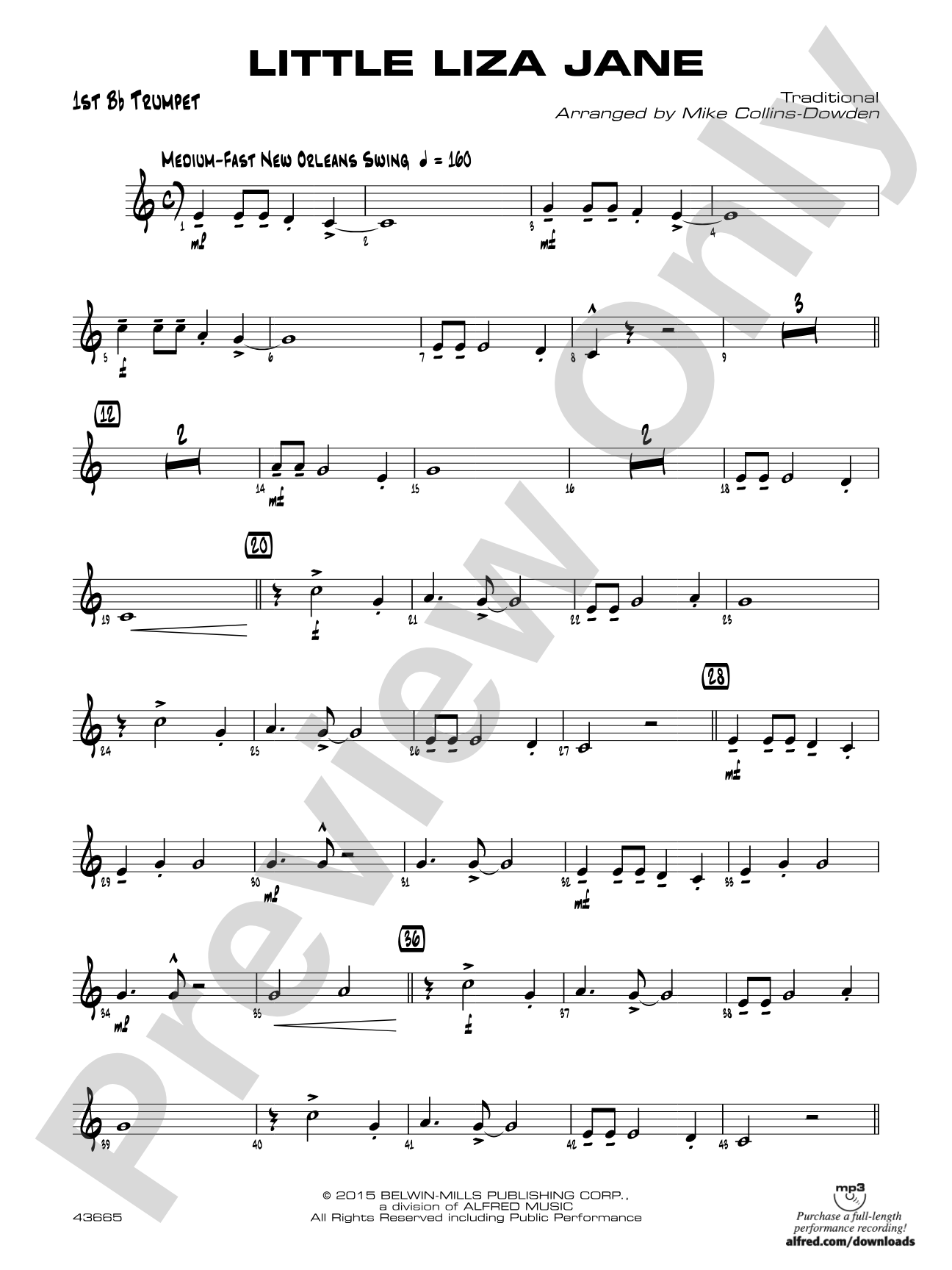
Little Liza Jane: 1st B-flat Trumpet

Traditional / arr. Mike Collins-Dowden

Grade: 1 (Easy)

Item: 00-PC-0016808_T1

Digital Download
$3.00
Description
This New Orleans style swing has a tempo of 158 BPM with written solos for any saxophone and any trumpet or trombone. With the easy brass ranges and optional parts, this is clearly a fun chart! (2:28)

Don't just read it, hear it, play along with it, and watch your students grow with it. In MakeMusic Cloud, Little Liza Jane: 1st B-flat Trumpet comes alive with professional accompaniment, adjustable tempo, and built-in practice tools that turn solo practice into real progress.

Sample Audio
0:00
0:00
Sample Video
Additional Details
Series: First Year Charts for Jazz Ensemble
Publisher: Alfred Music
Page Count: 86
SKU: 00-PC-0016808_T1

More about this title

About the Arranger: Mike Collins-Dowden

Mike Collins-Dowden

Mike Collins-Dowden has directed band programs in the Glenview, Illinois school district since 2007, where he works with upper elementary students across concert and jazz ensembles. He holds a B.M. in music education and trombone performance from the Eastman School of Music (2003) and an M.M. in music education from Temple University (2007). During his time at Eastman, he performed with the Wind Ensemble on their 2004 Japan tour.

Collins-Dowden is a prolific composer with deep roots in writing for young musicians. His catalog of over 30 published works spans concert band, jazz band, and pedagogical pieces released through Alfred/Belwin, FJH, and Jalen Music. Beyond the classroom and manuscript, he remains an active performer on trombone and guitar and has cultivated an eclectic interest in video game music composition.

Why we love this

Collins-Dowden understands exactly what first-year jazz ensemble players need, and this New Orleans swing delivers it without condescension. The written solos sit comfortably in the range of developing players while preserving the spirit of authentic jazz vocabulary, and the optional parts give you genuine flexibility as a director without sacrificing the groove.

What to expect

Warm and infectious. The New Orleans swing style carries an infectious groove that makes students smile the moment they lock in, and the relatively straightforward melody and harmonies let them focus on feel rather than fighting the chart. It sounds like a real jazz tune, not a training exercise.

Who it's for

First-year jazz ensemble students and their directors. This chart meets young players where they are, offering achievable ranges and parts while maintaining genuine jazz character. It's equally useful as a confidence-builder early in the ensemble's formation or as a fun addition to a full concert later in the year.

How to get the most out of it

  • Establish the New Orleans swing feel in early rehearsals by having students listen to the recording and count swing eighth notes; the 158 BPM sits perfectly for first-year players to internalize the pocket without rushing.
  • Let soloists know they can play the written parts as written or use them as a starting point for their own ideas; this encourages ownership and reduces anxiety about improvisation.
  • Assign solos strategically across your section once everyone is secure on the head; rotating performers builds confidence and gives more students a chance to step forward.
  • Keep the rhythm section tight and locked; they anchor everything, so spend rehearsal time there before diving into the brass soli.

How to use it

Program this early in the year to establish ensemble identity and build momentum before tackling more complex charts. It also works well as a closer on a pops concert or as part of a jazz standards set when you want to remind audiences and students alike why they love playing together.

Skills your students will build

  • Understanding and performing swing eighth-note feel
  • Reading and responding to jazz articulations and dynamics
  • Building comfort with basic jazz soloing using written frameworks
  • Ensemble balance and listening across a four-part jazz lineup
  • Time feel and pocket awareness in a rhythm section context

You May Also Like