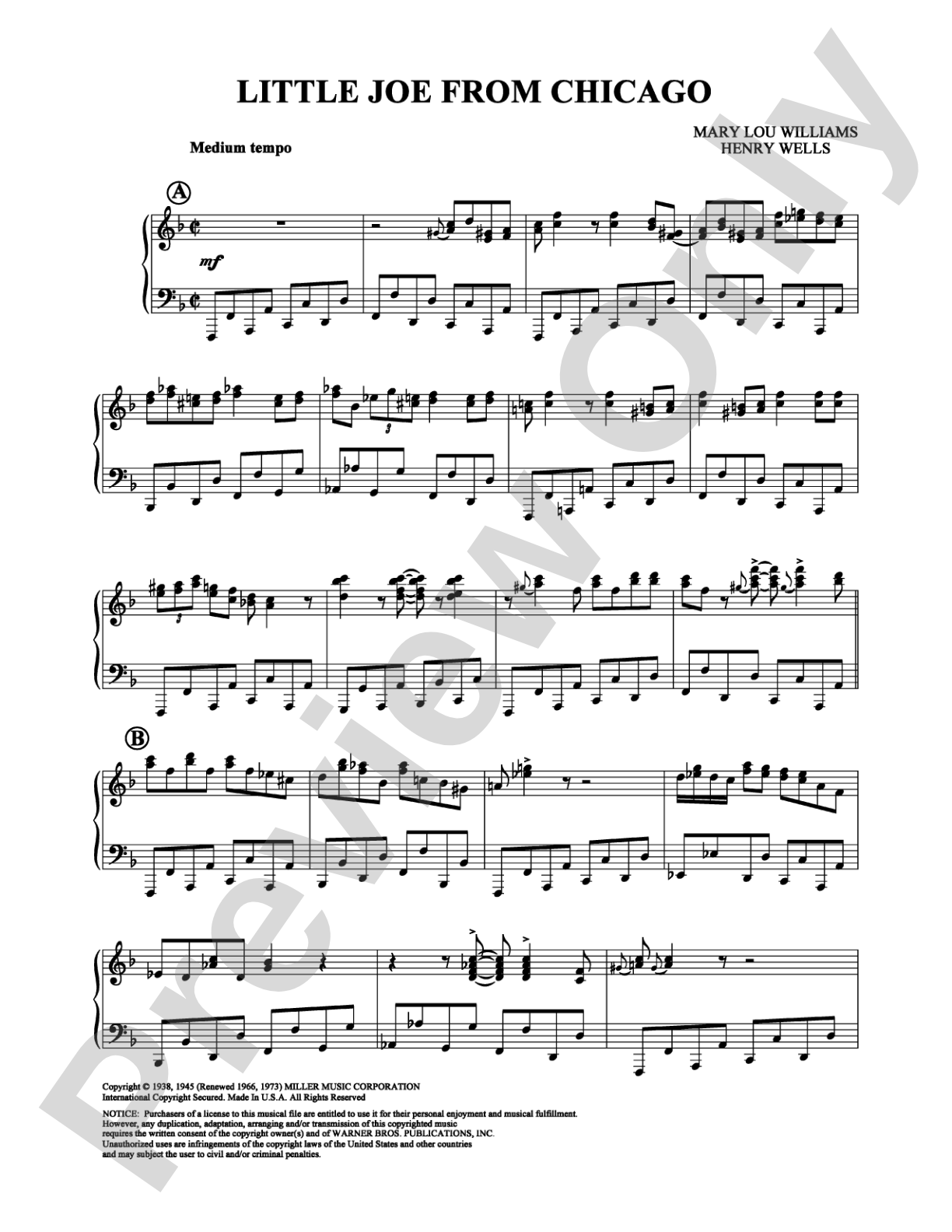
Little Joe From Chicago: Piano Digital Sheet Music

Little Joe From Chicago: Piano Digital Sheet Music

Mary Lou Williams, Henry Wells

Item: 00-PS-0007212

Digital Download
$3.99
Description

Little Joe From Chicago: Piano Digital Sheet Music isn't in MakeMusic Cloud just yet...but it could be. Let us know you'd like to see it, and you'll help shape what comes next. In the meantime, start a free trial and dive into thousands of interactive titles your students can play along with today.

Sample Audio
No sample audio found.
Sample Video
Additional Details
SKU: 00-PS-0007212

More about this title

About the Artist: Mary Lou Williams

Mary Lou Williams (1910–1981) was a pianist, composer, and arranger whose career spanned nearly six decades and touched nearly every significant development in jazz. She began as a stride pianist in the 1920s, moved through swing and bebop as both a performer and behind-the-scenes orchestrator, and continued composing and teaching until her death. Williams earned recognition not just as a virtuoso but as a musical thinker who could write for large ensembles, lead her own groups, and mentor younger musicians including Dizzy Gillespie and Thelonious Monk.

Her compositions reflect her gift for melody and harmonic sophistication. "Little Joe From Chicago" showcases the witty, blues-inflected writing that made her a standout voice in jazz composition. Williams later became deeply involved in music education and spiritual music, but her earlier jazz works remain essential repertoire for understanding the period and for pianists seeking authentic jazz vocabulary from one of the era's most skilled musicians.

Why we love this

This is a genuine jazz composition from one of the tradition's most inventive minds, and it sits at an accessible level for intermediate pianists who want to move beyond standards into more sophisticated compositional territory. The piece captures the playful, swinging character Williams brought to her best work, making it genuinely rewarding to learn and perform rather than simply instructive.

What to expect

Witty and conversational, with a blues foundation that never feels heavy or overly sentimental. The piece swings with a light touch and melodic charm, combining the stride tradition with modern jazz sensibility.

Who it's for

Intermediate to advanced jazz pianists who have solid comping skills and want to deepen their understanding of jazz composition through a master's own work. Teachers and students looking to move beyond lead sheets and fake books will find this a rich text for study and performance.

How to get the most out of it

  • Study the original recording to absorb Williams's phrasing and touch; her approach to rhythm and space is as important as the notes on the page.
  • Treat the blues elements as conversational, not mechanical. Williams uses rubato and rhythmic flexibility, so lock into the underlying pulse while allowing breathing room in the melody.
  • Approach the left hand with independence. The stride or walking patterns aren't there to prop up the right hand; they're a full musical voice that should speak clearly.
  • Balance swing feel with precision. The notation may suggest straight rhythms, but jazz interpretation means listening closely to how Williams intended the eighth notes and syncopations to breathe.

How to use it

Program this in a jazz recital or concert alongside other Williams compositions to build a coherent set, or use it as a bridge piece in a program that moves between traditional jazz standards and more contemporary material. It also works well as a teaching recital piece when you want to showcase a student's progress into more sophisticated repertoire.

Skills your students will build

  • Reading and performing jazz articulation and phrasing
  • Left-hand independence and stride/walking bass patterns
  • Blues vocabulary and harmonic understanding
  • Interpreting swing rhythms and rubato in a notated score
  • Understanding compositional voice in jazz melody and accompaniment

You May Also Like