Little Girl Sheet Music Preview

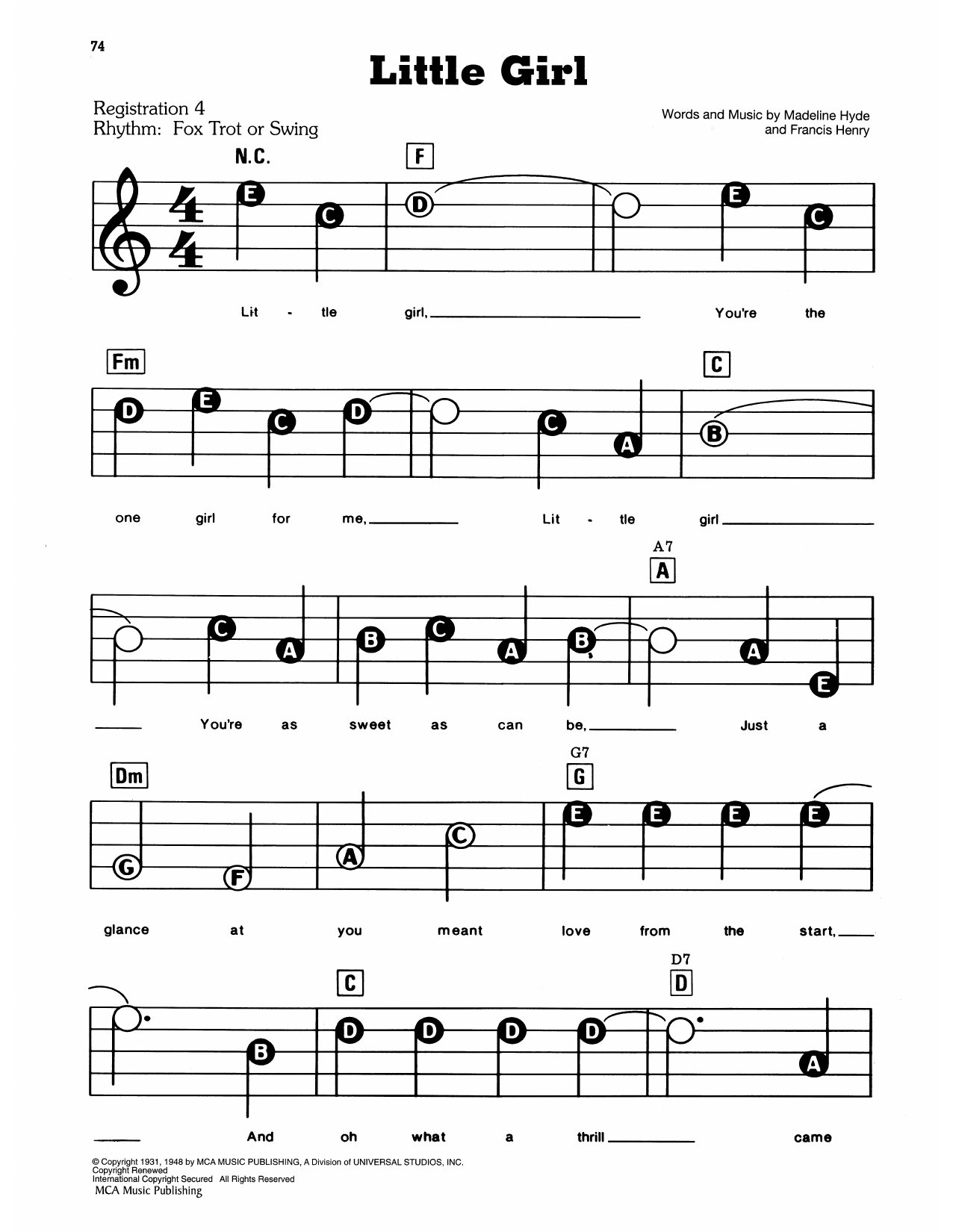
Little Girl: E-Z Play Today

As performed by Joe Venuti's Blue Four

Item: 35-DS01862109

Digital Download
$4.99
Description

Little Girl: E-Z Play Today isn't in MakeMusic Cloud just yet...but it could be. Let us know you'd like to see it, and you'll help shape what comes next. In the meantime, start a free trial and dive into thousands of interactive titles your students can play along with today.

Sample Audio
No sample audio found.
Sample Video
Additional Details
Publisher: Hal Leonard
Page Count: 2
SKU: 35-DS01862109

More about this title

About the Artist: Joe Venuti's Blue Four

Joe Venuti (1903-1978) was one of the first major jazz violinists and a pioneering figure in hot jazz during the 1920s and 1930s. His Blue Four was a small ensemble that captured the spirit of early jazz innovation, blending improvisation with structured arrangements that influenced countless musicians. Venuti's work remains essential listening for understanding how jazz violin entered the mainstream and how small groups shaped the jazz idiom.

Why we love this

This arrangement captures the playful sophistication of early jazz small ensemble writing without demanding virtuosic technical fireworks from your pianist. The two-page format keeps focus sharp while the country-jazz fusion sits at an accessible skill level, making it genuine repertoire rather than a watered-down transcription.

What to expect

The piece carries the informal warmth and rhythmic looseness of a small group session, where musicians play off one another with knowing familiarity. There's a lightness to it; it swings without pretension and stays conversational in scale and scope.

Who it's for

This works well for intermediate pianists exploring jazz and early twentieth-century styles, or for students building familiarity with the country-jazz crossover that defined much American popular music. It's also useful as a study piece for understanding jazz arranging principles in a compact form.

How to get the most out of it

  • Shape the melody with the natural phrasing of the jazz idiom; lean into the syncopation rather than playing it metrically straight.
  • Balance accompaniment texture so the harmonic movement supports rather than overshadows the line.
  • Let the piece breathe in its quieter moments; early jazz often built drama through space and contrast rather than constant activity.

How to use it

Slot this into a jazz history unit or an Americana-focused concert where you're tracing the roots of American musical styles. Its brief length also makes it a natural choice for student recitals focused on twentieth-century repertoire or for demonstrating the viability of jazz standards as serious concert material.

Skills your students will build

  • Interpreting jazz articulation and swing rhythms on the piano
  • Reading and realizing jazz-style harmonic accompaniment
  • Understanding early jazz ensemble texture and voice leading
  • Adapting classical technique to the idioms of vernacular American music

You May Also Like