
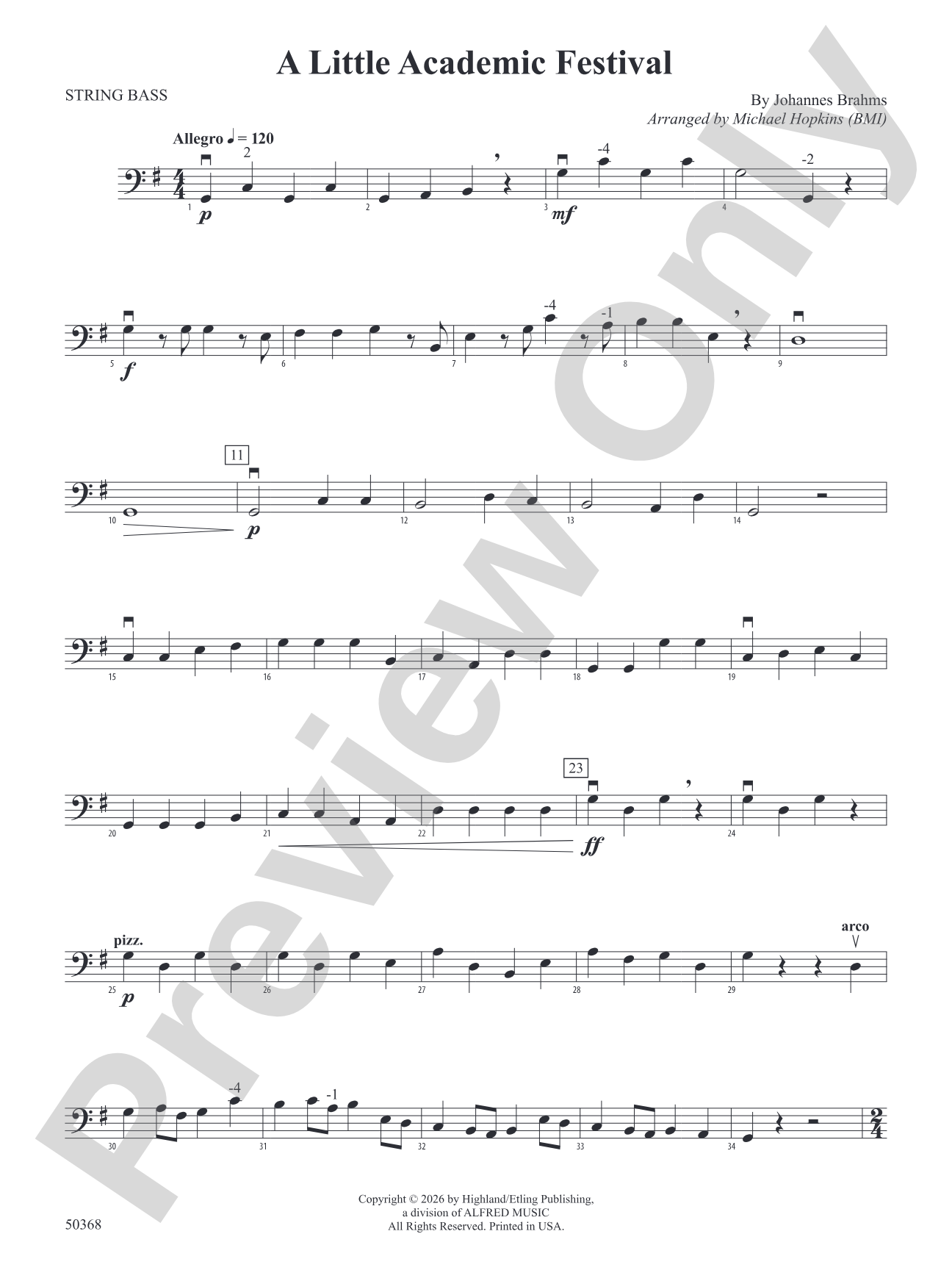

LITTLE ACADEMIC FESTIVAL/HSO: String Bass
By Johannes Brahms / arr. Michael Hopkins (BMI)
Grade: 1.5
Item: 00-PC-0019667_SB
$5.99
Pickup currently not available
Description
The great composer Johannes Brahms (1833–1897) composed the Academic Festival Overture Op. 80, during the summer of 1880 for the University of Breslau, which was awarding him an honorary doctorate in music. In the overture, Brahms included popular student songs from the time. This arrangement of themes from the overture, by Michael Hopkins, includes three of the student songs. After a brief, march-like introduction in mm. 1-10, the first college song is Wir hatten gebauet ein stattliches Haus (We have built a stately house) in mm. 11-23. One of Brahms' original themes is presented in mm. 23-35. This leads to the second student song, Was kommt dort von der Höh (What comes from afar?), a light and playful 2/4 song in mm. 35-57. The arrangement ends with the triumphant graduation song Gaudeamus igitur (Therefore, let us rejoice). Featuring all sections of the orchestra on melodic themes this arrangement is a great piece for teaching bow distribution, alternating pizzicato and arco, repeated down bows, and using full bows.


Don't just read it, hear it, play along with it, and watch your students grow with it. In MakeMusic Cloud, LITTLE ACADEMIC FESTIVAL/HSO: String Bass comes alive with professional accompaniment, adjustable tempo, and built-in practice tools that turn solo practice into real progress.
Open in the Player
Jump straight in and assign it today.
Start Your Free Trial
Open this title and explore the full library in minutes.
Sample Audio
1
Audio File
--:--
0:00
0:00
Sample Video
Additional Details
Series:
Highland String Orchestra
Publisher:
Alfred Music
SKU:
00-PC-0019667_SB
More about this title
About the Composer: Johannes Brahms
Johannes Brahms (1833–1897) stands as one of the nineteenth century's most structurally rigorous and emotionally profound composers. His four symphonies, three concertos, and vast chamber music catalog established him as the successor to Beethoven's legacy, yet his compositional voice remained entirely his own. Brahms composed the Academic Festival Overture at age 47, having spent decades earning international recognition through painstaking revision and unflinching artistic standards.
The overture represents Brahms at his most public and celebratory. Commissioned to mark his honorary doctorate from the University of Breslau, he wove student songs of the era into a work that balances learned counterpoint with genuine warmth and humor. This arrangement captures that duality for young string players: the sophisticated orchestration of a master composer paired with melodies accessible enough to sing around a student tavern table.
Why we love this
This arrangement preserves the Academic Festival Overture's joyful character while addressing real pedagogical priorities for Grade 1.5 orchestras. The piece naturally teaches bow control and distribution through its alternating arco and pizzicato passages, while the three distinct student songs give players a sense of narrative arc and multiple textures to master. Programming it at graduations or spring concerts creates an earned sense of occasion: students hear themselves performing material rooted in one of the concert tradition's most beloved works.
What to expect
Dignified yet spirited, with a quality of celebration that feels earned rather than imposed. The opening march radiates confidence, while the student songs introduce moments of lighter character and warmth. The arc builds toward genuine triumph in the final section, giving players the experience of conducting an emotional journey rather than executing a series of exercises.
Who it's for
String orchestras at the Grade 1.5 level who are ready to tackle intermediate bow technique and orchestration concepts without sacrificing musical reward. Players who have developed basic intonation and rhythmic security will find genuine musical satisfaction in performing a Brahms work, especially one with such clear historical context. This arrangement works equally well in rehearsal-based settings and contest or festival environments.
How to get the most out of it
- Shape the march-like opening (mm. 1-10) with clear, unified down bows in the rhythm section, establishing a confident foundation before the first song enters.
- Balance the 2/4 character of the second student song by keeping the accompaniment light and precise; full bows should support the melody without overwhelming the playful character Hopkins has preserved.
- Plan bow distribution in advance for the repeated melodic figures so individual sections (violins, violas, cellos, basses) maintain consistent articulation and energy across longer phrases.
- Anchor the "Gaudeamus igitur" finale by locking rhythmic unity across the entire orchestra; this is the moment where all sections carry equal weight and brightness should shine through.
How to use it
Program this for graduation concerts, end-of-year celebrations, or spring festivals where the ceremonial character and historical context add weight to the occasion. It also works as a bridge between technical studies and full concert repertoire, allowing directors to introduce students to major composers through music that remains tactically manageable. Consider pairing it with original orchestral works at the same level to frame Brahms within a broader survey of the string orchestra tradition.
Skills your students will build
- Bow distribution and control across repeated melodic figures
- Alternating between arco and pizzicato articulation with rhythmic precision
- Maintaining unified bow strokes (particularly repeated down bows) within sections
- Balance and blend when all orchestral sections carry equal melodic weight
- Intonation control during sustained harmonic support passages