Litany Sheet Music Preview

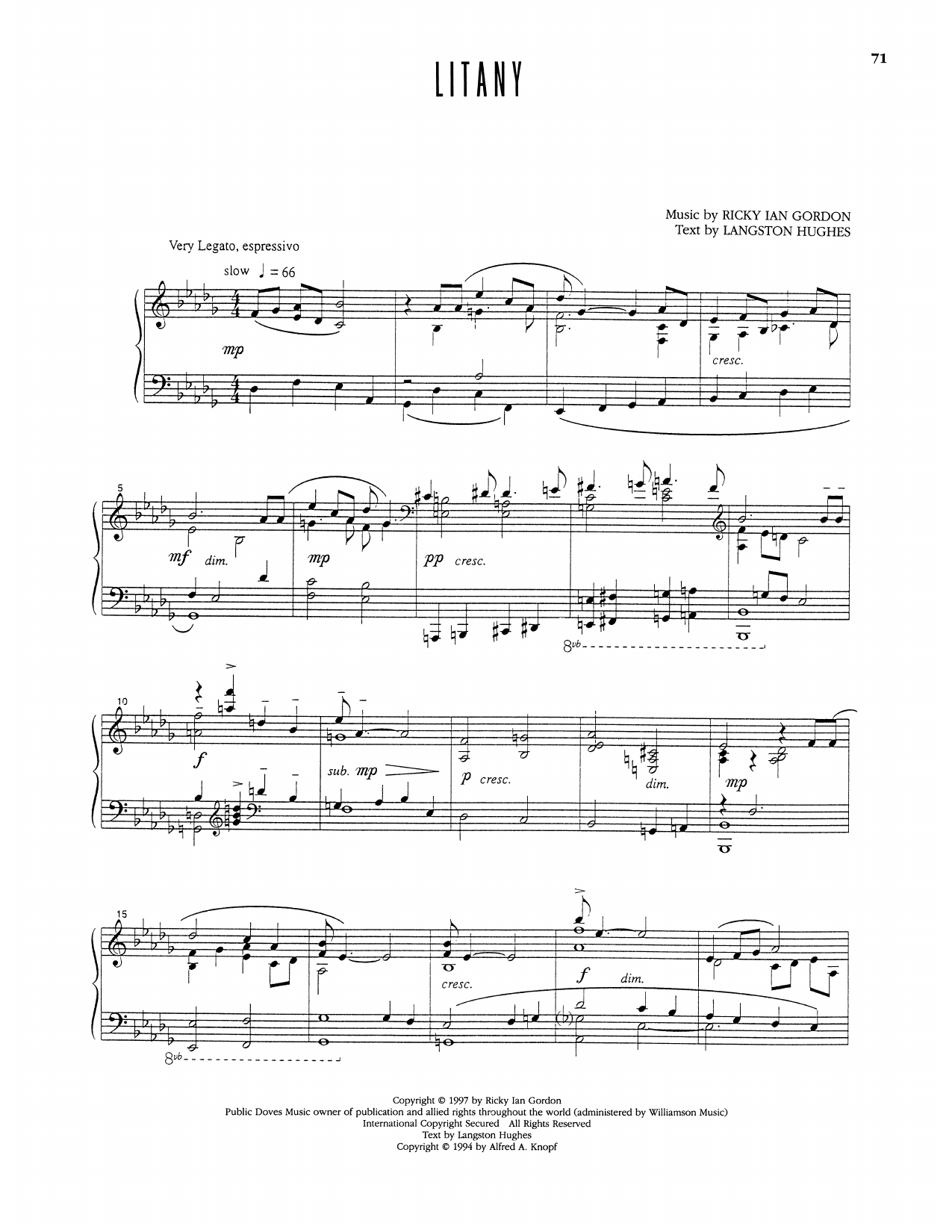
Litany: Piano Vocal

As performed by Ricky Ian Gordon

Item: 35-DS01947309

Digital Download
$5.99
Description

Litany: Piano Vocal isn't in MakeMusic Cloud just yet...but it could be. Let us know you'd like to see it, and you'll help shape what comes next. In the meantime, start a free trial and dive into thousands of interactive titles your students can play along with today.

Sample Audio
No sample audio found.
Sample Video
Additional Details
Publisher: Hal Leonard
Page Count: 5
SKU: 35-DS01947309

More about this title

About the Artist: Ricky Ian Gordon

Ricky Ian Gordon is an American composer and conductor whose output spans opera, art song, orchestral works, and chamber music. His compositions often explore lyrical melody and emotional directness, drawing on American vernacular traditions while maintaining contemporary sophistication. Gordon's work for voice and piano has become essential repertoire for recitalists seeking pieces that combine technical interest with immediate emotional resonance.

Why we love this

Gordon writes for the voice with genuine understanding of what singers need to sound their best. The text setting is natural and singable, the piano part supports without overwhelming, and the harmonic language is modern yet accessible. This is the kind of piece that gives singers confidence while allowing them to communicate something genuine to an audience.

What to expect

The piece carries the meditative, repetitive quality suggested by its title, building meaning through return and variation rather than linear narrative. There's an underlying formal discipline that allows space for genuine interpretation and vocal expressivity.

Who it's for

Solo singers preparing recital repertoire, voice students seeking contemporary classical pieces with emotional weight, and pianists wanting songs that showcase collaborative musicianship. This works equally well in academic settings, concert hall debuts, or senior recitals.

How to get the most out of it

  • Treat the text with interpretive specificity rather than a one-size-fit-all approach; the title "Litany" suggests ritualistic quality, so consider whether repetition should feel meditative, urgent, or something between.
  • Balance the vocal line against the piano accompaniment by establishing clear breath points that don't interrupt the overall musical phrase.
  • Explore dynamic contrast within smaller sections rather than relying on dramatic shifts; contemporary writing often rewards subtle gradient over obvious climax.
  • Work the piano part independently at first to understand its harmonic function and rhythmic independence before integrating it with the voice.

How to use it

Position this alongside other contemporary American vocal works to frame a recital exploring modern song traditions, or pair it with earlier art song to highlight how text setting and harmonic language have evolved. The five-page length makes it manageable as a standalone or as part of a larger cycle.

Skills your students will build

  • Text interpretation in contemporary classical settings
  • Balancing vocal projection with sensitive accompaniment
  • Understanding harmonic function in post-tonal language
  • Building continuity through repetition and variation
  • Collaborative listening between voice and piano

You May Also Like