Liszt: Songs, Volume V, Nos. 1-25 (German) Sheet Music Preview

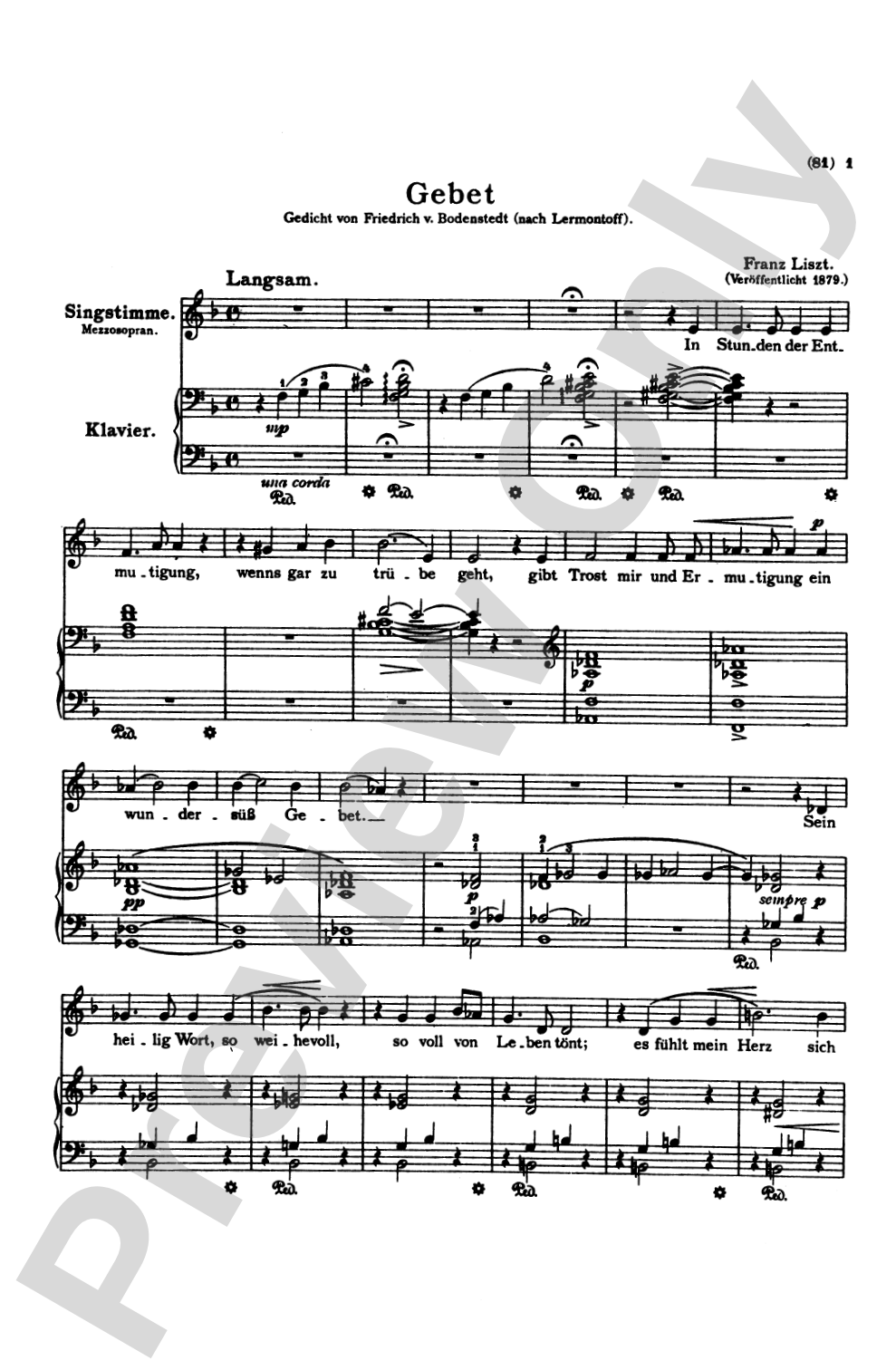
Liszt: Songs, Volume V, Nos. 1-25 (German)

By Franz Liszt

Item: 00-PC-0012029

Digital Download
$0.99
Description
Written from 1860 to 1879. Twenty-five songs, all with German text. Two also have French, and one each has Italian, Hungarian and English Text (Go Not, Happy Day).

Don't just read it, hear it, play along with it, and watch your students grow with it. In MakeMusic Cloud, Liszt: Songs, Volume V, Nos. 1-25 (German) comes alive with professional accompaniment, adjustable tempo, and built-in practice tools that turn solo practice into real progress.

Sample Audio
No sample audio found.
Sample Video
Additional Details
Series: Kalmus Edition
Publisher: Alfred Music
Page Count: 96
SKU: 00-PC-0012029

More about this title

About the Composer: Franz Liszt

Franz Liszt (1811-1886) was a Hungarian composer and virtuoso pianist whose harmonic innovations and compositional ambition reshaped nineteenth-century music. His vocal works, often overshadowed by his legendary piano compositions, reveal a sophisticated lyricist who set poetry in multiple languages with the same visionary technique that defined his instrumental writing. In his later years, Liszt composed many of the songs in this collection while serving as Abbé in minor orders, a spiritual turn that deepened his expressive range.

Listzt's songs bridge Romantic song traditions and modernist harmonic language. He favored literary texts of substance—Goethe, Heine, Byron, and Hungarian poets—and treated the voice not as mere vehicle for words but as an equal partner to the piano, demanding both musical intelligence and vocal power from performers.

Why we love this

This collection captures Liszt's voice writing at full maturity, spanning two decades of aesthetic evolution. The combination of accessible Romantic song traditions with moments of genuine harmonic daring makes these works rewarding for singers who want substance without insuperable technical hurdles. Programming multiple songs from this volume offers a coherent evening of high-quality Lieder that gives prominence to one of music history's most innovative voices.

What to expect

These songs embody Romantic longing filtered through a modernist sensibility. You move between moments of crystalline lyricism and surprising harmonic turns that feel both emotionally true and structurally adventurous. There's an intimacy to many of these works, yet an underlying sophistication that keeps both performer and listener engaged.

Who it's for

This collection serves experienced art song singers, advanced voice students, and teachers seeking substantial German Lieder beyond the standard Schubert and Schumann repertoire. Singers comfortable with chromatic harmony and varied vocal demands will find rich material for recital programs and serious study.

How to get the most out of it

  • Balance the piano line carefully; Liszt often embeds essential musical material in the accompaniment rather than solely supporting the voice. The piano is never merely accompaniment.
  • Pay close attention to Liszt's harmonic rhythm. His unexpected key shifts and chromatic voice-leading require singers to listen keenly to the harmonic environment rather than floating above it.
  • Approach the German text with clarity and natural phrasing; Liszt's vocal lines often follow poetic syntax rather than square periodic structures. Let the words guide your breathing and phrase length.
  • Explore the emotional range within individual songs. Liszt moves between intimate lyricism and dramatic intensity sometimes within a single piece; avoid one-note interpretations.

How to use it

Program several songs from this volume as a substantial German song cycle within a larger recital, or use individual pieces to fill specific thematic needs (love songs, nature settings, philosophical texts). These works pair naturally with Liszt's piano transcriptions or other nineteenth-century composers, offering singers a repertoire option that sounds fresh without sacrificing artistic substance.

Skills your students will build

  • Reading chromatic harmony and unexpected key relationships
  • Balancing vocal line with complex, essential piano accompaniment
  • Interpreting German poetry within sophisticated musical structures
  • Sustaining expressive singing across varied emotional terrain within single works
  • Collaborating with pianists to achieve integrated vocal-piano partnerships

You May Also Like