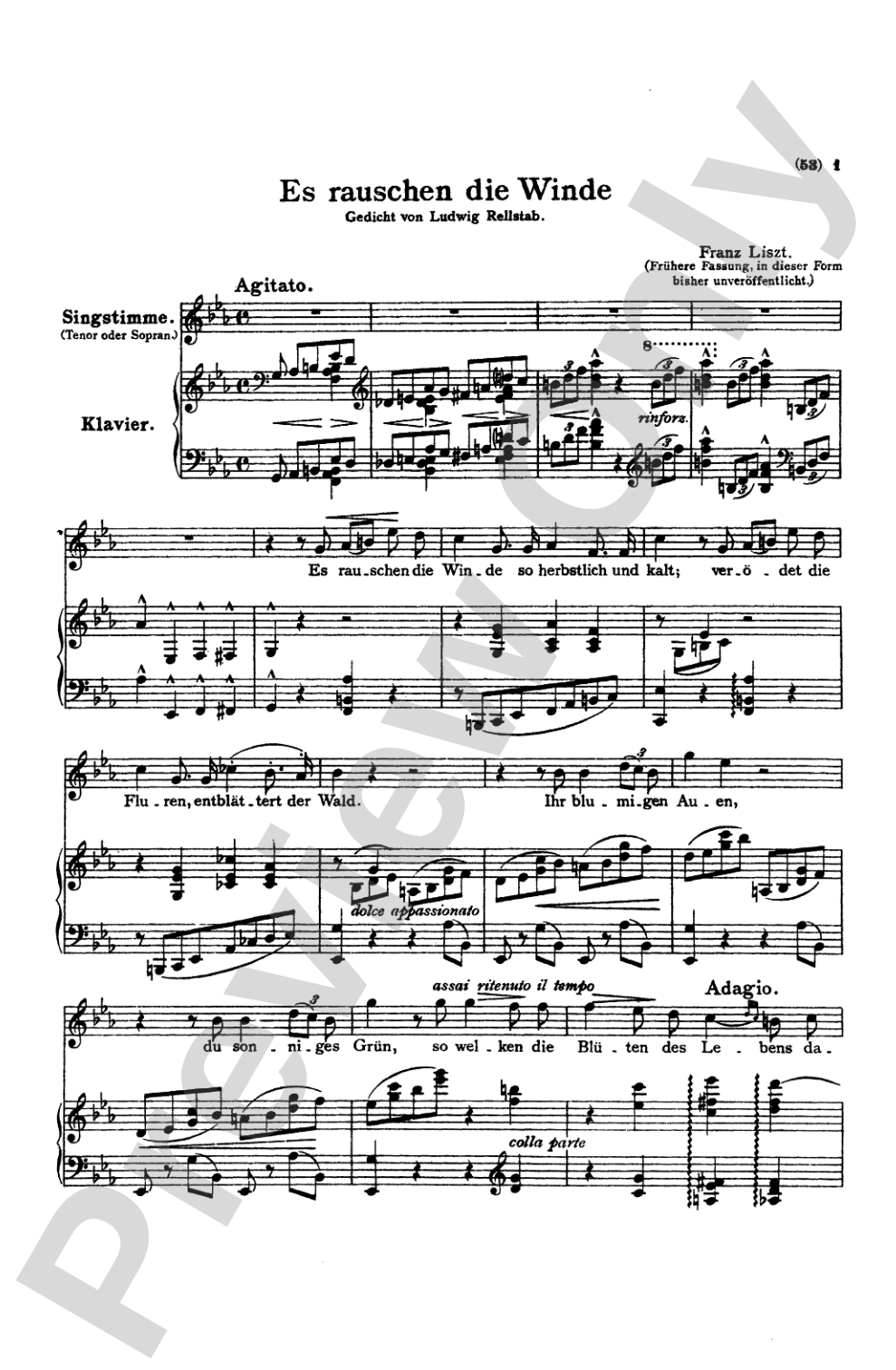
Liszt: Songs, Volume III, Nos. 1-22 (German) Sheet Music Preview

Liszt: Songs, Volume III, Nos. 1-22 (German)

By Franz Liszt

Item: 00-PC-0011998

Digital Download
$0.99
Description
Twenty-two Songs, including two versions of Mignon's Lied and several second settings of earlier songs. Composed from 1850 - 1860. All with German text.

Don't just read it, hear it, play along with it, and watch your students grow with it. In MakeMusic Cloud, Liszt: Songs, Volume III, Nos. 1-22 (German) comes alive with professional accompaniment, adjustable tempo, and built-in practice tools that turn solo practice into real progress.

Sample Audio
No sample audio found.
Sample Video
Additional Details
Series: Kalmus Edition
Publisher: Alfred Music
Page Count: 104
SKU: 00-PC-0011998

More about this title

About the Composer: Franz Liszt

Franz Liszt (1811-1886) was a Hungarian virtuoso pianist and composer whose innovations in harmony, orchestration, and program music shaped the Romantic era. Beyond his legendary keyboard prowess, Liszt composed extensively for voice, creating over 70 songs that range from intimate character pieces to dramatic settings of Goethe and Heine. His late vocal works, including many in this collection, show a composer willing to experiment with harmonic language and emotional depth, often revisiting earlier texts with fresh musical perspectives.

Why we love this

Liszt's mature vocal writing combines the pianistic brilliance expected of his era with genuine attention to text and character. The inclusion of multiple settings of the same poems (notably two versions of Mignon's Lied) gives singers and pianists a rare opportunity to study how a master composer reconceives musical material, a lesson far more valuable than any textbook on revision.

What to expect

These songs breathe the introspection and grandeur of high Romanticism, moving from intimate character sketches to sweeping dramatic narratives. Liszt's harmonic palette feels both lush and occasionally startling, with unexpected tonal shifts that pull the listener inward just as the melody soars outward.

Who it's for

This collection serves advanced art song singers, professional vocalists building recital repertoire, and serious voice students ready to tackle Romantic-era song cycles and complex German poetry settings. Collaborative pianists will find this an essential resource for understanding how Liszt adapted keyboard virtuosity to the accompanist's role.

How to get the most out of it

  • Examine both settings of repeated texts side by side to understand Liszt's evolving approach to the same poetry; the differences illuminate his compositional priorities at different points in his career.
  • Balance the virtuosic piano writing with vocal line clarity; Liszt's accompaniments are integral to the song's character, not decorative.
  • Pay close attention to harmonic color and unexpected modulations as emotional drivers; Liszt uses chromatic movement and key shifts to underscore textual meaning rather than merely as technical display.
  • Lean into the Romantic sensibility: these songs embrace dramatic expression and lyrical breadth, so allow rubato and dynamic shaping to emerge naturally from the text.

How to use it

Program selections from this collection as centerpieces in recitals focused on Romantic vocal literature or German Lieder traditions; the presence of multiple settings of the same text creates natural thematic programming opportunities. These songs also work well as teaching repertoire in upper-level voice studios, where students can study revision and compositional craft through Liszt's own re-imaginings.

Skills your students will build

  • Navigating chromatic harmony and unexpected key relationships
  • Balancing lyrical vocal line with complex piano accompaniment
  • Interpreting German text with attention to Romantic-era diction and phrasing
  • Understanding compositional revision through comparative study of multiple settings
  • Sustained breath control and dynamic range in extended Romantic song forms
  • Collaborative listening and ensemble flexibility with an active piano part

You May Also Like