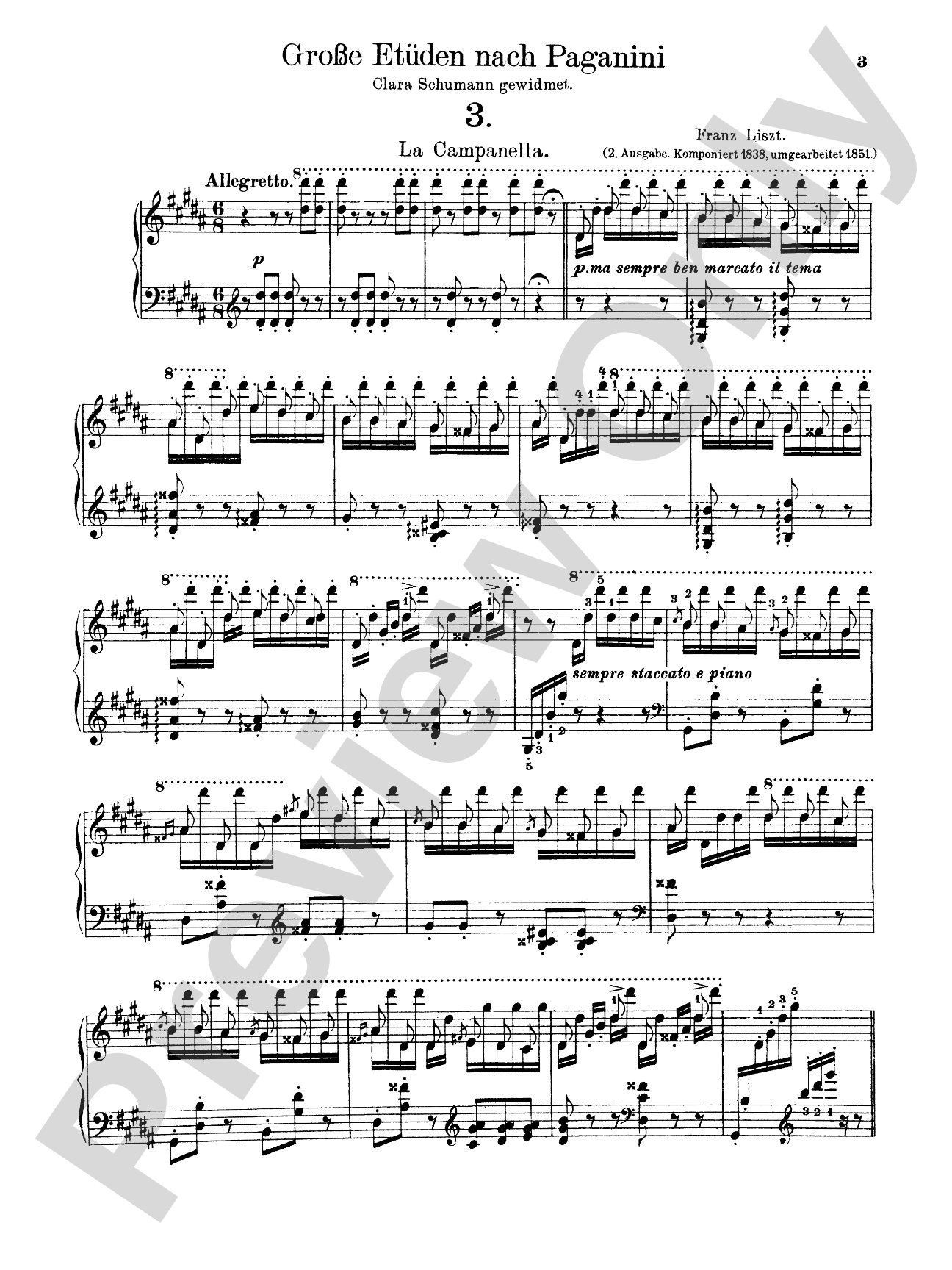
Liszt: La Campanella Sheet Music Preview

Liszt: La Campanella

By Franz Liszt

Level: Advanced

Item: 00-PC-0008241

Digital Download
$6.99
Description
This virtuosic piece, commonly known as one of the most difficult in piano repertoire, was written by Franz Liszt in 1838. It is based on the last movement of Paganini's second violin concerto. Liszt was a great fan of Paganini and after hearing one of his performances decided to become the equivalent of Paganini on the piano. He took six of Paganini's original compositions and transformed them into virtuosic etudes for piano, of which "La Campanella" is third in the set of six and is sometimes referred to as No. 3.

Don't just read it, hear it, play along with it, and watch your students grow with it. In MakeMusic Cloud, Liszt: La Campanella comes alive with professional accompaniment, adjustable tempo, and built-in practice tools that turn solo practice into real progress.

Sample Audio
No sample audio found.
Sample Video
Additional Details
Series: Kalmus Edition
Publisher: Alfred Music
Page Count: 12
SKU: 00-PC-0008241

More about this title

About the Composer: Franz Liszt

Franz Liszt (1811-1886) was a Hungarian composer and virtuoso pianist who fundamentally transformed what the instrument could do. He pioneered the symphonic poem, developed revolutionary harmonic language, and created a vast catalog of works that pushed technical boundaries while exploring profound musical ideas. His obsession with transcribing and reimagining masterworks by other composers (particularly Paganini) wasn't mere technical exercise; it was his way of absorbing compositional genius and expanding the piano's expressive range.

Listz's Paganini Etudes represent a pivotal moment in piano pedagogy and literature. Rather than simply copying Paganini's violin writing, Liszt rebuilt these pieces from the ground up, creating entirely new technical challenges that exploited the piano's unique capabilities. La Campanella, the third in the set, became one of the most iconic virtuoso pieces ever written and remains a benchmark for advanced pianists.

Why we love this

La Campanella sits at the apex of Romantic piano writing: intellectually rigorous, technically uncompromising, and genuinely thrilling to hear. It's the piece advanced students aspire to master, and programming it signals serious artistry in your recital or concert. The bell effects, brilliant passagework, and architectural strength create an unforgettable finale.

What to expect

La Campanella evokes the shimmer and resonance of bells cascading through a Venetian evening, layered beneath brilliant, almost weightless fingerwork. The music swells and subsides with romantic grandeur while maintaining an almost impressionistic quality in its textures.

Who it's for

Advanced pianists preparing for competitions, conservatory auditions, or advanced recitals will find this a defining technical and artistic challenge. Students ready to tackle Liszt's harmonic language and willing to invest serious practice time in mastery belong here.

How to get the most out of it

  • Balance the melodic bell tones against the flowing accompaniment by practicing hands separately until the independence is automatic; only then can you shape both voices with true control.
  • Map out the harmonic progression before diving into tempo work; understanding where Liszt is heading harmonically gives your fingers a cognitive roadmap through the rapid passages.
  • Experiment with tempo flexibility in the cadenza-like sections; this isn't a piece that benefits from metronomic rigidity, and small rubato in the right places enhances the virtuosic character.
  • Record yourself regularly at performance tempo and listen critically for clarity in the double-note passages; clarity at speed is the signature of confident playing in this work.

How to use it

Program this as the centerpiece of an advanced recital, particularly one exploring transcription and recomposition across musical eras. It pairs naturally with other Liszt works or with Paganini's original compositions to frame a discussion of musical transformation.

Skills your students will build

  • Scalar and arpeggiated passagework at advanced tempos
  • Double-note technique and hand independence
  • Pedal control for color and resonance without muddiness
  • Harmonic thinking in Romantic-era tonal language
  • Balancing melody and accompaniment in dense textures
  • Stamina and endurance at performance level

You May Also Like