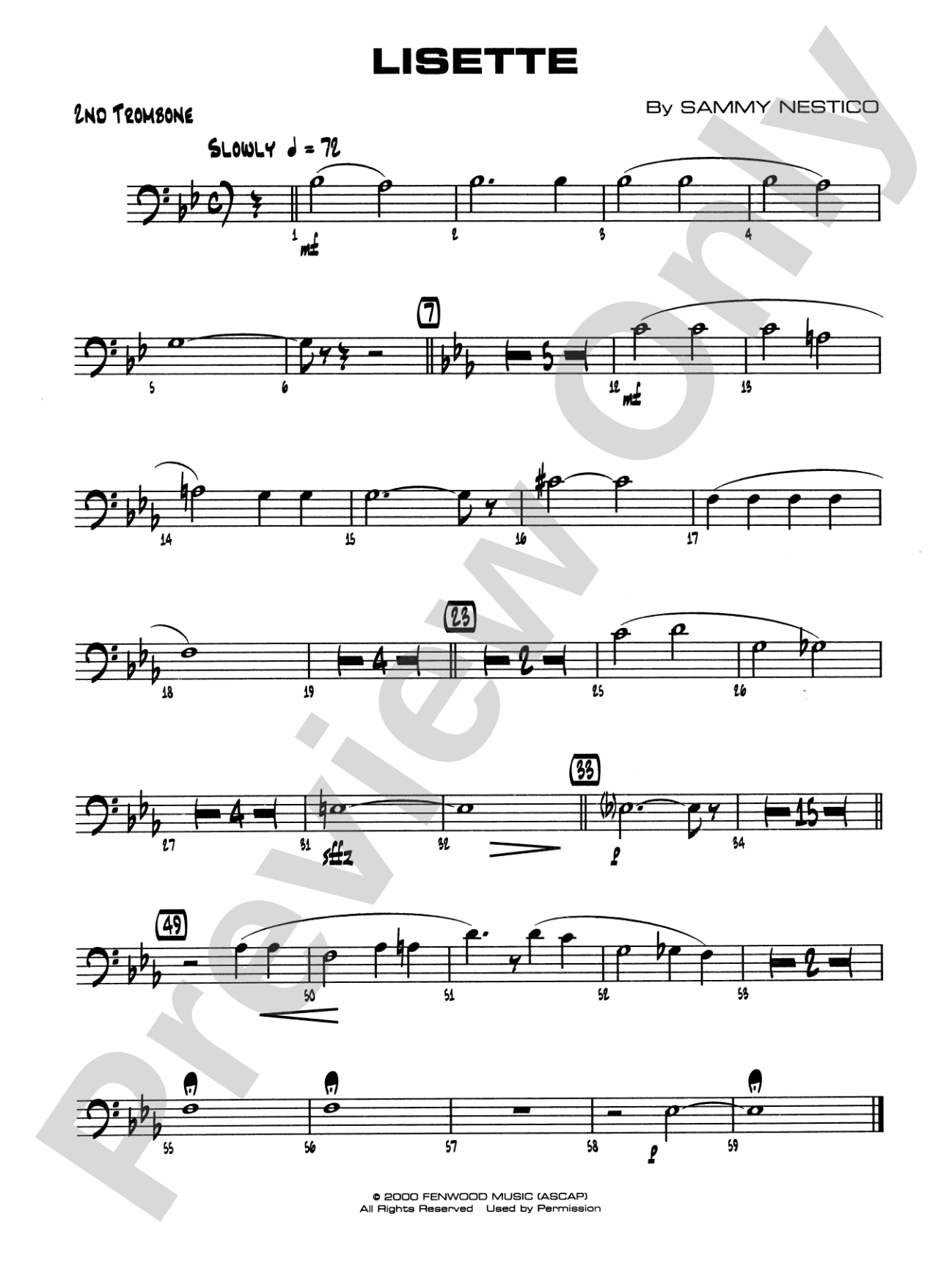
Lisette: 2nd Trombone Sheet Music Preview

Lisette: 2nd Trombone

By Sammy Nestico

Grade: 4.5 (Medium Advanced / Difficult)

Item: 00-PC-0002434_TN2

Digital Download
$3.00
Description
An outstanding ballad for tenor or soprano saxophone soloist, this chart is truly gorgeous. Modest brass ranges (trumpet to fourth space E) make this arrangement accessible to most high school jazz ensembles. Add the lush harmony and the distinctive unison saxes, and you have a superb chart composed and arranged by perhaps one of the finest big band writers anywhere, Sammy Nestico. Superior dynamics and intonation will get right to the heart of this chart. Exceptional!

Don't just read it, hear it, play along with it, and watch your students grow with it. In MakeMusic Cloud, Lisette: 2nd Trombone comes alive with professional accompaniment, adjustable tempo, and built-in practice tools that turn solo practice into real progress.

Sample Audio
0:00
0:00
Sample Video
Additional Details
Series: Quincy Jones & Sammy Nestico Premier Jazz
Publisher: Alfred Music
Page Count: 58
SKU: 00-PC-0002434_TN2

More about this title

About the Composer: Sammy Nestico

Sammy Nestico stands as one of the most recorded big band arrangers in jazz history, with a catalog spanning decades of work for Count Basie, the Toshiba Big Band, and countless jazz ensembles. His arranging style combines sophisticated harmonic writing with accessibility, making professional-level charts teachable for student musicians without compromising musical integrity.

Nestico's gift for balancing complexity with playability has made him a cornerstone of jazz education. His arrangements prioritize clear section writing, logical voice leading, and respect for the ensemble's capabilities, ensuring that students engage with genuine big band literature rather than simplified approximations.

Why we love this

Nestico's arrangement demands superior musicianship without resorting to extreme ranges or awkward passages. The modest brass voicings (trumpet capped at fourth space E) let your section players focus on tone quality and intonation rather than survival, while the unison saxophone writing creates visceral ensemble moments that reward your reed section's attention to blend. This is the kind of chart that makes a good ensemble sound excellent.

What to expect

Lush and intimate, with the warmth of a classic big band ballad. The arrangement wraps around the soloist like soft lighting, allowing personal expression while the ensemble provides sophisticated harmonic cushion. This is music that breathes.

Who it's for

High school jazz ensembles with a capable saxophone section and solid fundamentals in intonation and blend. This chart rewards musicianship and serves ensembles ready to step into legitimate big band repertoire that sounds and feels professional without excessive technical demands.

How to get the most out of it

  • Balance the tenor or soprano saxophone solo against the supporting ensemble by controlling dynamics in the background voicings. The lush harmony can quickly overwhelm a soloist who isn't amplified or positioned forward.
  • Lock the unison saxophone passages with precision tuning and identical articulation. These moments define the chart's character, so spend rehearsal time achieving uniformity across all three saxes.
  • Shape the overall arc with dynamic control. Nestico's writing responds beautifully to subtle crescendos and releases, so avoid playing the indicated dynamics as static levels.
  • Commit fully to the ballad's phrasing rather than rushing. The beauty of this arrangement lies in its space and breathing, not in forward motion.

How to use it

Program this as a feature for your best tenor or soprano saxophonist at a concert focused on ballad traditions or as part of a set showcasing your ensemble's dynamic range. The 58-page score makes it substantial enough for a concert centerpiece, and its genuine musicality earns a standing with a discerning audience.

Skills your students will build

  • Balancing solo and ensemble textures in big band contexts
  • Playing unison passages with identical articulation and tone quality
  • Reading and executing dynamic shadings that serve the musical phrase
  • Intonation control in lush harmonic contexts
  • Ballad phrasing and space management

You May Also Like