
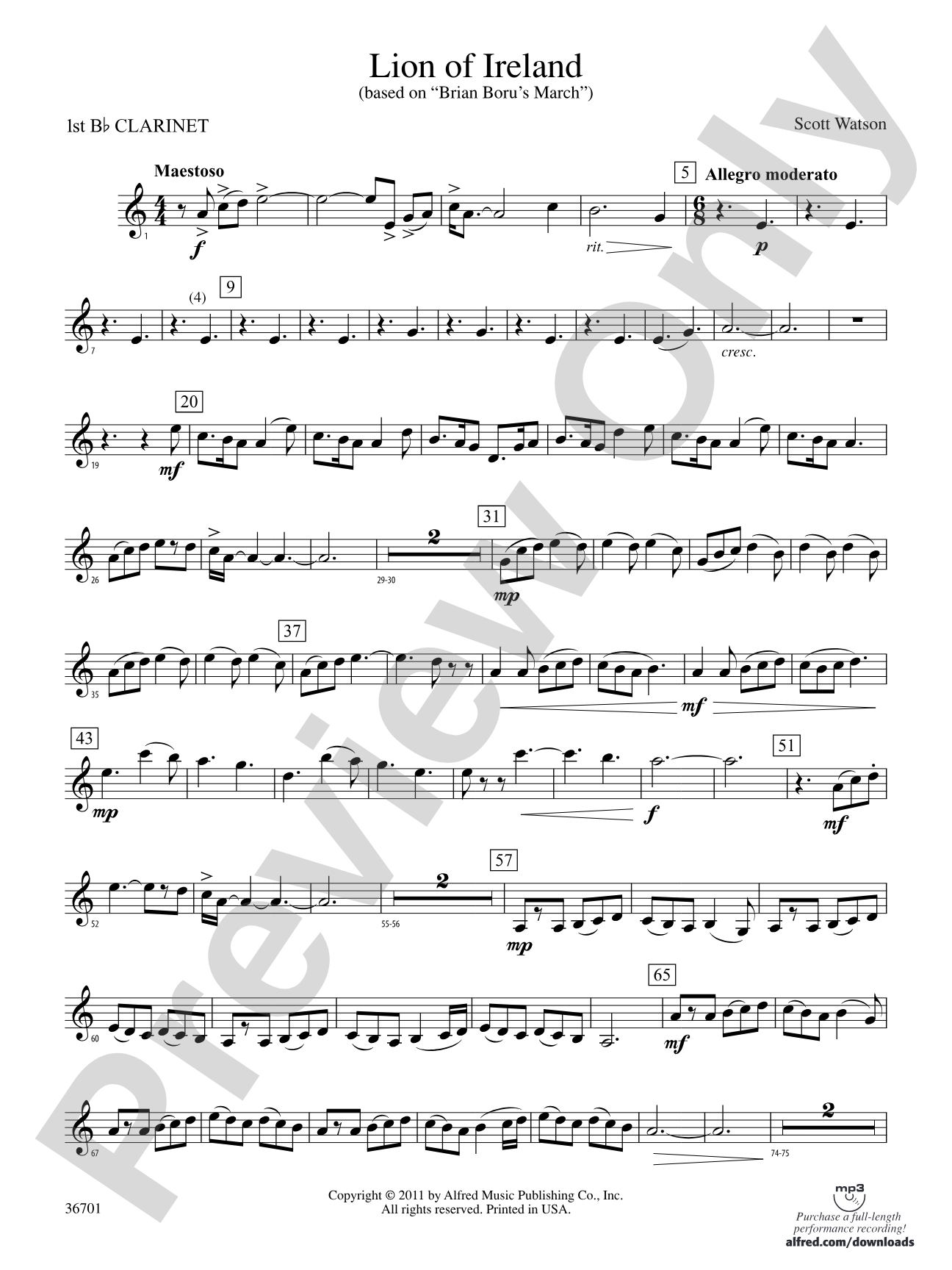

Lion of Ireland: 1st B-flat Clarinet
Based on "Brian Boru's March"
Traditional Irish Tune / arr. Scott Watson
Grade: 3 (Medium)
Item: 00-PC-0015129_C1
$5.99
Pickup currently not available
Description
"Lion of Ireland" is an exciting concert piece based on "Brian Boru's March," a traditional Irish tune named for the legendary 11th-century ruler. Framed by dramatic opening and closing statements, the rustic Celtic tune gives way to original material, all in a showcase for band that reflects the valor and glory of the storied "last high king" of Ireland.


Don't just read it, hear it, play along with it, and watch your students grow with it. In MakeMusic Cloud, Lion of Ireland: 1st B-flat Clarinet comes alive with professional accompaniment, adjustable tempo, and built-in practice tools that turn solo practice into real progress.
Open in the Player
Jump straight in and assign it today.
Start Your Free Trial
Open this title and explore the full library in minutes.
Sample Audio
1
Audio File
--:--
0:00
0:00
Sample Video
No sample videos found.
Additional Details
Series:
Young Symphonic
Publisher:
Alfred Music
Page Count:
264
SKU:
00-PC-0015129_C1
More about this title
About the Arranger: Scott Watson

Scott Watson brings three decades of classroom experience to his work as a composer and arranger. After leading the instrumental program at Parkland School District in Allentown, Pennsylvania, he joined Cairn University as Associate Professor of Music, where he continues to shape music education through both teaching and creative output. His catalog of over 120 published works spans concert band, string orchestra, and chamber ensembles across all levels, and his pieces have been performed at venues including the Academy of Music in Philadelphia, the Midwest Clinic, and the White House.
Watson's dual expertise in contemporary concert music and the practical realities of the rehearsal room informs every score he creates. He serves as exclusive composer and clinician for Alfred Publications, contributes to their Sound Innovations series, and has authored the music education text Using Technology to Unlock Musical Creativity (Oxford University Press, 2011). His clinician work with honor bands and festival ensembles keeps him deeply connected to the needs of directors and students at all ability levels.
Why we love this
Watson's arrangement honors the melodic strength of "Brian Boru's March" while framing it with substantial original material that captures genuine drama without overcomplicating the score. Grade 3 bands get a piece that sounds concert-ready and rewarding to play, with clear architectural intent that teaches young musicians how traditional material can anchor a larger musical argument.
What to expect
Heroic and grounded in equal measure. The opening announcements evoke the gravity of legend and historical significance, then the music shifts into the warm, rustic character of an Irish folk melody before building toward a powerful conclusion. There is both nobility and earthiness in this score.
Who it's for
Concert bands at the Grade 3 level who want a piece with genuine dramatic arc and cultural substance. This works equally well for ensembles seeking repertoire that combines accessible writing with meaningful musical content, and for programs that want to explore Irish traditional music in a concert setting.
How to get the most out of it
- Shape the dramatic outer sections to contrast with the folk melody at the center. The opening and closing statements need weight and presence; think of them as bookends that give context to the rustic character of the Irish tune.
- Bring out the Celtic character of "Brian Boru's March" through articulation and phrasing rather than tempo changes. Let the melody sing with the idioms of a traditional tune while the band locks rhythmically around it.
- Balance the transition from the dramatic framing into the original material. This shift in mood and energy is central to the piece's design, so rehearse the connection between sections deliberately.
How to use it
Program this as a centerpiece for a concert focused on folk traditions or national music, where it can sit alongside other culturally rooted works. Its Grade 3 accessibility and concert-quality sound make it suitable for spring concerts, festival appearances, or programs celebrating Irish heritage. The piece also works as a strong closer for a set that opens with lighter fare.
Skills your students will build
- Contrasting musical characters within a single piece (dramatic statements versus lyrical folk melody)
- Maintaining ensemble precision across transitions between distinct sections
- Interpreting traditional melodic material with appropriate phrasing and idiom
- Dynamic range and sectional balance in a multi-section concert arrangement