
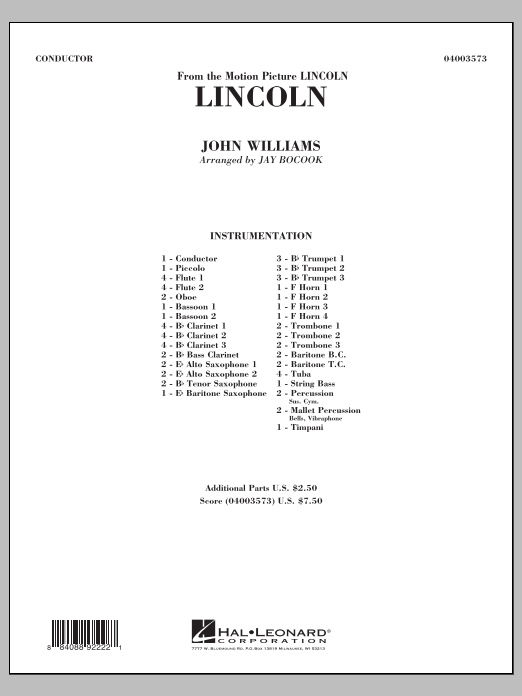

Lincoln: Concert Band Conductor Score & Parts
By John Williams / As performed by Lincoln (Movie) / Arranged by Jay Bocook
Grade: 4
Item: 35-PK00270194
$85.00
Pickup currently not available
Buy Extra Parts (Digital PDF Download)
| Product | Price | Quantity |
|---|---|---|
| Lincoln - Conductor Score (Full Score) | $12.50 | |
| Lincoln - Piccolo | $6.00 | |
| Lincoln - Flute 1 | $6.00 | |
| Lincoln - Flute 2 | $6.00 | |
| Lincoln - Oboe | $6.00 | |
| Lincoln - Bassoon 1 | $6.00 | |
| Lincoln - Bassoon 2 | $6.00 | |
| Lincoln - Bb Clarinet 1 | $6.00 | |
| Lincoln - Bb Clarinet 2 | $6.00 | |
| Lincoln - Bb Clarinet 3 | $6.00 | |
| Lincoln - Bb Bass Clarinet | $6.00 | |
| Lincoln - Eb Alto Saxophone 1 | $6.00 | |
| Lincoln - Eb Alto Saxophone 2 | $6.00 | |
| Lincoln - Bb Tenor Saxophone | $6.00 | |
| Lincoln - Eb Baritone Saxophone | $6.00 | |
| Lincoln - Bb Trumpet 1 | $6.00 | |
| Lincoln - Bb Trumpet 2 | $6.00 | |
| Lincoln - Bb Trumpet 3 | $6.00 | |
| Lincoln - F Horn 1 | $6.00 | |
| Lincoln - F Horn 2 | $6.00 | |
| Lincoln - F Horn 3 | $6.00 | |
| Lincoln - F Horn 4 | $6.00 | |
| Lincoln - Trombone 1 | $6.00 | |
| Lincoln - Trombone 2 | $6.00 | |
| Lincoln - Trombone 3 | $6.00 | |
| Lincoln - Baritone B.C. | $6.00 | |
| Lincoln - Baritone T.C. | $6.00 | |
| Lincoln - Tuba | $6.00 | |
| Lincoln - String Bass | $6.00 | |
| Lincoln - Percussion | $6.00 | |
| Lincoln - Mallet Percussion | $6.00 | |
| Lincoln - Timpani | $6.00 |
Parts Added to Cart!
Description
Steven Spielberg's powerful movie brought us an equally moving soundtrack from master composer John Williams. Effectively adapted here for the concert stage, the amazing depth and range of the music is at times poignant and understated, and at times spirited and buoyant. Dur: 4:20


Lincoln: Concert Band Conductor Score & Parts isn't in MakeMusic Cloud just yet...but it could be. Let us know you'd like to see it, and you'll help shape what comes next. In the meantime, start a free trial and dive into thousands of interactive titles your students can play along with today.
Request This Title
Tell us you want it.
Start Your Free Trial
Explore everything that's ready to play right now.
Sample Audio
No sample audio found.
Sample Video
No sample videos found.
Additional Details
Publisher:
Hal Leonard
SKU:
35-PK00270194
More about this title
About the Composer: John Williams
John Williams stands among the most performed composers in the world, with a catalog spanning seven decades of film scores that have fundamentally shaped how we experience cinema. His concert works and orchestral arrangements reveal a deep mastery of classical form and instrumental writing, informed by his studies with major twentieth-century composers and his work as a conductor.
Williams brings to every project an uncompromising commitment to melody, harmonic clarity, and emotional directness. His ability to craft music that moves audiences while respecting the technical and expressive capabilities of performers makes his work especially valuable in educational settings.
Why we love this
This adaptation captures the emotional arc of Williams' score without overwhelming a Grade 4 band. Jay Bocook's orchestration preserves the memorable themes while distributing the harmonic and textural weight across the ensemble in ways that young musicians can execute with confidence. Programming this lets you deliver a major-league soundtrack moment that your audience recognizes immediately, while your students engage with music that respects both their current abilities and their musical intelligence.
What to expect
The score moves between intimate, reflective passages of spare beauty and broader, more assertive moments that unfold with quiet dignity. You'll recognize Williams' gift for a soaring melody that lands in the heart without sentimentality, paired with harmonic language that feels both contemporary and rooted in classical tradition.
Who it's for
Band directors seeking repertoire with genuine artistic weight and immediate audience resonance will find this essential. It works equally well for programs wanting to showcase melodic maturity and emotional sophistication at Grade 4 level, or for ensembles looking to build confidence through music with professional film credentials.
How to get the most out of it
- Balance the string-like sustained tones in woodwinds and low brass with the moving inner voices; this layering creates the emotional depth Williams intended.
- Shape each thematic statement as you would a vocal line, allowing phrases to breathe rather than pushing toward a metronomic inevitability.
- Pay attention to dynamic nuance in the quieter passages. The "understated" moments Williams mentions are often where the score's vulnerability emerges most powerfully.
- Align the tempo to the emotional content of each section rather than treating the 4:20 duration as a fixed constraint; flexibility within the broader arc serves the music.
How to use it
This works especially well in spring concerts or as a finale offering a shift toward contemporary film music without abandoning artistic seriousness. It pairs naturally alongside other Williams concert works or as a dramatic centerpiece alongside period repertoire, bridging traditional band literature and what students encounter in their broader cultural life.
Skills your students will build
- Shaping long melodic lines with sensitive phrasing and rubato
- Balancing sustained harmonic voices while featuring moving inner parts
- Executing dynamic contrast across extended dynamic ranges
- Responding to emotional content and adjusting interpretation accordingly