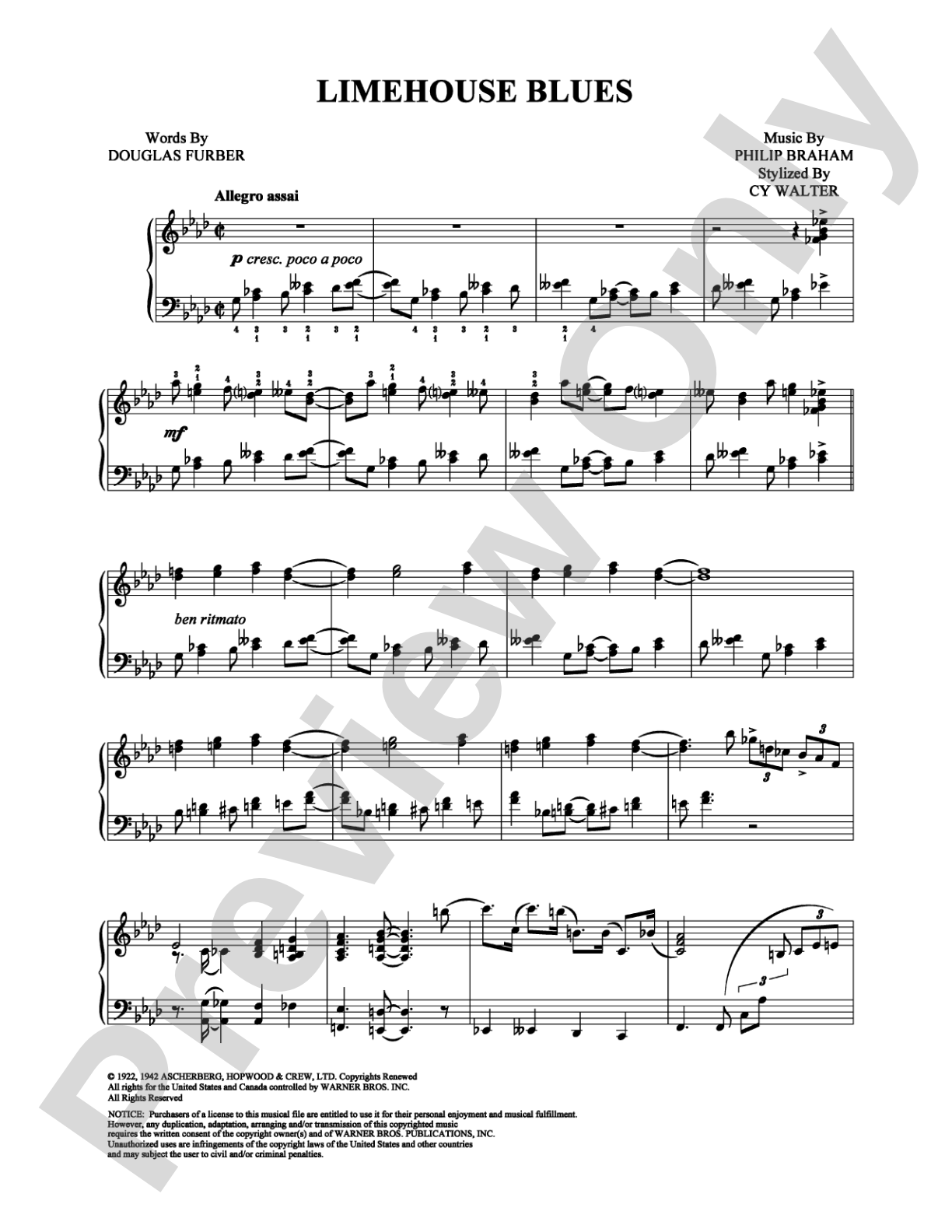
Limehouse Blues: Piano Digital Sheet Music

Limehouse Blues: Piano Digital Sheet Music

Philip Braham, Cy Walter

Item: 00-PS-0003461

Digital Download
$3.99
Description

Limehouse Blues: Piano Digital Sheet Music isn't in MakeMusic Cloud just yet...but it could be. Let us know you'd like to see it, and you'll help shape what comes next. In the meantime, start a free trial and dive into thousands of interactive titles your students can play along with today.

Sample Audio
No sample audio found.
Sample Video
Additional Details
SKU: 00-PS-0003461

More about this title

About the Artist: Cy Walter

Cy Walter (1915-1968) was an American jazz pianist and composer known for his sophisticated interpretations of American popular standards and jazz classics. He built a reputation as a sensitive accompanist and bandleader, performing regularly in New York's top venues and recording prolifically throughout the 1940s and 1950s. His playing balanced technical precision with emotional restraint, making him a respected figure among singers and fellow musicians who valued his musicianship and ability to support a vocalist while maintaining strong harmonic sensibility.

Why we love this

Walter's arrangement of this jazz standard captures the essence of classic swing-era piano playing, with clean voicings and strong harmonic grounding that rewards careful listening and execution. The piece sits comfortably under the hands while offering genuine interpretive challenges around dynamics, touch, and phrasing that distinguish a mature performance from a mere note-reading exercise.

What to expect

Limehouse Blues carries the sophisticated charm of 1920s London low-life through a jazz lens, with minor-key color and a melody that sits somewhere between wistful and mischievous. Walter's arrangement emphasizes the chromatic sophistication of the harmony while keeping the performance accessible, creating a sense of cultured ease rather than brittle complexity.

Who it's for

Pianists working to build fluency with jazz standards and the harmonic language of the American Songbook will find this an approachable entry point. It suits intermediate to advanced adult students, advanced high school pianists, and professionals seeking a reliable, well-crafted arrangement of a classic tune.

How to get the most out of it

  • Shape the melodic line with attention to rubato; this standard expects flexibility in phrasing rather than metronomic regularity, especially in the opening statement of the tune
  • Balance the harmony by listening to the weight of left-hand voicings against the right-hand melody, using pedal judiciously to blend sonorities without muddying the clarity of the line
  • Approach the swing feel with a relaxed understanding of triplet subdivision rather than a rigid interpretation; let the rhythm breathe naturally within the measure

How to use it

This works well on a recital devoted to standards and jazz repertoire, pairing naturally with other Gershwin-era material or American popular songs arranged for solo piano. It also serves as a model study piece for pianists learning to interpret jazz harmony and swing phrasing without relying on a full ensemble.

Skills your students will build

  • Jazz harmony and voice leading in standard progressions
  • Swing phrasing and rhythmic flexibility in solo performance
  • Balance and independence between melody and left-hand voicings
  • Pedal control for blend and resonance without harmonic blur

You May Also Like