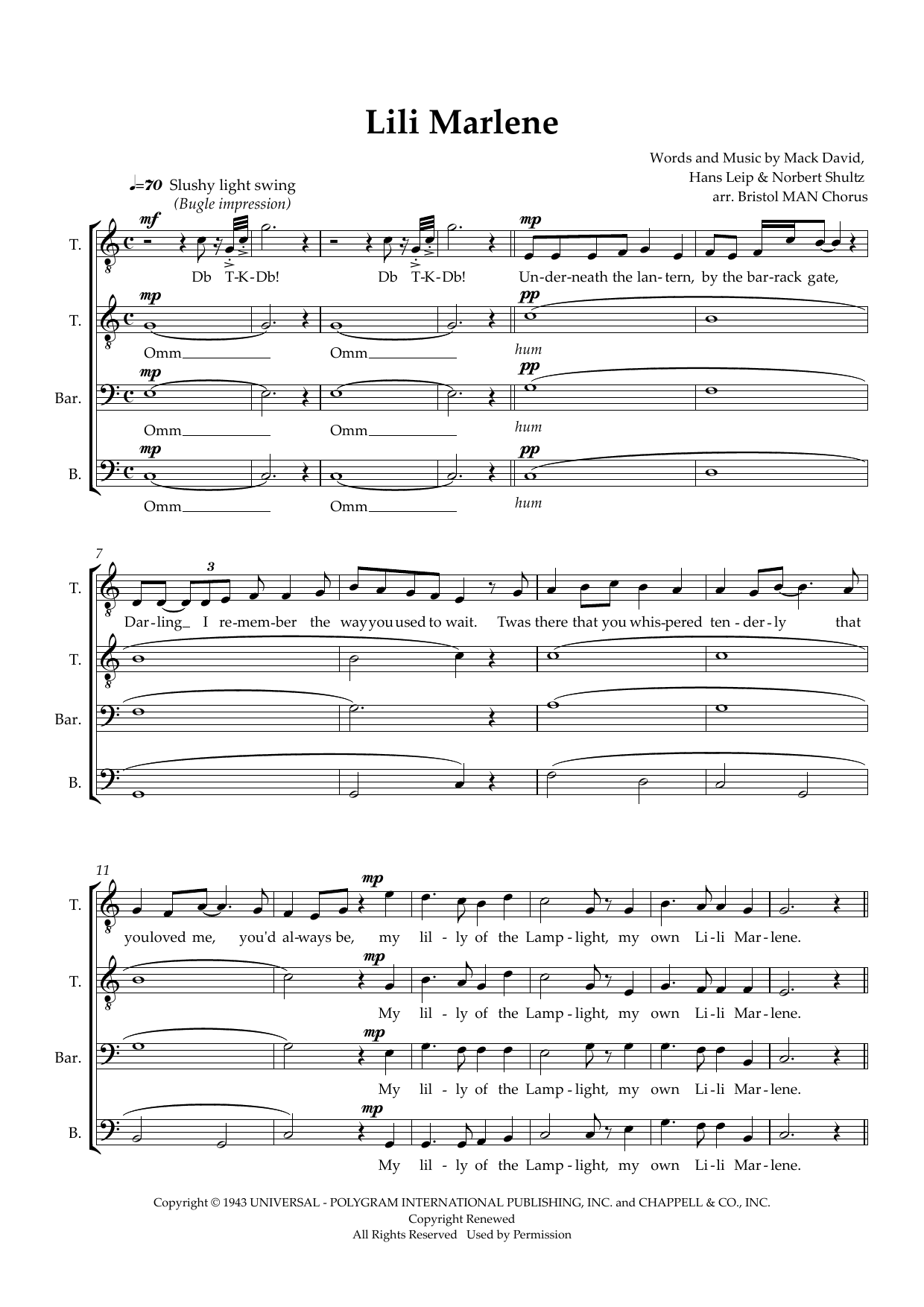
Lili Marlene (arr. Sam Burns) Sheet Music Preview

Lili Marlene (arr. Sam Burns): TTBB Choral Octavo

As performed by Hans Leip / Arranged by Sam Burns

Item: 35-DS00457648

Digital Download
$1.99
Description

Lili Marlene (arr. Sam Burns): TTBB Choral Octavo isn't in MakeMusic Cloud just yet...but it could be. Let us know you'd like to see it, and you'll help shape what comes next. In the meantime, start a free trial and dive into thousands of interactive titles your students can play along with today.

Sample Audio
No sample audio found.
Sample Video
Additional Details
Publisher: Hal Leonard
Page Count: 4
SKU: 35-DS00457648

More about this title

About the Artist: Hans Leip

Hans Leip was a German songwriter and poet whose 1915 composition 'Lili Marlene' became one of the most iconic songs of World War II. Written during his military service, the song captured the longing and melancholy of soldiers across multiple nations, eventually transcending its original context to become a standard in jazz and popular music repertoires.

Leip's ability to distill universal emotion into a simple, memorable melody made 'Lili Marlene' endure far beyond its wartime origins. The song's narrative quality and emotional directness continue to draw arrangers and performers seeking material with historical weight and genuine human resonance.

Why we love this

Sam Burns has crafted an arrangement that respects the song's inherent poignancy while giving your men's voices room to explore harmonic color and interpretive nuance. The TTBB voicing sits naturally for male singers, and Burns avoids overwrought jazz styling in favor of understated sophistication that lets the melody speak. Programming this carries narrative power without requiring elaborate staging or explanation.

What to expect

Bittersweet and reflective, this arrangement honors the song's melancholic heart while the jazz harmony adds subtle sophistication. There's an underlying wistfulness here, the sense of soldiers thinking of home, delivered with quiet dignity rather than theatrical emotion.

Who it's for

Men's choirs looking to expand beyond traditional barbershop or classical territory will find this arrangement accessible yet substantial. It works equally well for mixed groups where you want to feature your tenor and bass sections with meaningful material.

How to get the most out of it

  • Balance the melody line carefully across sections; the arrangement's effectiveness hinges on clarity rather than volume. A tenor soloist could front the primary melodic material while the other voices create harmonic context.
  • Shape the harmonic progressions with slight dynamic swells at phrase peaks, allowing the underlying jazz harmony to emerge without forcing it. Restraint serves this arrangement better than aggressive stylization.
  • Work the articulation distinctly enough that jazz inflection reads clearly, but avoid cartoon-like phrasing. The song deserves the dignity its subject matter carries.

How to use it

Pair this with other jazz standards to create a themed concert set, or use it as the emotional centerpiece in a program exploring how popular songs cross cultural and temporal boundaries. The song's historical resonance makes it particularly fitting for Veterans Day or remembrance programs, though its musical substance stands on merit alone.

Skills your students will build

  • Reading and executing jazz harmony voicings in TTBB texture
  • Balancing melody projection with harmonic accompaniment across four independent lines
  • Applying appropriate articulation and phrasing for jazz idiom while maintaining lyrical quality
  • Exploring historical context and emotional authenticity in arrangement interpretation

You May Also Like