
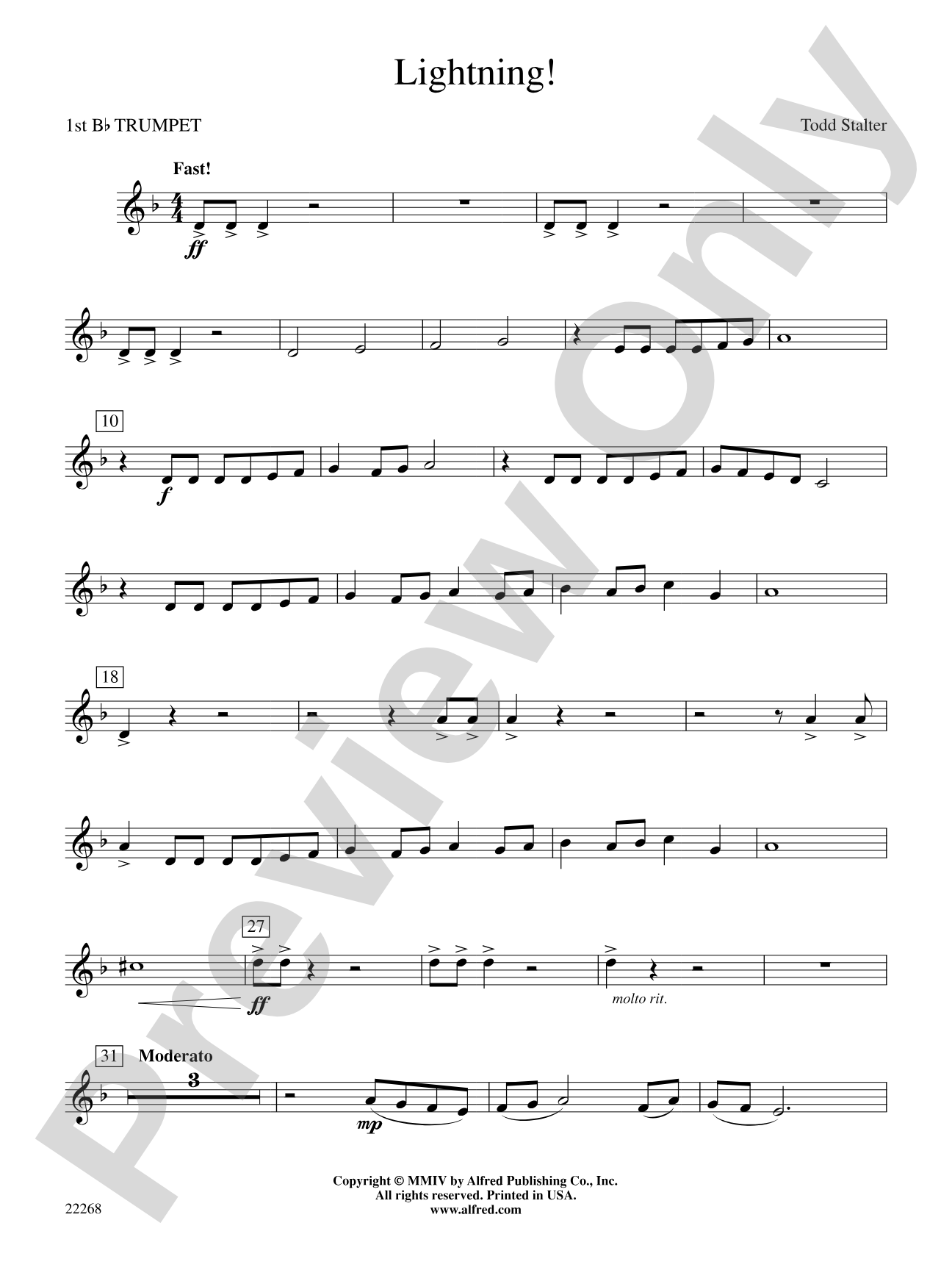

Lightning!: 1st B-flat Trumpet
By Todd Stalter
Grade: 2 (Medium Easy)
Item: 00-PC-0000522_T1
$5.99
Pickup currently not available
Description
"Lightning!" was inspired by the awesome display of beauty and raw energy from a powerful spring thunderstorm that the composer observed in the night sky. Although the storm was almost 100 miles away, the sight of the accompanying electrical show was both an exhilarating and humbling experience. The aggressive parts of this composition attempt to portray the level of energy present in the storm, while the slow interior section provides an opportunity for listeners and performers alike to reflect on its visual beauty. (2:45)


Don't just read it, hear it, play along with it, and watch your students grow with it. In MakeMusic Cloud, Lightning!: 1st B-flat Trumpet comes alive with professional accompaniment, adjustable tempo, and built-in practice tools that turn solo practice into real progress.
Open in the Player
Jump straight in and assign it today.
Start Your Free Trial
Open this title and explore the full library in minutes.
Sample Audio
1
Audio File
--:--
0:00
0:00
Sample Video
Additional Details
Series:
Young Symphonic
Publisher:
Alfred Music
Page Count:
264
SKU:
00-PC-0000522_T1
More about this title
About the Composer: Todd Stalter

Todd Stalter directed bands at Eureka High School in Eureka, Illinois, for 34 years, building a program recognized statewide for consistent excellence. His marching band won 16 Class 1A state championships, his concert band earned repeated Superior ratings at IHSA contests, and his ensembles performed at Orchestra Hall in Chicago and Walt Disney World, as well as competing in the Cotton and Liberty Bowl music festivals. He holds membership in the Illinois State Marching Band Championships Hall of Fame.
As a conductor, Stalter has led All-State Bands in Georgia and Delaware, directed numerous district and honor bands, and maintained an active schedule as an adjudicator and clinician across the Midwest. His compositions for band and string orchestra are performed internationally and appear regularly on state contest and festival lists; several works are included in the GIA publication Teaching Music Through Performance in Band. He holds degrees from Illinois State University in music education and trumpet performance, where he studied with members of the United States Marine Band and worked as a conducting assistant.
Why we love this
Stalter captures genuine meteorological drama without resorting to cheap special effects. The aggressive outer sections and reflective interior give your ensemble a complete emotional arc to execute, and the Grade 2 scoring ensures that even newer players can participate meaningfully in portraying a weather event that's genuinely powerful. This piece contests well and sounds like a band working together toward a real artistic idea.
What to expect
The piece opens with raw, pulsing energy that mirrors the electrical intensity of a spring thunderstorm. A contemplative middle section invites both players and listeners to witness the storm's visual majesty before the ensemble returns to aggressive momentum, leaving performers and audiences energized by the experience of collective musical storytelling.
Who it's for
Concert bands at the high school level and advanced middle school programs will find this piece ideally scaled for developing musicians who are ready for something with genuine musical purpose. Directors looking for contest or festival repertoire that demands musicianship without overwhelming instrumental technique will find strong material here.
How to get the most out of it
- Build dynamic contrast deliberately in the aggressive sections. The energy should feel earned and controlled, not simply loud; work the accelerations and sudden shifts to create momentum rather than relying on volume alone.
- Treat the slow interior as a genuine moment of reflection for your ensemble. Balance clarity of line against the harmonic support; this section rewards patient, focused intonation.
- Lock the rhythmic precision during the storm passages. Listeners will hear the distinction between a tight ensemble and a loose one immediately in depictive writing like this.
- Shape the return to aggression from the slow section as a dramatic event. Rehearse the transition carefully so the energy shift feels inevitable rather than abrupt.
How to use it
Program this during a concert season when you want to showcase your band's dynamic range and dramatic sensibility. It pairs well alongside lyrical or lighter works, providing contrast that strengthens the entire program. The duration (2:45) and contest-appropriate difficulty make it valuable repertoire for festival preparation.
Skills your students will build
- Dynamic control and contrast (sustained soft playing against aggressive tutti passages)
- Sectional balance and blend across multiple dynamic levels
- Rhythmic precision in fast-moving parts
- Phrase shaping and sustain in lyrical sections
- Responding to rapid mood and tempo shifts
- Reading a full score context (conductor score with integrated parts)