
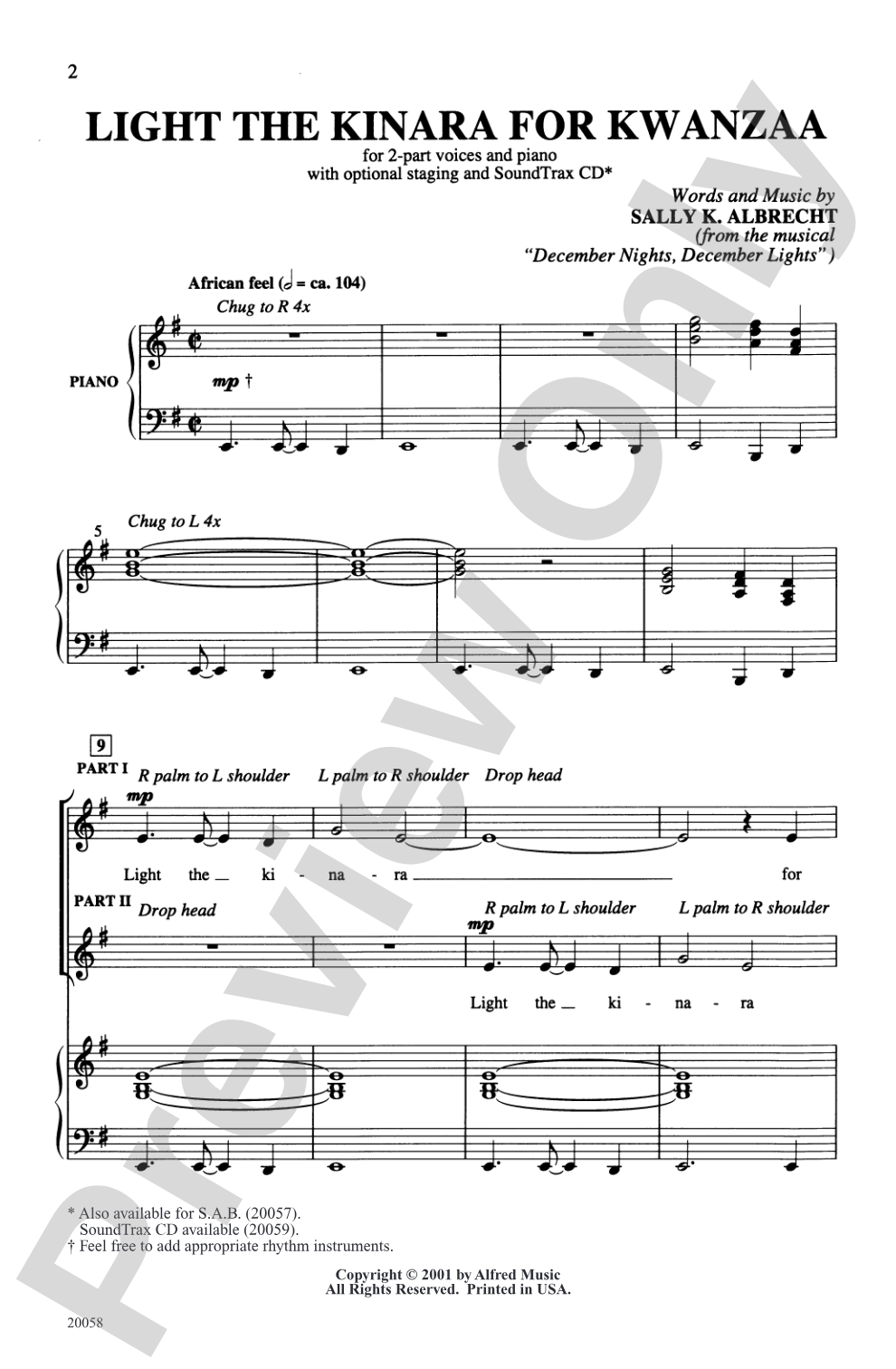
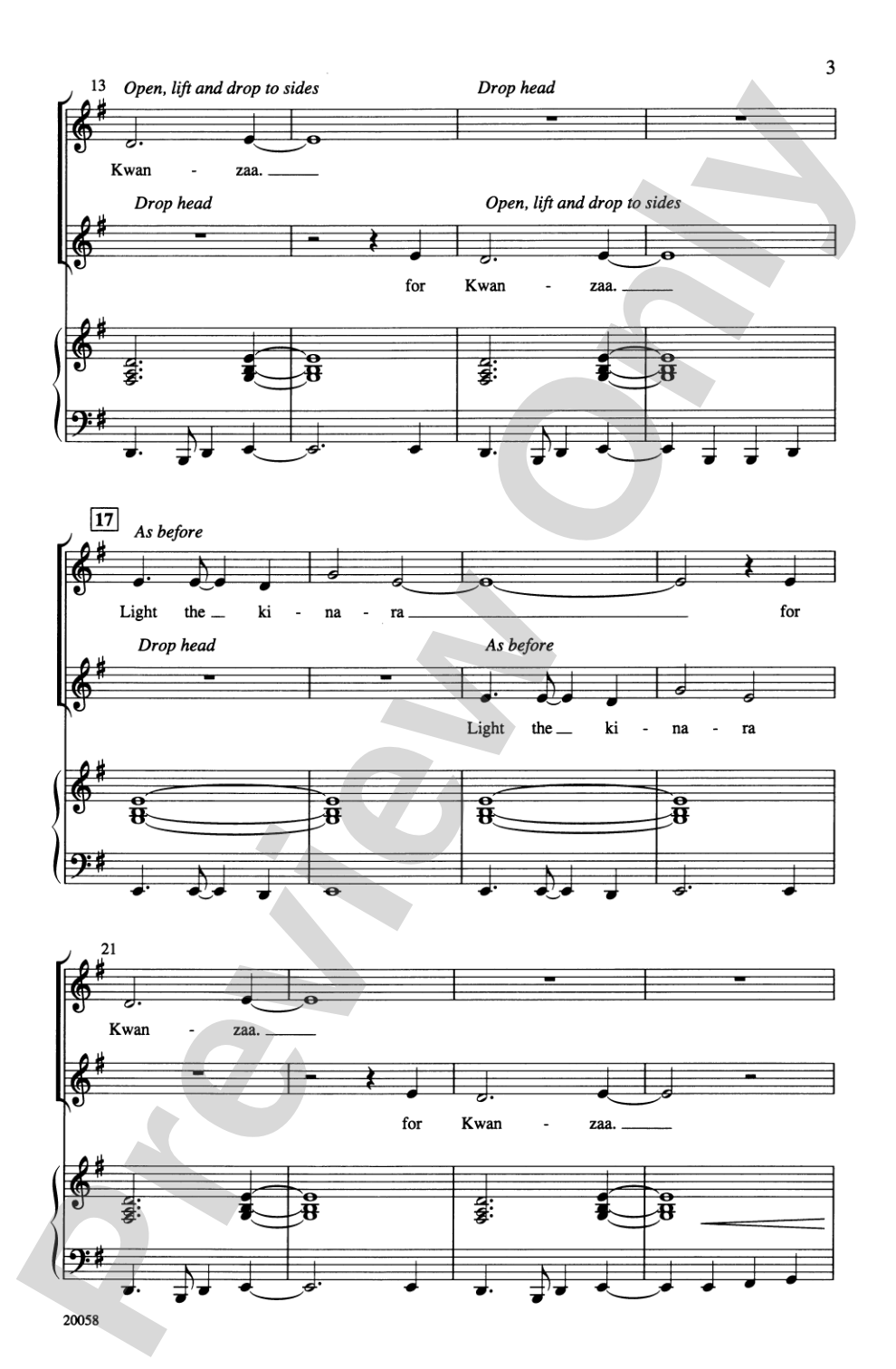

Light the Kinara for Kwanzaa: 2-Part Choral Octavo
Music by Sally K. Albrecht
Item: 00-PO-0006511
$2.25
Minimum order quantity: 20 copies
Pickup currently not available
Description
A kinara is a candelabra holding seven candles, each representing a day in the festival of Kwanzaa. This original piece by Sally Albrecht evokes images of Africa as it tells the story of Kwanzaa. It's in the easy-to-tech echo style, reminiscent of African call and response. You won't just be teaching notes, you'll be teaching the origins of this fast growing African-American holiday. Sally's simple staging is included in the publication. Don't miss the cool SoundTrax CD.


Discover MakeMusic Cloud: thousands of interactive titles your students can play along with today.
Sample Audio
1
Audio File
--:--
0:00
0:00
Sample Video
No sample videos found.
Additional Details
Series:
Alfred Choral Designs
Publisher:
Alfred Music
Page Count:
8
SKU:
00-PO-0006511
More about this title
About the Composer: Sally K. Albrecht

Sally K. Albrecht has built a career spanning three decades as a choral composer, conductor, and clinician with particular expertise in integrating movement into choral performance. Her prolific output includes over 600 published choral works and 75 larger musicals and songbooks currently in print. A consistent recipient of the ASCAP Special Music Award since 1987, she has guest conducted honor choirs at major venues including Lincoln Center, Carnegie Hall, and The Kennedy Center. Her work as Director of School Choral, Vocal, and Elementary Publications for Alfred Music shaped educational choral practice across the country.
Albrecht holds degrees from Rollins College (B.A. in Music and Theater, 1976), the University of Miami (M.A. in Drama, 1977, and M.M. in Accompanying, 1979), and has taught at Oakland University, Jersey City State College, and Meredith College. She serves on the Board of Trustees at Rollins College and received the Distinguished Alumna Award from both Rollins and the University of Miami Frost School of Music in 2021. She resides in Wake Forest, North Carolina, with her husband, composer and arranger Jay Althouse.
Why we love this
Albrecht's command of call-and-response structure makes this piece exceptionally accessible for younger or less experienced singers while avoiding oversimplification. The inclusion of staging directions and cultural context transforms a brief rehearsal time into genuine music education, giving students agency in understanding why they're learning this particular piece and what it represents. The echo style does the heavy lifting for you technically, freeing your attention for the meaningful work of exploring African-American cultural traditions.
What to expect
The piece pulses with the warmth of a community gathering around firelight, its call-and-response structure drawing singers into dialogue rather than mere performance. African melodic colors and rhythmic vitality enliven the text, creating an atmosphere both celebratory and reverent as singers learn the significance of each candle in the kinara.
Who it's for
Directors working with younger choirs, middle school singers, or ensembles new to multicultural repertoire will find this piece immediately singable and deeply purposeful. It suits any program looking to expand its Kwanzaa observance or winter concert beyond secular holiday standards, offering cultural authenticity without requiring advanced vocal technique.
How to get the most out of it
- Establish clear antiphonal sections before adding text; have one group echo the other on a neutral syllable first to lock in the rhythmic pattern and response timing.
- Use the recorded accompaniment to anchor unfamiliar melodic phrases, especially if your singers have limited exposure to African musical idioms.
- Incorporate the staging suggestions from the publication early in rehearsal rather than adding them as an afterthought; movement clarifies phrasing and deepens ensemble connection.
- Emphasize the call section's energy and intention, treating it as a direct communication to the group giving the response, not simply reciting text.
How to use it
This works powerfully as the centerpiece of a Kwanzaa-themed concert segment or as part of a winter celebration exploring global holiday traditions. It can also stand alone as a short assembly piece or classroom performance, requiring minimal staging space and allowing flexibility in performance venue.
Skills your students will build
- Call-and-response singing with clear rhythmic synchronization
- Understanding of African-American cultural traditions and their musical expression
- Ensemble blend and balance within a 2-part texture
- Integration of movement with choral sound
- Responsiveness to a conductor's phrasing in echo structures