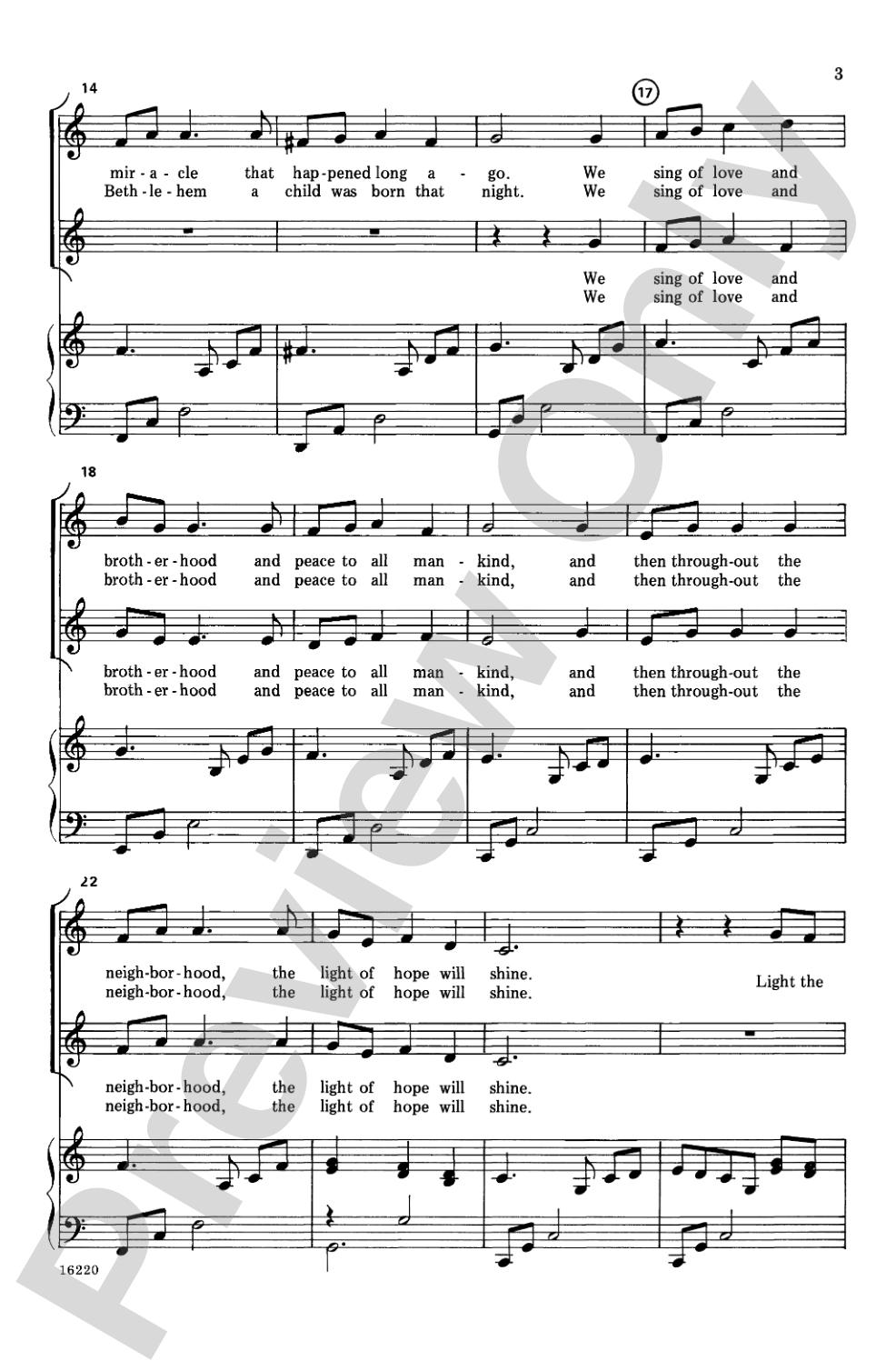
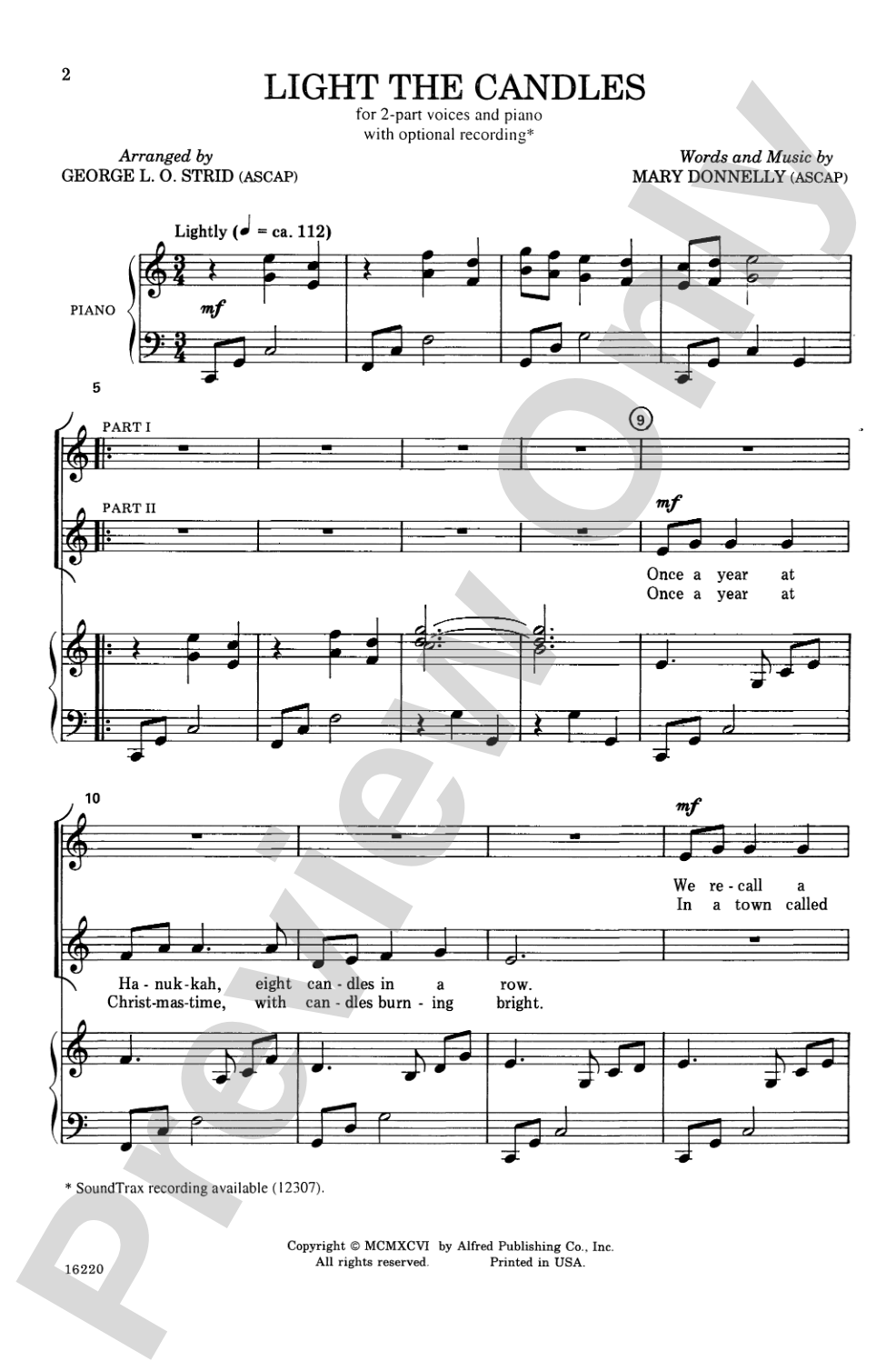
Light the Candles Sheet Music Preview

Light the Candles: 2-Part Choral Octavo

Music by Mary Donnelly / arr. George L. O. Strid

Item: 00-PO-0003935

Digital Download
$2.25

Minimum order quantity: 20 copies

Description
A new edition for 3-part mixed voices of a top-selling Hanukkah piece. Text tells the story of Hanukkah. Light 2-beat feel with a brief slow passage. Descant enters on final statement of melody.

Light the Candles: 2-Part Choral Octavo isn't in MakeMusic Cloud just yet...but it could be. Let us know you'd like to see it, and you'll help shape what comes next. In the meantime, start a free trial and dive into thousands of interactive titles your students can play along with today.

Sample Audio
No sample audio found.
Sample Video
Additional Details
Series: Alfred Archive Edition: Alfred Choral Designs
Publisher: Alfred Music
Page Count: 8
SKU: 00-PO-0003935

More about this title

About the Composer: Mary Donnelly

Mary Donnelly

Mary Donnelly grew up in Reno, Nevada, and studied English and French at the University of Nevada, Reno. While still an undergraduate, she organized children's choruses and discovered her passion for music education, leading her to pursue formal training. She earned a Master's Degree in Education from Lesley College in Cambridge, Massachusetts, where she focused on integrating the arts across the curriculum.

Donnelly spent thirty years teaching general music and choir in elementary and middle schools throughout the Washoe County School District in Nevada before retiring. She met arranger George L. O. Strid in 1985 while team-teaching a sixth-grade general music class; their principal's request to write a musical for Reading Week sparked a prolific collaboration that has produced over two hundred songs and twenty-five musicals. She holds memberships in ACDA, NEA, and ASCAP.

Why we love this

This arrangement captures the warmth and narrative clarity of the original while fitting neatly into a 2-part voicing that works for mixed middle school choirs and emerging high school ensembles. The light 2-beat feel keeps the piece accessible and energetic, and the descant entrance on the final statement gives singers a satisfying melodic moment without demanding advanced vocal technique. It's a reliable choice for winter programming when you need something that tells a clear story and doesn't require extensive rehearsal time.

What to expect

The piece radiates quiet joy and purpose. Its light 2-beat momentum carries listeners through the Hanukkah story with warmth rather than heaviness, while the descant and brief slower passage create moments of reflection that deepen the seasonal message. This is music that feels both celebratory and sincere.

Who it's for

This piece works well for middle school and early high school choirs, community choruses, and church music programs looking for accessible Hanukkah repertoire that requires modest ranges and straightforward part writing. It suits singers who are still building confidence with part singing and directors who want a meaningful holiday selection that won't demand weeks of preparation.

How to get the most out of it

  • Bring out the text clarity in the opening sections. These singers are telling Hanukkah's story, so articulation and diction matter more than blending; let each part carry its narrative weight.
  • Use the light 2-beat feel to keep energy moving forward without rushing. The tempo should feel buoyant, not anxious.
  • Shape the slow passage as a moment of reflection that contrasts with the surrounding sections. This brief shift in pace helps audiences hear the text's deeper meaning.
  • Balance the descant entrance carefully on the final statement so it sparkles without overpowering the main melody. This is a moment to celebrate, not obscure.

How to use it

Pair this with other winter repertoire to build a thematic program, or use it as your seasonal choral anchor in a multi-faith winter concert. It works particularly well for school assemblies, community Hanukkah celebrations, or interfaith holiday services where the story needs to be clear and the music approachable for both singers and audiences unfamiliar with the material.

Skills your students will build

  • Singing in two-part harmony with clear voice independence
  • Text-driven interpretation and diction in English language lyrics
  • Contrasting musical character (light 2-beat feel versus slower passages)
  • Descant singing on final melodic statement
  • Narrative expression through choral music

You May Also Like