
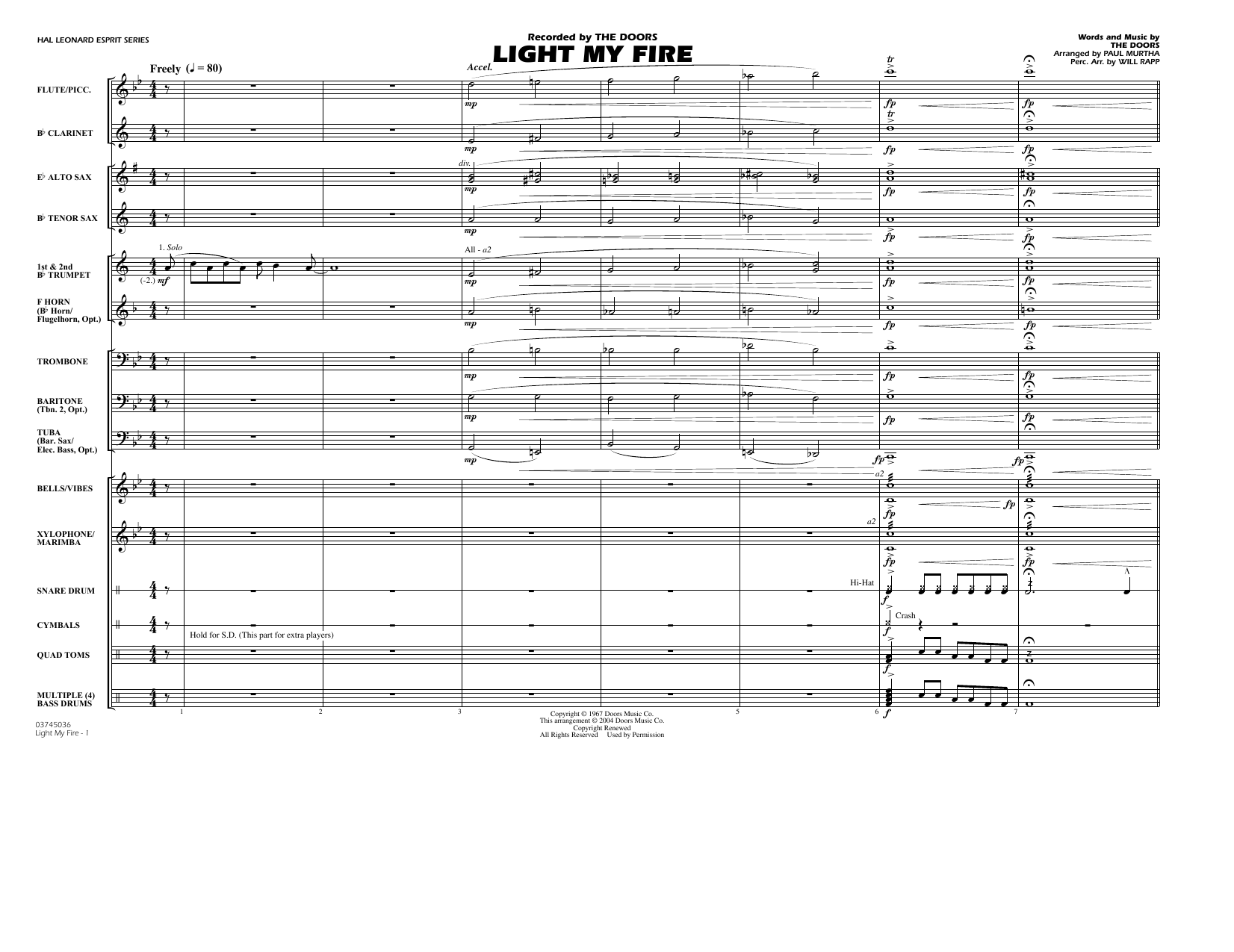

Light My Fire (arr. Paul Murtha): Marching Band Conductor Score & Parts
As performed by The Doors / Arranged by Paul Murtha / Arranged by Will Rapp
Grade: 3
Item: 35-PK00463402
$55.00
Pickup currently not available
Buy Extra Parts (Digital PDF Download)
Parts Added to Cart!
Description
A lone trumpet announces this signature hit by The Doors as the chart settles into the familiar moderate rock groove. Particularly effective is the woodwind feature section simulating the unique sound of the Farfisa organ of the late '60s.


Light My Fire (arr. Paul Murtha): Marching Band Conductor Score & Parts isn't in MakeMusic Cloud just yet...but it could be. Let us know you'd like to see it, and you'll help shape what comes next. In the meantime, start a free trial and dive into thousands of interactive titles your students can play along with today.
Request This Title
Tell us you want it.
Start Your Free Trial
Explore everything that's ready to play right now.
Sample Audio
No sample audio found.
Sample Video
No sample videos found.
Additional Details
Publisher:
Hal Leonard
SKU:
35-PK00463402
More about this title
About the Artist: The Doors
The Doors emerged from Los Angeles in 1965 as one of rock music's most artistically ambitious and controversial bands. Led by the poetic, unpredictable Jim Morrison, the group brought a darkly theatrical energy to rock and roll, drawing from blues, jazz, and classical influences. Their 1967 self-titled debut album, which includes "Light My Fire," remains a watershed moment in rock history, demonstrating how popular music could achieve genuine artistic complexity without sacrificing immediate appeal.
For music educators, The Doors represent a crucial bridge between the rock and roll of the 1950s and the progressive rock of the 1970s. Their work shows students that rock idioms can support sophisticated compositional ideas, from the organ textures and modal harmonies of their greatest hits to Morrison's spoken-word storytelling. Teaching Doors material gives students permission to take popular music seriously as an art form.
Why we love this
Paul Murtha's arrangement captures the iconic opening without gimmickry; the solo trumpet announcement lands exactly as students and audiences expect it to, earning immediate recognition before the chart shifts into accessible, groovy territory. The woodwind section writing that reimagines the Farfisa organ shows how a skilled arranger translates one instrument's sonic character to another ensemble, teaching your band something real about orchestration and texture.
What to expect
Cool, assured, and instantly familiar. The arrangement preserves the late '60s rock groove and the mysterious, controlled intensity of the original while making it playable for developing musicians. There's a sense of sophistication here; students feel like they're playing "real" material, not a simplified version.
Who it's for
Grade 3 bands with solid fundamentals and students who respond to popular music repertoire. This works equally well for programs seeking accessible concert repertoire and for directors who want their ensemble to connect with recognizable material from rock history. The arrangement respects the Grade 3 skill level while avoiding condescension.
How to get the most out of it
- Feature that opening trumpet solo with confidence. This is the musical hook; precision in the lead voice sells the entire arrangement.
- Balance the rock groove in the rhythm section so the pulse propels without overwhelming the melodic material. The familiarity of the song works against you here if the foundation feels rushed or loose.
- Shape the woodwind feature as a unified block when simulating the organ sound. Blend and intonation matter more than individual voice projection in that section.
- Let the arrangement breathe during the moderate rock tempo. Resist the urge to accelerate; the groove lives in relaxed pocket playing, not in pushing the beat.
How to use it
Program this alongside other rock and pop standards to show students the range of what contemporary marching band can address. It works particularly well in a concert that explores how classic rock songs translate to the ensemble context, or as a guaranteed crowd-pleaser when your program needs a moment of immediate connection with the audience.
Skills your students will build
- Sustaining a steady rock groove across multiple sections
- Balancing ensemble blend when creating unified textural effects
- Executing clean attacks and releases in popular music idioms
- Listening for and matching the articulation and phrasing of a lead voice
- Reading parts that prioritize rhythmic accuracy in a non-classical context