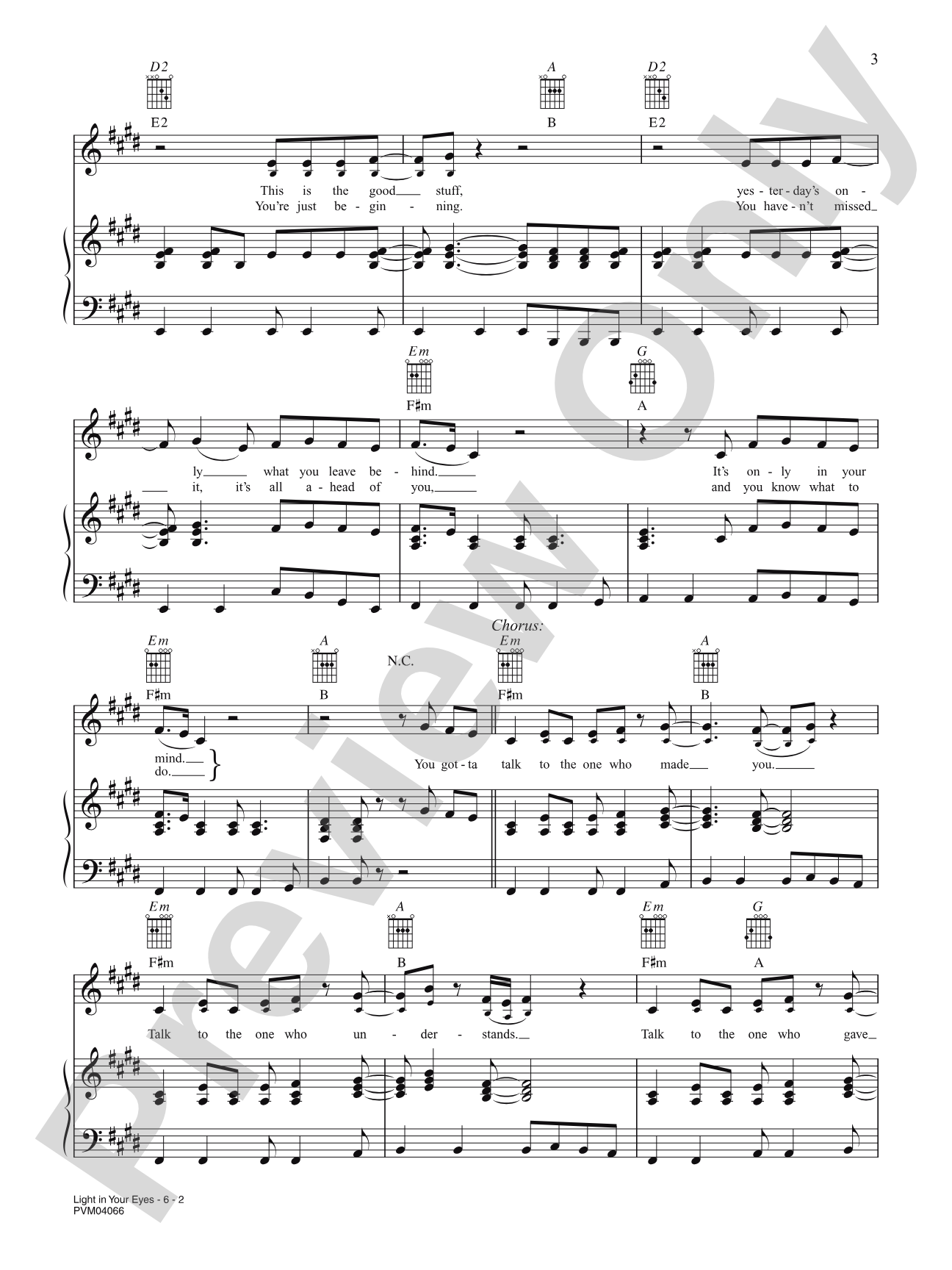
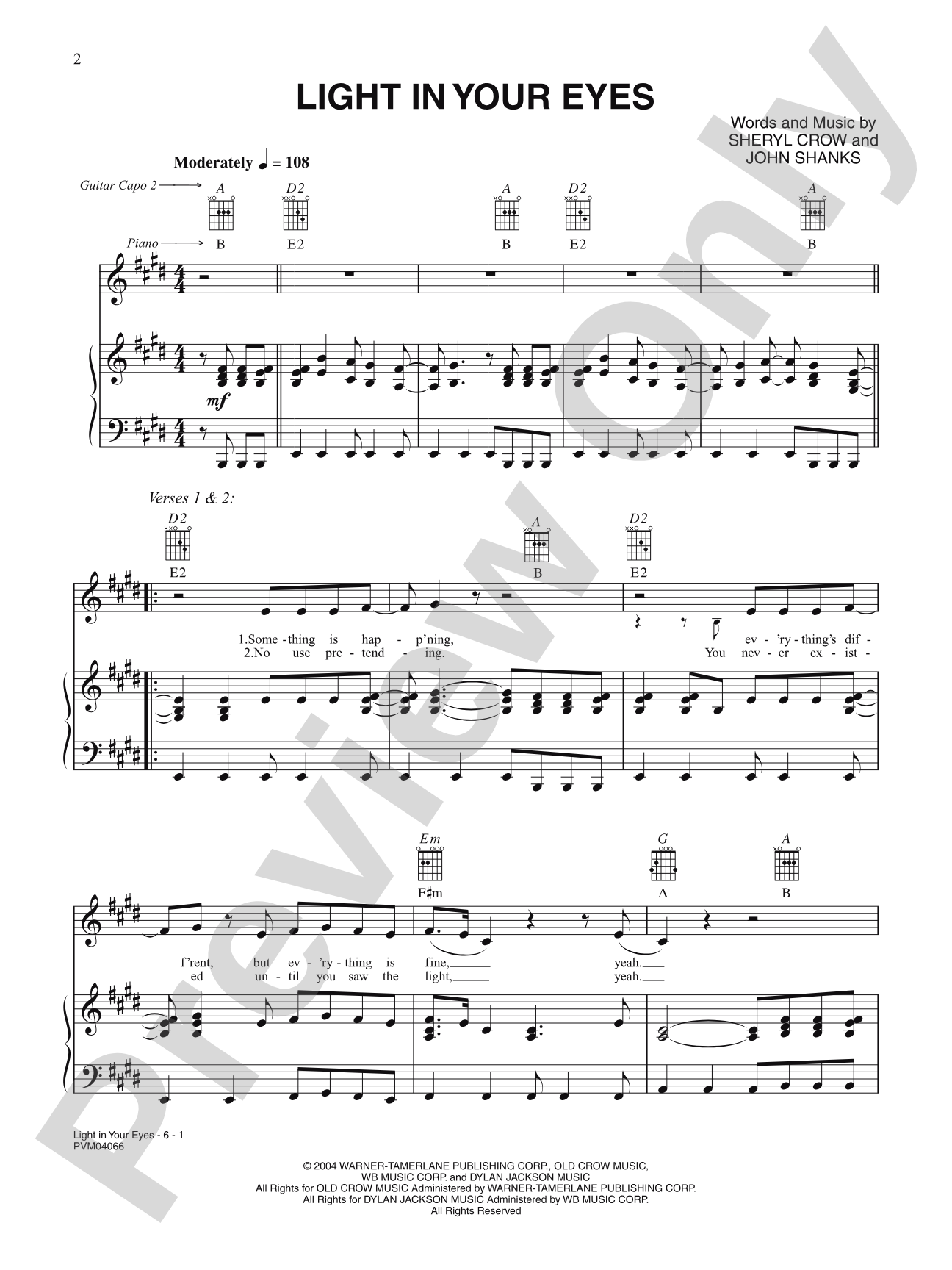
Light in Your Eyes Sheet Music Preview

Light in Your Eyes: Piano/Vocal/Chords

Recorded by Sheryl Crow

Item: 00-PIP-000611

Digital Download
$3.99
Description

Light in Your Eyes: Piano/Vocal/Chords isn't in MakeMusic Cloud just yet...but it could be. Let us know you'd like to see it, and you'll help shape what comes next. In the meantime, start a free trial and dive into thousands of interactive titles your students can play along with today.

Sample Audio
No sample audio found.
Sample Video
Additional Details
Publisher: Alfred Music
Page Count: 8
SKU: 00-PIP-000611

More about this title

About the Artist: Sheryl Crow

Sheryl Crow rose to prominence in the 1990s as a singer-songwriter who blended rock, pop, and country influences into chart-topping hits. Her career spans multiple decades, five Grammy Awards, and a reputation for crafting songs that balance accessibility with genuine emotional depth. As both a vocalist and instrumentalist, Crow brings a performer's understanding of what works in the studio and on stage, making her compositions natural vehicles for pianists and singers learning contemporary repertoire.

Crow's songwriting draws from personal experience and observational storytelling, resulting in melodies that stick with listeners while lyrics reward closer attention. Her influence on pop-rock music education has grown as more students seek out contemporary artists whose work bridges commercial appeal and musical substance.

Why we love this

This arrangement gives singers and pianists access to a contemporary pop-rock standard that sits well for multiple voice types and requires genuine musicianship to execute effectively. The chord changes reward singers who listen closely, and the piano part offers enough independence to keep instrumentalists engaged without overshadowing the vocal line. Students often connect more deeply with material they hear on the radio, and this song delivers both commercial credibility and a satisfying arrangement for rehearsal and recital.

What to expect

Warm and reflective, with the kind of accessibility that makes a song memorable on first hearing yet emotionally resonant on repeated listening. The arrangement invites both performer and listener into an intimate space; there's no bombast here, just a direct connection between the story being told and the accompaniment supporting it.

Who it's for

Pianists and singers at intermediate level or above looking for contemporary repertoire that bridges commercial and educational value. This works equally well for solo singers performing with piano accompaniment, duet arrangements, or classroom exploration of how pop-rock songwriting functions musically.

How to get the most out of it

  • Balance the vocal melody so it sits naturally over the piano accompaniment; the piano here supports rather than competes, and respecting that dynamic keeps the song's intimacy intact.
  • Pay attention to the lyrical phrasing rather than strict metric divisions; Crow's recorded vocal often sits slightly ahead of or behind the beat for expressive effect, so encourage singers to breathe where the words naturally land.
  • Use the chord chart to explore reharmonization possibilities with intermediate pianists; this piece works equally well with straightforward voicings or more jazz-influenced interpretations, depending on ensemble level and context.
  • Consider the song's narrative arc when shaping dynamics; the progression of the lyrics builds emotional weight, and letting that development guide volume and tone creates a more compelling performance than a static approach.

How to use it

Feature this in a showcase of contemporary songwriters, pairing it with acoustic or stripped-down arrangements of pop-rock standards that have earned their place in serious musical study. It also serves well as a bridge-building piece when introducing singers to repertoire outside classical or musical theater traditions, or as part of a student recital where contemporary song selections are welcome.

Skills your students will build

  • Singing over chord changes in pop-rock harmonic language
  • Piano accompaniment that supports rather than doubles the vocal line
  • Phrasing and breath placement in contemporary song context
  • Reading and interpreting chord symbols effectively
  • Balancing melody and accompaniment in small ensemble performance

You May Also Like