
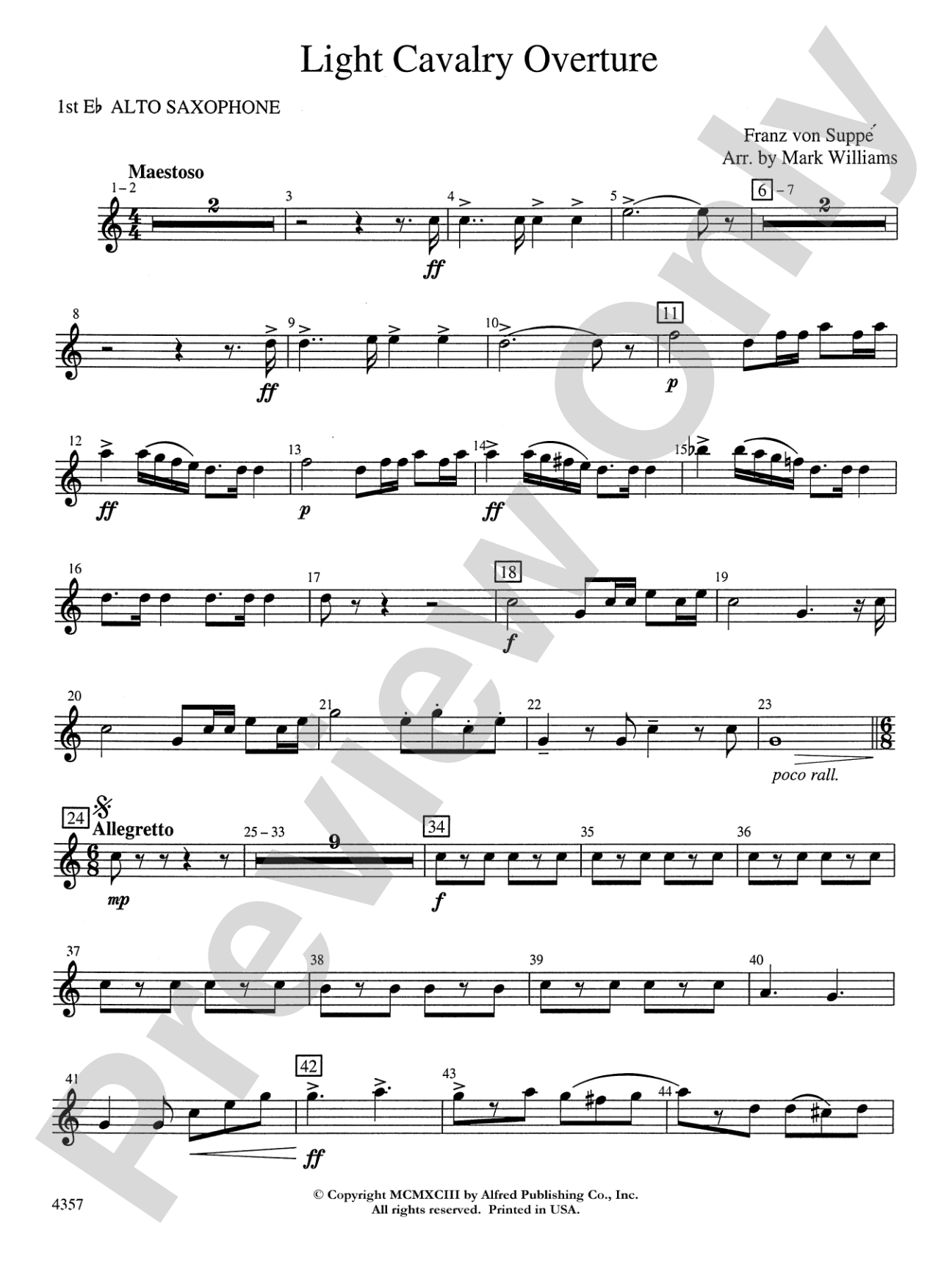

Light Cavalry Overture: E-flat Alto Saxophone
By Franz von Suppé / arr. Mark Williams
Grade: 1.5 (Easy)
Item: 00-PC-0001860_AX1
$3.00
Pickup currently not available
Description
This title is available in MakeMusic Cloud.


Don't just read it, hear it, play along with it, and watch your students grow with it. In MakeMusic Cloud, Light Cavalry Overture: E-flat Alto Saxophone comes alive with professional accompaniment, adjustable tempo, and built-in practice tools that turn solo practice into real progress.
Open in the Player
Jump straight in and assign it today.
Start Your Free Trial
Open this title and explore the full library in minutes.
Sample Audio
1
Audio File
--:--
0:00
0:00
Sample Video
No sample videos found.
Additional Details
Series:
Challenger Band Series
Publisher:
Alfred Music
Page Count:
234
SKU:
00-PC-0001860_AX1
More about this title
About the Composer: Franz von Suppé
Franz von Suppé (1819-1895) was an Austrian composer who practically invented the operetta genre. Born in Split (then part of the Austro-Hungarian Empire), he spent most of his career in Vienna, where he composed more than 30 stage works and numerous orchestral pieces that delighted audiences across Europe. His overtures remain concert staples because they capture Romantic-era orchestration at its most infectious and accessible.
Suppé's gift was melody. He understood how to build momentum through catchy themes, clever orchestration, and structural clarity—skills that made his operetta overtures as popular in concert halls as in theaters. *Light Cavalry Overture* exemplifies this approach: it's a masterclass in managing energy, harmonic color, and ensemble balance without requiring virtuosic technique from players.
Why we love this
Mark Williams's arrangement makes this beloved operetta overture genuinely playable at Grade 1.5 without sacrificing Suppé's essential character. The orchestration preserves the work's humor, forward momentum, and those earworm melodies that make students actually excited to rehearse this piece. At this level, finding repertoire that feels like real concert music rather than a simplified exercise is rare.
What to expect
Charming and spirited, with the breezy confidence of 19th-century operetta. The piece bounces between march-like sections and lyrical passages, never settling into one mood for long; it's theatrical without being precious, energetic without demanding technical extremes. Audiences recognize the tunefulness immediately, and players feel the genuine satisfaction of performing something with real orchestral color.
Who it's for
This arrangement serves conductors building Grade 1.5 concert bands that need repertoire with genuine musical substance. It works equally well for conductors programming festival competitions, community bands seeking recognizable masterworks, or high school bands that want Romantic-era orchestral sophistication within reach.
How to get the most out of it
- Balance the principal melodic lines carefully. In Romantic-era overtures, the tune needs to sing above the accompaniment, but secondary themes deserve their moment in the spotlight too. Mark each section's lead voice clearly in rehearsal.
- Watch for tempo consistency during key modulations. Suppé moves through several tonal areas, and conductors often rush or drag unconsciously in these transitions. A steady pulse keeps the piece's propulsive energy intact.
- Let the rhythm section establish the military character early. The piece has a distinctive march quality; if your percussion and bass section nail the rhythmic foundation in the opening, the entire band's execution improves immediately.
- Shape the softer passages without losing momentum. Grade 1.5 arrangements sometimes cut the dynamic contrasts, so milk every piano and pianissimo moment for color and drama. Your audience will feel the difference.
How to use it
Open a concert with this overture to establish upbeat energy and draw the audience in with accessible melody. It pairs well with heavier Romantic-era arrangements or modern compositions because its lightness provides contrast. Consider programming it early in competition seasons when you're still building technique; the musicality and historical context teach ensemble values without requiring advanced chops.
Skills your students will build
- Reading articulation markings consistently across different instrumental sections
- Balancing principal melodies against harmonic accompaniment
- Controlling tempo through key modulations
- Shaping dynamic contrasts in softer passages
- Executing the military march character in rhythmic coordination with percussion