
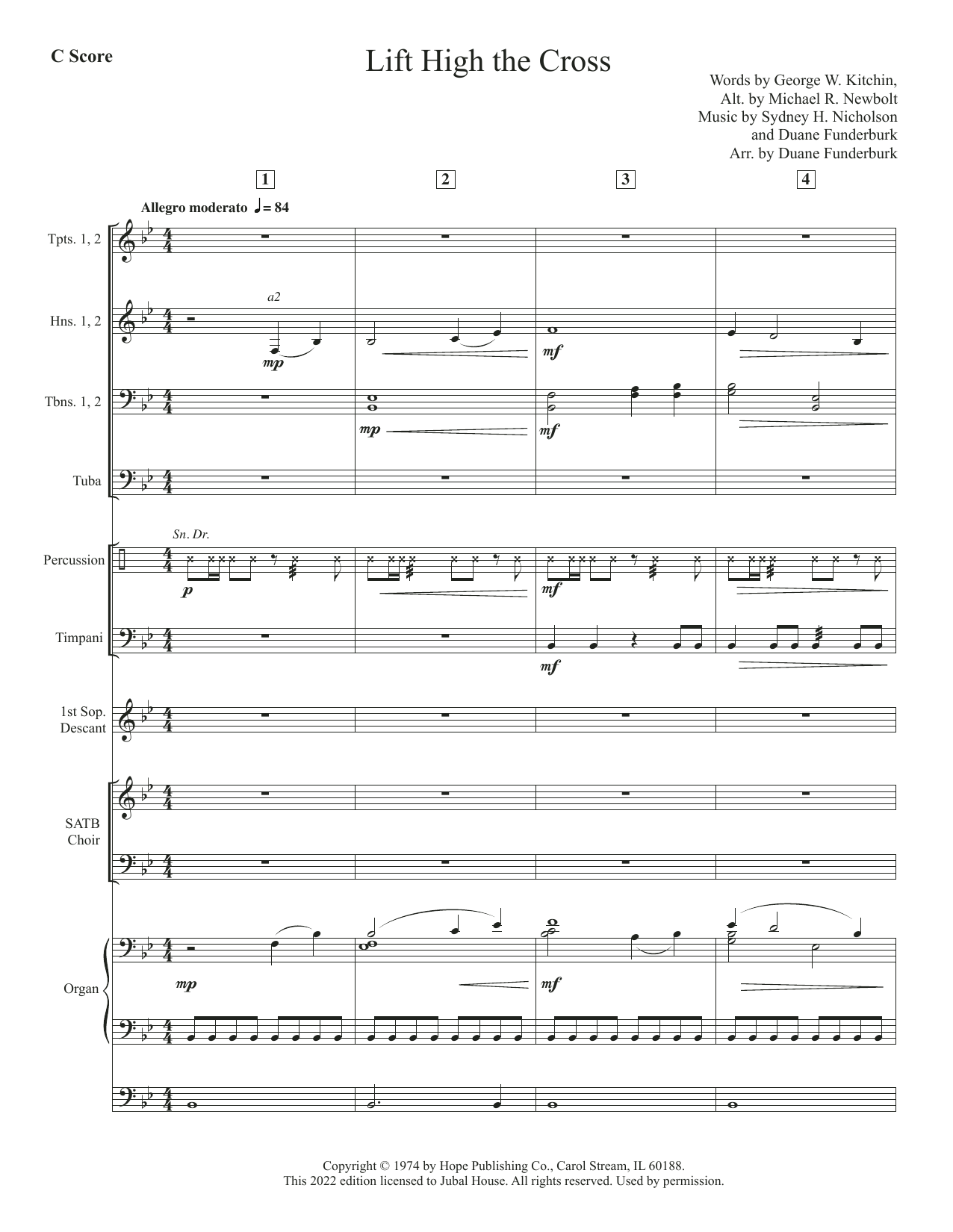

Lift High the Cross: Choral Instrumental Pak
By Sydney H. Nicholson / By George W. Kitchin / Arranged by Duane Funderburk
Item: 35-PK01404004
$35.00
Pickup currently not available
Buy Extra Parts (Digital PDF Download)
Parts Added to Cart!
Description
Duane Funderburk's insightful arrangement of the well-known hymn "Lift High the Cross" offers creative options for congregational participation. Also featuring brass and percussion instrumentation, this piece is sure to become a choir and congregation favorite.


Lift High the Cross: Choral Instrumental Pak isn't in MakeMusic Cloud just yet...but it could be. Let us know you'd like to see it, and you'll help shape what comes next. In the meantime, start a free trial and dive into thousands of interactive titles your students can play along with today.
Request This Title
Tell us you want it.
Start Your Free Trial
Explore everything that's ready to play right now.
Sample Audio
No sample audio found.
Sample Video
No sample videos found.
Additional Details
Publisher:
Hal Leonard
SKU:
35-PK01404004
More about this title
About the Composer: Sydney H. Nicholson
Sydney H. Nicholson (1875–1947) was a British organist and composer whose works shaped twentieth-century Anglican church music. His gift for melody and structural clarity made his compositions staples in liturgical settings across denominational lines. Nicholson understood how hymn tunes function in worship: they needed to be memorable enough for congregations to sing without effort, yet crafted with enough harmonic sophistication to reward skilled musicians.
As a composer who bridged Victorian hymn tradition and modern sensibilities, Nicholson created music that invites rather than excludes. His melodies sit naturally in the voice, and his harmonic language remains approachable while offering genuine musical substance. This balance explains why his work continues to appear in hymnals and why arrangers like Funderburk return to it again and again.
Why we love this
Funderburk's arrangement treats congregational participation as a central feature rather than an afterthought, giving your choir room to support and enhance rather than dominate the assembly. The addition of brass and percussion transforms this familiar hymn into something celebratory without losing its dignity, making it equally effective as a processional, a liturgical high point, or a concert closer.
What to expect
There is an unmistakable sense of lifting and aspiration here, true to the text. Nicholson's tune rises naturally, and Funderburk's instrumentation adds brilliance and forward motion without sacrificing the reverence the words demand. You hear both intimacy and grandeur coexisting.
Who it's for
This arrangement serves churches with choirs of any size seeking to engage their congregation actively during worship. It also works for schools, community choirs, and concert ensembles looking for sacred repertoire that allows for flexible voicing and instrumental combinations.
How to get the most out of it
- Balance the organ or piano accompaniment so it anchors the harmony without overwhelming the vocal line; congregations need to hear the hymn melody clearly to join in confidently.
- Let the percussion entrance gradually build momentum rather than entering abruptly; this creates space for the brass to cut through while maintaining the hymn's reverent foundation.
- Communicate dynamic shapes with your choir before adding instrumental forces; coordinate how verses build and recede so the full ensemble moves as one.
- Consider having your choir sing select verses in parts while the congregation carries the melody, then joining them in unison for the final statement.
How to use it
Program this on a concert where you need a piece that can bridge sacred and secular contexts, or use it as your anchor in an all-sacred program. It also works beautifully as the final piece in a service of lessons and carols, where its processional character and congregational warmth provide a natural closing moment.
Skills your students will build
- Singing with congregational awareness and flexibility
- Balancing choral tone with instrumental textures
- Interpreting dynamic contrast in strophic forms
- Ensemble coordination with percussion and brass parts