

Lift Every Voice and Sing: Bass Educational Pack
Often Referred to as the "African-American National Anthem"
Music by J. Rosamond Johnson, words by James Weldon Johnson / arr. Bob Phillips
Grade: 2.5
Item: 00-PC-0017344_SB_EDPAK
$5.99
Pickup currently not available
Description
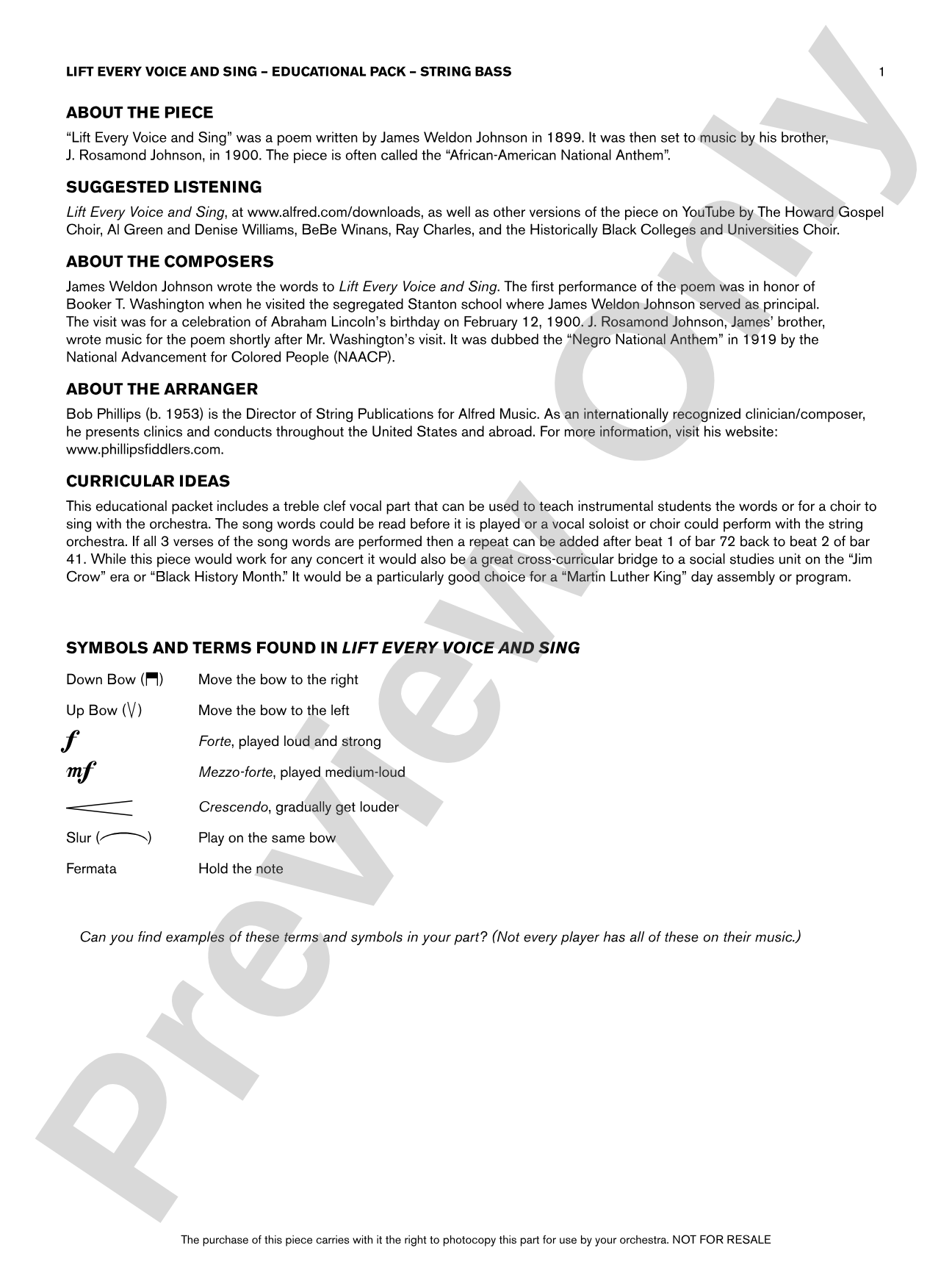
The poem and original hymn-like music of "Lift Every Voice and Sing," by James and J. Rosamond Johnson, reverberate through the decades of the civil rights movement. Originally performed for Booker T. Washington in 1900, it is sometimes called the "African-American National Anthem." This setting, by Bob Phillips, teaches 6/8 and uses chromatic alterations in first position. A vocal lead sheet is included in the reproducible educational packets. The cross-curricular programming possibilities are vast. (2:40)


Don't just read it, hear it, play along with it, and watch your students grow with it. In MakeMusic Cloud, Lift Every Voice and Sing: Bass Educational Pack comes alive with professional accompaniment, adjustable tempo, and built-in practice tools that turn solo practice into real progress.
Open in the Player
Jump straight in and assign it today.
Start Your Free Trial
Open this title and explore the full library in minutes.
Sample Audio
1
Audio File
--:--
0:00
0:00
Sample Video
Additional Details
Series:
Sound Innovations for String Orchestra
Publisher:
Alfred Music
Page Count:
80
SKU:
00-PC-0017344_SB_EDPAK
More about this title
About the Composer: J. Rosamond Johnson
J. Rosamond Johnson (1873–1954) was a composer, lyricist, and performer who shaped American musical culture across multiple genres. Working alongside his brother James Weldon Johnson, he created music that bridged spirituals, folk traditions, and classical forms, composing for both theater and concert hall. His work carried profound social weight; "Lift Every Voice and Sing" became an enduring anthem of dignity and resilience.
Johnson's contributions to American music education extend far beyond this single composition. He understood how music could teach history, embody community values, and reach across cultural boundaries. Educators continue to program his work because it combines accessible musicality with deep historical and social significance, making it a natural choice for orchestras exploring repertoire with meaning.
Why we love this
Bob Phillips's arrangement captures the hymn-like dignity of the original while introducing string orchestras to 6/8 meter and chromatic alterations through music that students care about. Programming this piece opens conversations about American history, civil rights, and the power of collective music-making without feeling like an add-on. It's a substantive, grade-appropriate piece that moves audiences every time.
What to expect
Dignified, hopeful, and grounded in tradition. The hymn-like character gives the piece a quiet power; this is not bombastic but rather contemplative and resilient. The 6/8 meter creates a gentle, almost lilting quality that lifts the melody without losing its strength, while chromatic details add emotional depth to moments of particular weight.
Who it's for
String orchestras at the intermediate level (Grade 2.5) and conductors seeking repertoire with historical and cultural substance. This is ideal for ensembles ready to explore compound meter and chromatic voice-leading without losing musical coherence. It works equally well for students encountering this anthem for the first time and for orchestras building a program centered on American musical heritage.
How to get the most out of it
- Establish the 6/8 pulse early in rehearsals by having the orchestra count and conduct in two, feeling the compound meter as a whole rather than subdividing into triplets.
- Balance the vocal lead line with string accompaniment so that text clarity and emotional weight come through. The melody should never be buried.
- Shape phrases through the chromatic alterations rather than treating them as harmonic complications. These moments deserve slight expressive breathing to honor their emotional function.
- Allow time for students to understand the historical context and the poem's language before rehearsals begin. Musicians who know what they're expressing play with purpose.
How to use it
Feature this as the centerpiece of a concert exploring American voices and civil rights history, pairing it with spirituals, folk arrangements, or contemporary works addressing similar themes. Its length (2:40) makes it substantial enough to stand alone as a concert highlight while remaining accessible enough to anchor a longer school assembly program. The inclusion of a vocal lead sheet opens cross-curricular partnerships with history and English language arts classes.
Skills your students will build
- Reading and maintaining 6/8 meter with consistent pulse
- Playing chromatic alterations in first position with clear intonation
- Balancing accompanying figures with a singing melodic line
- Understanding call-and-response textures and their historical function
- Interpreting music with cultural and historical context