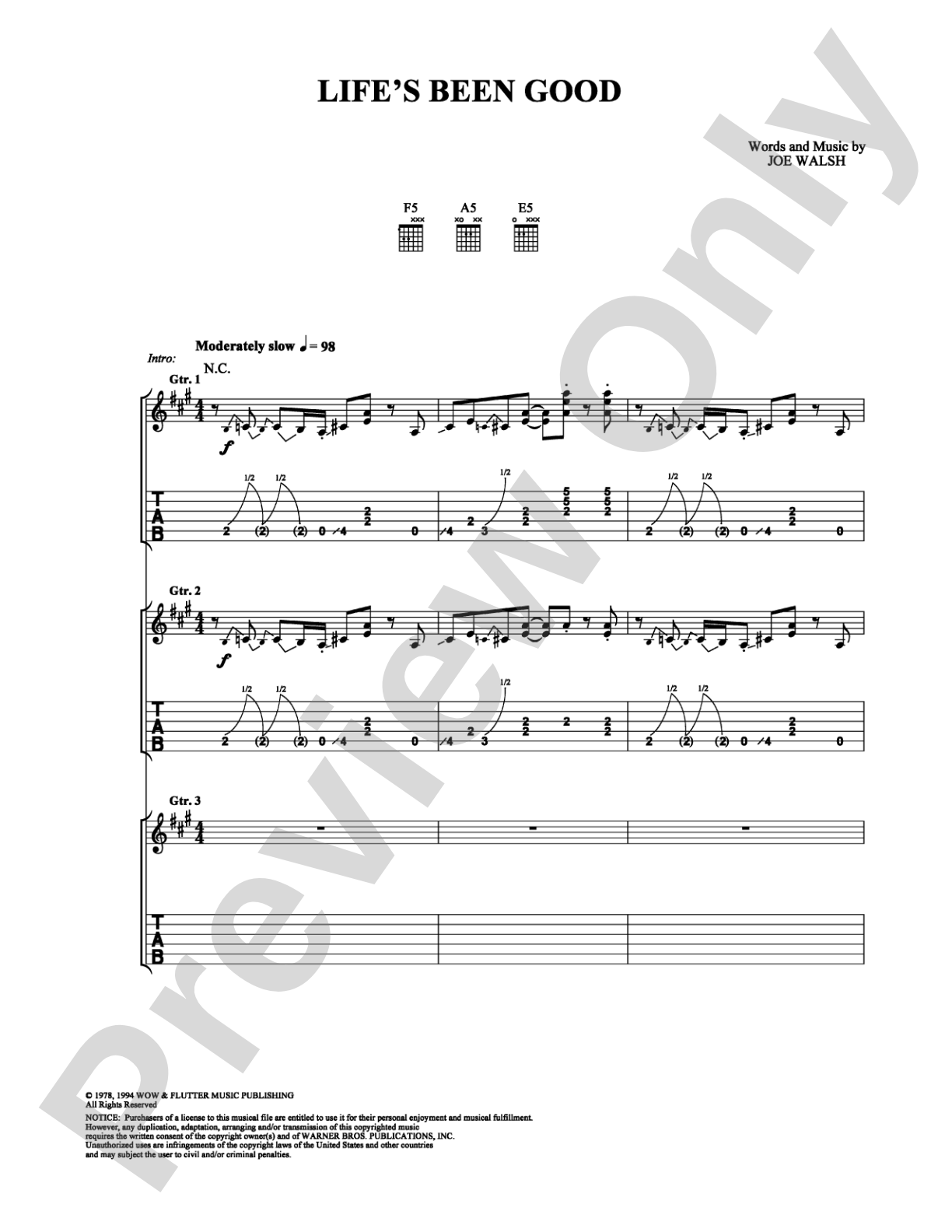
Life's Been Good: Guitar TAB Digital Sheet Music

Life's Been Good: Guitar TAB Digital Sheet Music

Eagles, Joe Walsh

Item: 00-PS-0002349

Digital Download
$2.99
Description

Life's Been Good: Guitar TAB Digital Sheet Music isn't in MakeMusic Cloud just yet...but it could be. Let us know you'd like to see it, and you'll help shape what comes next. In the meantime, start a free trial and dive into thousands of interactive titles your students can play along with today.

Sample Audio
No sample audio found.
Sample Video
Additional Details
SKU: 00-PS-0002349

More about this title

About the Artist: Eagles

The Eagles emerged from the Los Angeles rock scene in the early 1970s and became one of the most commercially successful bands of the decade. Their sophisticated harmonies, layered guitar work, and storytelling lyrics defined an era of rock music that continues to influence musicians across genres. Joe Walsh, who joined the band in 1975, brought a distinctive guitar voice and songwriting sensibility that shaped some of their most enduring hits, including "Life's Been Good."

The Eagles' influence on popular music extends far beyond their chart success. Their approach to arrangement, vocal blend, and instrumental interplay serves as a masterclass in ensemble musicianship, making their catalog valuable for musicians seeking to understand how rock music achieves both commercial appeal and artistic depth.

Why we love this

Joe Walsh's guitar part on this track strikes a perfect balance between rhythmic solidity and melodic personality, making it engaging to learn without requiring virtuosic technique. The TAB format lets guitarists focus immediately on the actual playing and phrasing rather than decoding notation, which keeps the focus on capturing the groove and attitude that define the song. It's a staple of rock guitar education precisely because it sounds great, feels satisfying to play, and rewards attention to touch and timing.

What to expect

Smooth, confident, and propulsive. The rhythm pushes forward with an easy swagger while the lead lines float just above, never straining or overreaching. There's a sense of accomplished ease throughout, as though the player is cruising and enjoying the ride rather than fighting the song. The arrangement captures the song's tongue-in-cheek humor and musical sophistication in equal measure.

Who it's for

Guitarists with solid rhythm guitar fundamentals who are ready to work with a rock standard in a professional arrangement. This works well for intermediate to advanced high school players, college students, and adult hobbyists looking to expand their command of classic rock repertoire. It's equally valuable as a performance piece or a teaching tool for understanding how rock bands balance rhythm, melody, and ensemble texture.

How to get the most out of it

  • Anchor the rhythm section feel by locking into the steady pulse of the kick drum and bass; this song lives in its groove, not in flashy playing
  • Pay close attention to dynamics and space in the rhythm parts; pulling back slightly between phrases creates the swagger that makes this arrangement work
  • Use the recorded version as a reference for tone and attack; the guitar's clarity and slight edge are essential to the character
  • Approach the melody and counter-melody lines with a sense of confidence and ease, matching the laid-back attitude of the lyrical content

How to use it

Program this alongside other rock standards from the 1970s and 1980s to build a set that showcases the era's guitar-driven songwriting and arranging. It works particularly well in a mixed ensemble or jazz combo context where guitarists need credible, recognizable material that stands on its own. Consider it for a rock history unit or as a bridge between classical technique and applied popular music study.

Skills your students will build

  • Reading guitar TAB and translating it to the instrument with accuracy
  • Developing steady rhythm guitar technique with dynamic control
  • Understanding groove and pocket in a rock context
  • Balancing rhythm and melodic responsibility within an ensemble texture
  • Interpreting a well-known recording and making personal choices within its framework

You May Also Like