
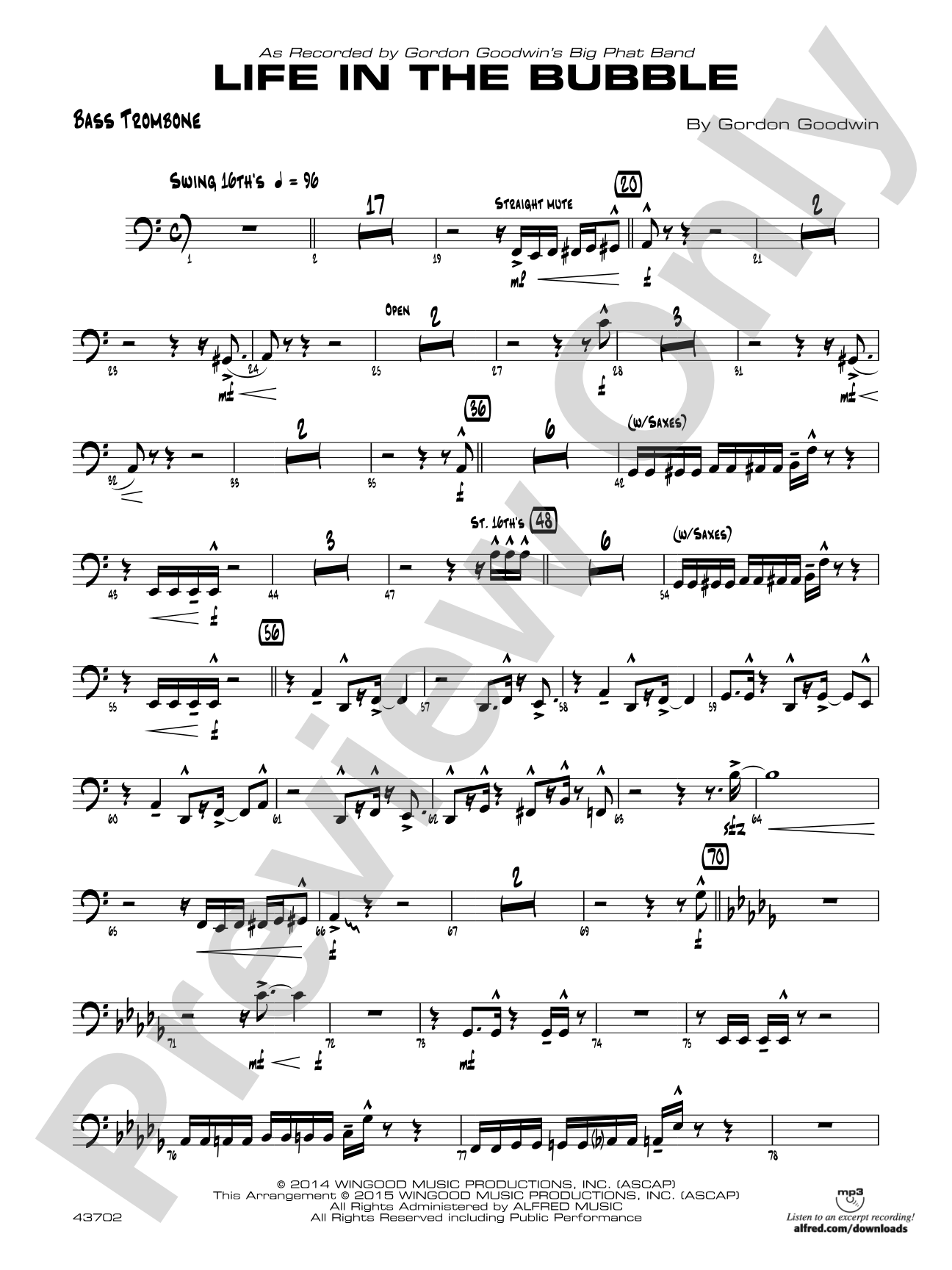

Life in the Bubble: Bass Trombone
As Recorded by Gordon Goodwin's Big Phat Band
By Gordon Goodwin
Grade: 6 (Professional / Very Advanced)
Item: 00-PC-0016831_BTN
$3.00
Pickup currently not available
Description
This is the title track chart from Gordon Goodwin's GRAMMY® Award-winning 2014 CD Life in the Bubble. This plays at around 96 BPM with swing sixteenths. Solo space is provided for all saxes, trumpet 3, and trombone 1. The lead trumpet range is up to written high G, and there is soprano sax lead and a few modulations. Yeah---it's got some tricky spots---but it's worth the work! (2:50)


Don't just read it, hear it, play along with it, and watch your students grow with it. In MakeMusic Cloud, Life in the Bubble: Bass Trombone comes alive with professional accompaniment, adjustable tempo, and built-in practice tools that turn solo practice into real progress.
Open in the Player
Jump straight in and assign it today.
Start Your Free Trial
Open this title and explore the full library in minutes.
Sample Audio
1
Audio File
--:--
0:00
0:00
Sample Video
No sample videos found.
Additional Details
Series:
Gordon Goodwin Series
Publisher:
Alfred Music
Page Count:
78
SKU:
00-PC-0016831_BTN
More about this title
About the Composer: Gordon Goodwin

Gordon Goodwin began composing at five years old, writing complete pieces rather than fragments. By thirteen, he had already created his first big band chart, Hang Loose, signaling the mature voice that would define his career. His work as a film and television composer earned him three Emmy Awards and multiple Grammy nominations, with orchestrations heard in films ranging from Bad Boys II to Remember the Titans. Goodwin has also written for world-class vocalists including Christina Aguilera, Quincy Jones, Mel Tormé, and Ray Charles, performing and recording alongside these artists across decades.
Since founding Gordon Goodwin's Big Phat Band in 2000, he has established himself as a leading figure in contemporary big band jazz. The ensemble's debut album, Swingin' for the Fences, made history as the first commercially available DVD audio release and earned two Grammy nominations. His subsequent albums have continued to garner critical acclaim, with XXL receiving three Grammy nominations including Best Large Jazz Ensemble Album. Today, Goodwin conducts his own ensemble while maintaining an active presence in film scoring and orchestral conducting with major symphony orchestras internationally.
Why we love this
This is the title track from a Grammy-winning album, which means you're teaching a piece that has already proven itself in the professional jazz world. Goodwin's writing here balances accessibility with sophistication; the chart demands serious chops but rewards the ensemble with genuinely exciting music that audiences recognize and respect. The solo opportunities scattered throughout keep every section engaged, and the modulations and high-register writing give your advanced players something substantial to sink their teeth into.
What to expect
Sleek, energetic, and sophisticated. The piece moves with the confidence of a working big band; it swings hard, features soloists generously, and carries the polish of someone who writes for film studios and Grammy-winning ensembles. There's an upbeat wit to the orchestration alongside moments of genuine musicality.
Who it's for
Advanced jazz ensembles with strong lead trumpet and saxophone sections ready for professional-level writing. This score and parts suit festival and contest contexts, and work best with groups that have serious experience with swing feel and jazz articulation.
How to get the most out of it
- Lock in the swing sixteenths from the top. This feel drives everything; nail it in sectionals before bringing sections together, and revisit it regularly throughout rehearsals since it can slip when players focus on the written passages.
- Balance the soprano sax lead against the ensemble. The range sits high, so work for clarity without forcing volume; the writing is intricate enough that precision matters more than power.
- Give soloists space to breathe during their features. Mark those sections lightly in ensemble writing so the rhythm section can support the soloist without overplaying, and ensure rhythm section players know the form cold so they can respond to tempo and phrasing choices.
- Address the modulations in context, not just as technical exercises. Play through to the modulation points in rehearsal so the ensemble hears where the key center shifts and understands the musical purpose, not just the mechanics.
How to use it
Program this as a concert opener or centerpiece for a jazz festival or spring big band concert. The length (2:50) and professional pedigree make it especially strong for competitive festival contexts, and it pairs well with other contemporary big band writing. It also serves as an excellent benchmark for groups working toward a higher performance standard.
Skills your students will build
- Swing sixteenth-note feel and articulation at tempo
- Reading and executing modulations in real time
- Solo construction in jazz idiom across multiple instruments
- Lead trumpet range extension and control up to written high G
- Ensemble balance when featuring soloists against ensemble backgrounds
- Professional big band interpretation and style awareness