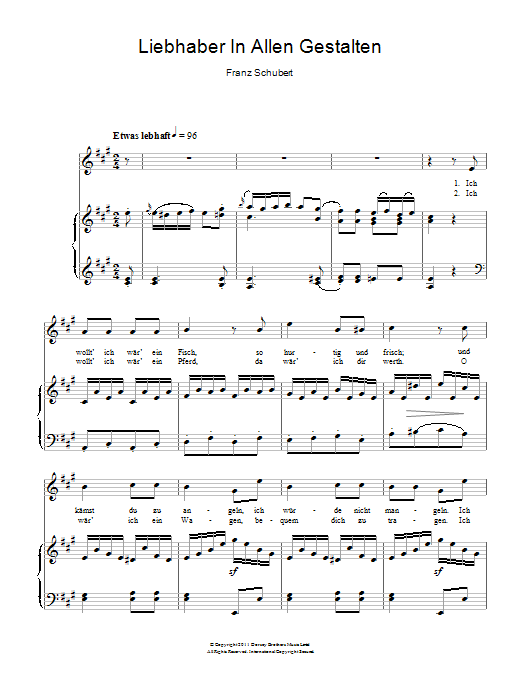
Liebhaber In Allen Gestalten Sheet Music Preview

Liebhaber In Allen Gestalten: Piano Vocal

As performed by Franz Schubert

Item: 35-DS00205453

Digital Download
$5.99
Description

Liebhaber In Allen Gestalten: Piano Vocal isn't in MakeMusic Cloud just yet...but it could be. Let us know you'd like to see it, and you'll help shape what comes next. In the meantime, start a free trial and dive into thousands of interactive titles your students can play along with today.

Sample Audio
No sample audio found.
Sample Video
Additional Details
Publisher: Hal Leonard
Page Count: 2
SKU: 35-DS00205453

More about this title

About the Artist: Franz Schubert

Franz Schubert (1797-1828) composed nearly 600 lieder, a body of work that redefined the art song and elevated the German vocal tradition to one of the highest forms of musical expression. His gift for melody and harmonic innovation allowed him to match music to text with unprecedented sensitivity, often discovering profound emotional depths in simple poems. For singers and pianists, his songs remain central to the repertoire because they balance technical accessibility with interpretive richness.

Why we love this

This lied showcases Schubert's ability to capture shifting emotional states within a compact form, making it rewarding for singers who thrive on nuance and pianists who can shape the accompaniment as an equal partner. The piece works beautifully in mixed recital programs or voice studio settings where interpretive freedom is valued over spectacle.

What to expect

The song unfolds with a sense of intimate reflection, drawing the listener into a private emotional space where every harmonic gesture and textural shift carries meaning. There is both elegance and vulnerability in the writing, creating an atmosphere suited to quiet, attentive concert settings.

Who it's for

Advanced high school singers and college vocalists preparing recital repertoire or studying the German lied tradition. Pianists looking for intimate chamber repertoire that demands both technical fluency and expressive sophistication will find the accompaniment equally satisfying.

How to get the most out of it

  • Shape the vocal line with attention to the text's emotional arc rather than relying on dynamic markings alone; Schubert's understatement often carries more weight than obvious gestures.
  • Balance the piano accompaniment so it supports without overwhelming; the relationship between voice and keyboard is conversational, not subordinate.
  • Explore the harmonic shifts carefully during rehearsal, as Schubert's key relationships often signal psychological turning points in the text.

How to use it

Pair this with other Schubert songs to create a thematic recital exploring love, desire, or transformation, or perform it alongside other German lieder from the 19th century as part of a voice student's required repertoire. It also serves as an excellent teaching tool in studio lessons for developing interpretive independence and collaborative ensemble work between singer and pianist.

Skills your students will build

  • Text declamation in German with clear diction and expression
  • Collaborative listening and balance between voice and piano
  • Harmonic analysis and understanding Schubert's chromatic language
  • Shaping extended vocal phrases across multiple harmonic regions
  • Interpretive choices based on textual meaning rather than traditional markings

You May Also Like