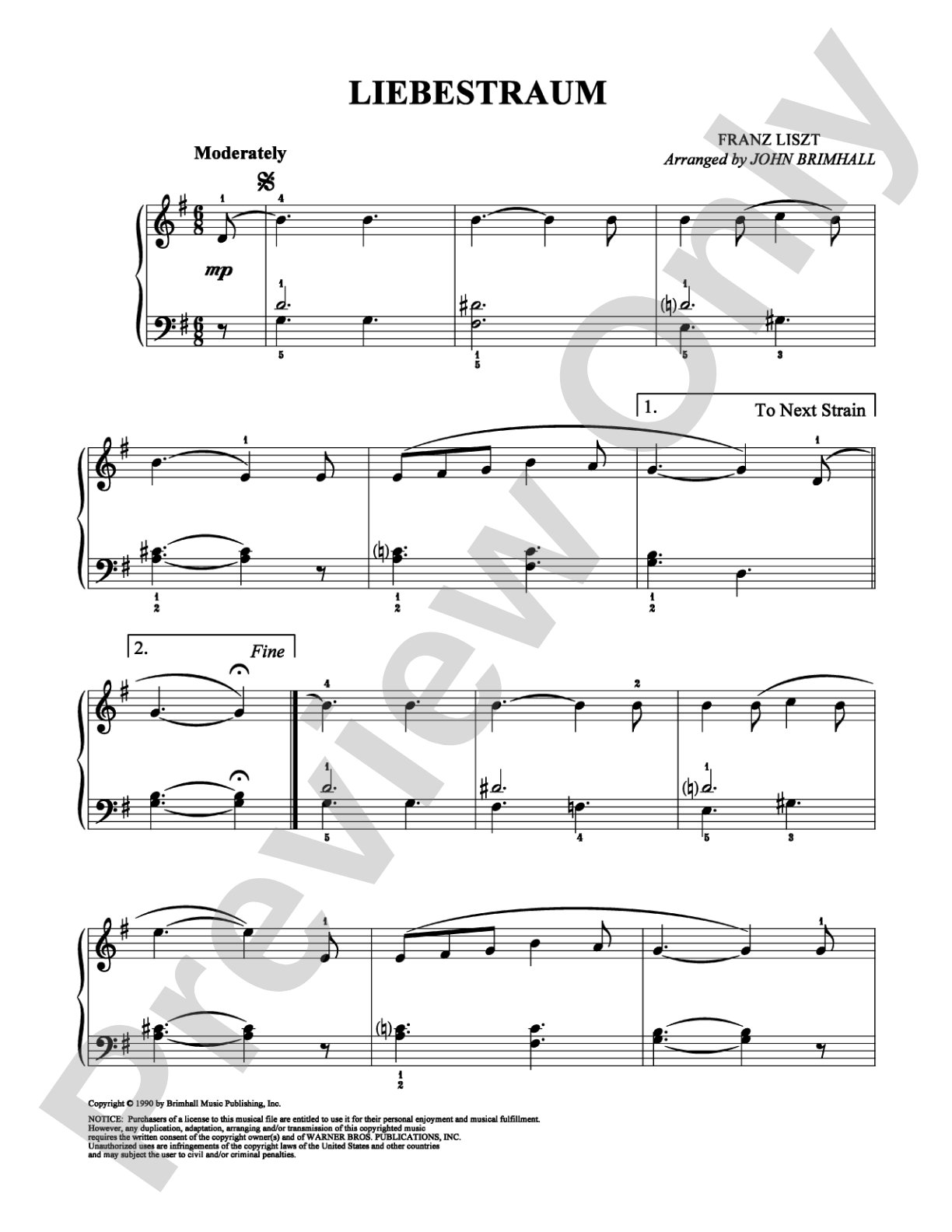
Liebestraum: Easy Piano Digital Sheet Music

Liebestraum: Easy Piano Digital Sheet Music

Franz Liszt

Item: 00-PS-0006772

Digital Download
$3.99
Description

Liebestraum: Easy Piano Digital Sheet Music isn't in MakeMusic Cloud just yet...but it could be. Let us know you'd like to see it, and you'll help shape what comes next. In the meantime, start a free trial and dive into thousands of interactive titles your students can play along with today.

Sample Audio
No sample audio found.
Sample Video
Additional Details
SKU: 00-PS-0006772

More about this title

About the Creator: Franz Liszt

Franz Liszt (1811, 1886) was a Hungarian virtuoso pianist and composer who fundamentally changed what the instrument could do. His technical innovations and romantic sensibility made him one of the most influential musicians of the nineteenth century. Liebestraum ("Dream of Love") represents a different side of Liszt than his showpiece concertos, it's introspective and lyrical, written for pianists who want to explore singing tone and emotional depth rather than technical fireworks.

Why we love this

This arrangement preserves the piece's emotional arc while removing the hand-crossing and octave stretches that intimidate developing pianists. Students encounter Liszt's actual voice here, not a dumbed-down version; the melody unfolds with the same romantic yearning that made this piece beloved for 150 years.

What to expect

Liebestraum unfolds like a confessional, intimate and unhurried, with a melody that seems almost to sing itself. The harmonies move gently underneath, supporting the narrative without demanding attention. There's a sweetness here that never tips into sentimentality, just earnest expression wrapped in beautiful sound.

Who it's for

Pianists at the easy intermediate level who are ready to tackle Romantic repertoire but need an accessible entry point. This works for students preparing their first art song arrangement or anyone seeking pieces that sound more advanced than they actually play.

How to get the most out of it

  • Shape the opening melody as a single continuous phrase, even across the bar lines. Resist the urge to breathe at every natural punctuation.
  • Control the pedal carefully in the accompaniment figures so the harmonies blur expressively without muddying the melody line.
  • Let the tempo breathe slightly during the phrase peaks, then settle back to a gentle forward motion in the quieter passages.
  • Balance the dynamic arch so that the warmth builds gradually toward the middle section without forcing the tone.

How to use it

Pair this with other accessible Romantic works in a student recital, or use it as a bridge piece that introduces listeners to Liszt beyond his more virtuosic works. It also serves well as a gentle encore or as part of a thematic program exploring love songs across different musical periods.

Skills your students will build

  • Sustaining long melodic lines with consistent tone and direction
  • Balancing melody against accompanimental texture
  • Using pedal expressively to enhance harmonic color
  • Shaping Romantic-era phrasing and rubato
  • Reading and interpreting dynamic and expressive markings

You May Also Like