
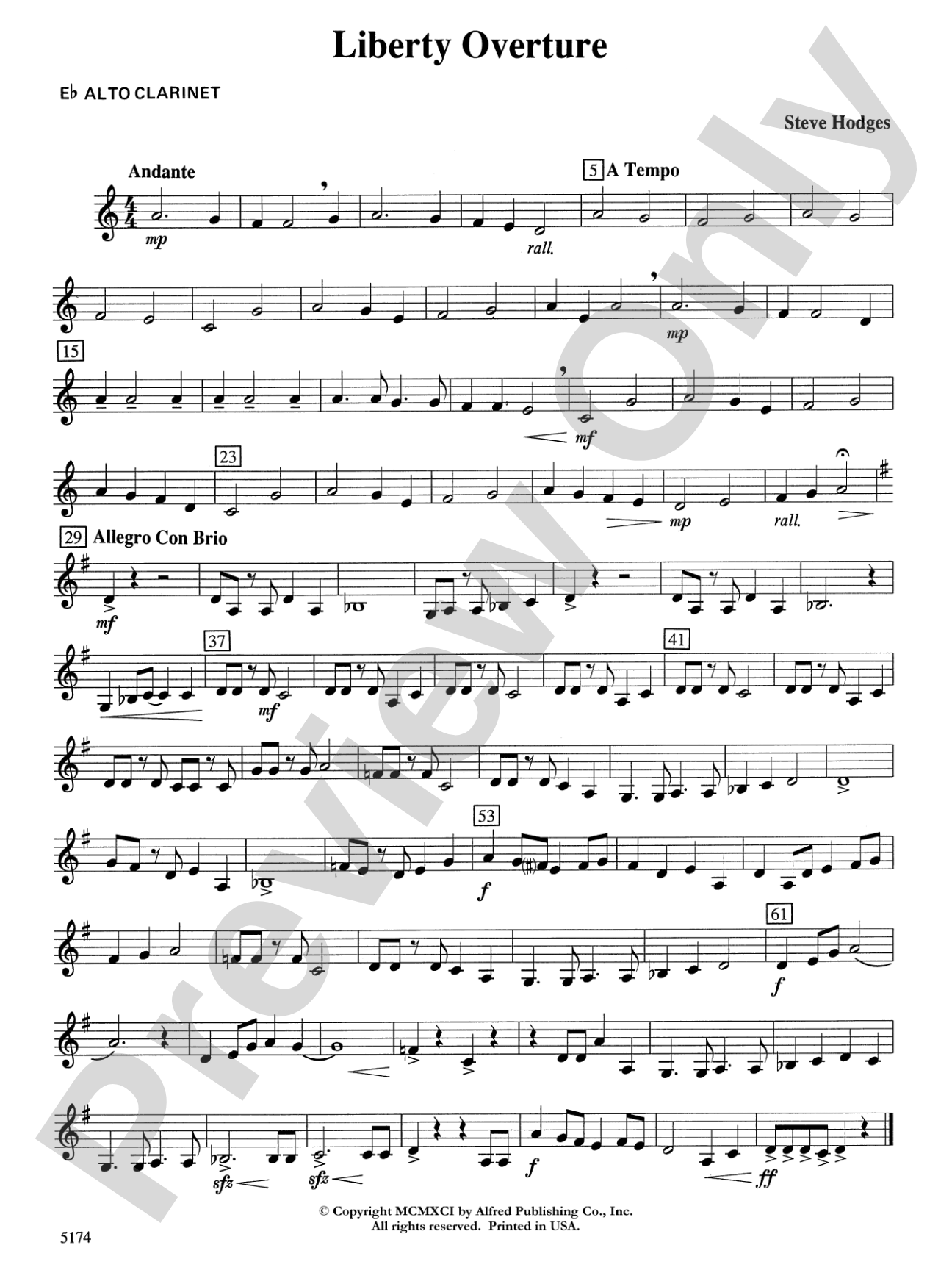

Liberty Overture: E-flat Alto Clarinet
Music by Steve Hodges
Grade: 1.5 (Easy)
Item: 00-PC-0001880_AC1
$3.00
Pickup currently not available
Description
This work opens with an Andante section that features a haunting minor melody played by clarinets, a strong low brass bass line and assorted counterlines that offer interesting contrast. Cornets repeat the melody that leads to a rallentando pause; a fast-tempo variation emerges. This second upbeat section is in a new key and features the melody played by cornets, then by low brass and woodwinds, over syncopated tutti rhythmic figures. (Grade 1 1/2)


Don't just read it, hear it, play along with it, and watch your students grow with it. In MakeMusic Cloud, Liberty Overture: E-flat Alto Clarinet comes alive with professional accompaniment, adjustable tempo, and built-in practice tools that turn solo practice into real progress.
Open in the Player
Jump straight in and assign it today.
Start Your Free Trial
Open this title and explore the full library in minutes.
Sample Audio
1
Audio File
--:--
0:00
0:00
Sample Video
No sample videos found.
Additional Details
Series:
Contempo Series
Publisher:
Alfred Music
Page Count:
1
SKU:
00-PC-0001880_AC1
More about this title
About the Composer: Steve Hodges

Steve Hodges holds degrees from Western Oregon University (Bachelor of Science) and Central Washington University (Master of Music Education). Over four decades as a public school music director, he led bands, choirs, and ensembles at all levels before retiring from classroom teaching.
Since 1986, Hodges has composed more than 120 concert band works published by Alfred Music, along with choral arrangements for Staff Music and Shawnee Press. His compositions have appeared at festivals and state conventions worldwide, commissioned by honor bands and schools across Virginia, Iowa, British Columbia, Oregon, Washington, and North Carolina. His music has also been featured on TBS and ESPN broadcasts. A member of ASCAP with multiple awards to his name, Hodges now lives in The Dalles, Oregon, where he continues supporting community music alongside his family of five children and ten grandchildren, several of whom perform his works in their school bands.
Why we love this
Liberty Overture nails the balance between accessibility and musicianship that Grade 1.5 programs need. The architecture is smart: the opening minor melody in clarinets creates genuine atmosphere without technical demands, while the syncopated tutti section in the faster second half gives your full ensemble a chance to lock in together. Directors consistently program Hodges for this exact quality—straightforward to teach, rewarding to perform, and genuinely musical from measure one.
What to expect
Liberty Overture opens with contemplative intensity, its minor melody unfolding over a solid harmonic foundation that feels both respectful and grounded. The second half bursts into brightness and forward motion, driven by syncopated tutti rhythms that turn the full ensemble into a unified voice.
Who it's for
This overture fits Grade 1.5 bands with developing rhythmic control and basic harmonic reading. It works equally well for first-year students expanding beyond march repertoire and for established groups looking for a patriotic work that doesn't demand advanced technique. The single-page length makes it ideal for programs with limited rehearsal time.
How to get the most out of it
- Shape the opening Andante as a true melody moment. The clarinet line carries the emotional weight here, so encourage consistent phrasing and a warm tone rather than rushing the section despite its haunting character.
- Balance the cornet melody against the low brass bass line and counterlines during the first section. These inner voices add textural interest, so bring them forward slightly in rehearsal to let students hear how the parts interact.
- Lock the tempo transition at the rallentando pause. Mark it clearly in parts so the section knows exactly where the tempo shift lands; this moment defines the energy pivot into the fast section.
- Emphasize the syncopated rhythmic figures under the faster melody. These tutti figures give the piece its forward momentum, so drilling the rhythm section (low brass and percussion) tight will lift the entire ensemble.
How to use it
Program this as the second or third piece in a patriotic concert, where it can follow a march and precede a larger work. The overture format and emotional range also make it effective for fall festival programming or as a closing selection on a concert that emphasizes American works.
Skills your students will build
- Playing sustained minor melodies with consistent tone and phrasing
- Reading syncopated rhythmic figures in tutti textures
- Balancing melodic and harmonic voices within a four-part texture
- Executing tempo transitions and rallentando moments with ensemble control
- Understanding overture form and sectional architecture