
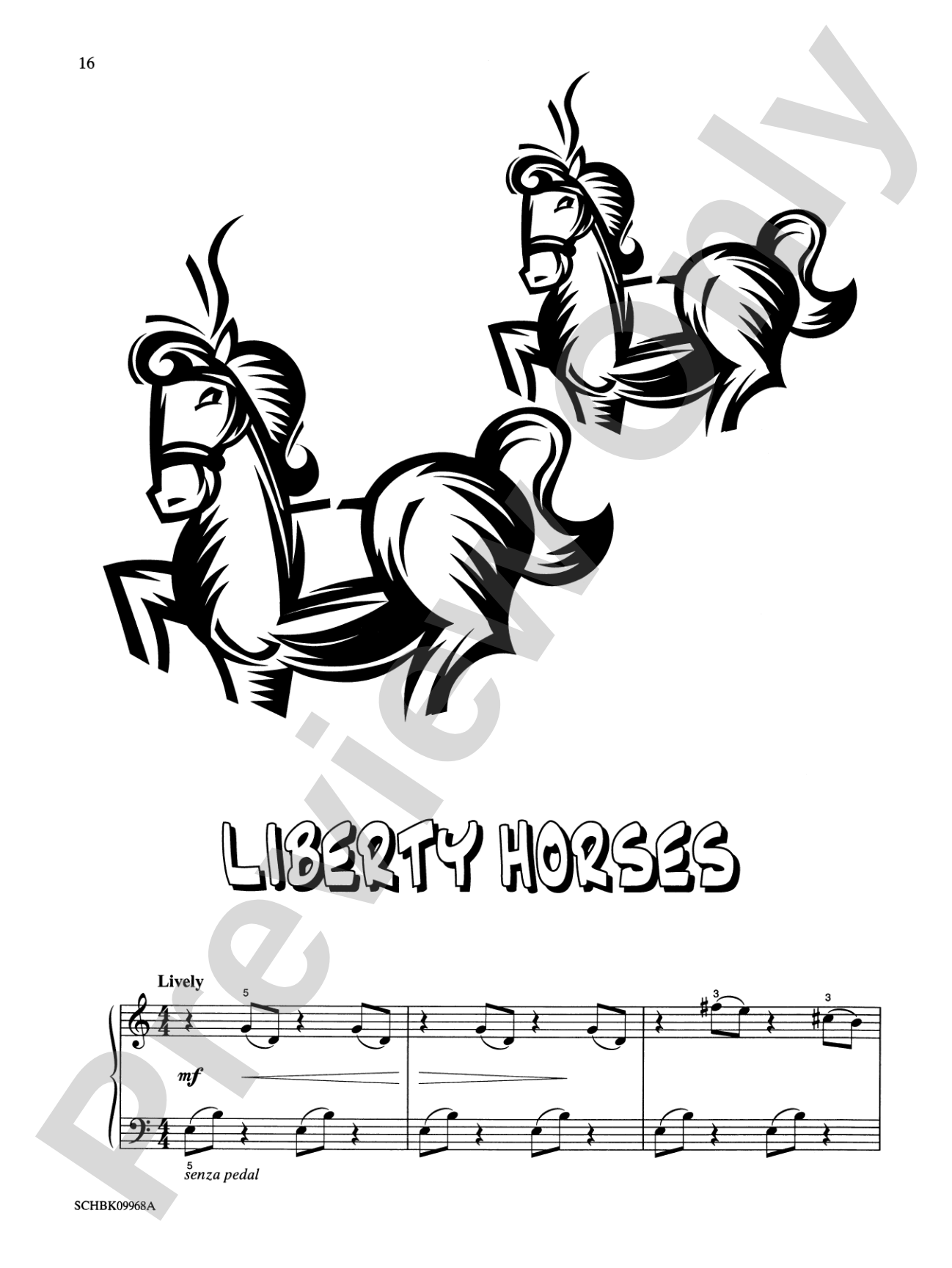

Liberty Horses - Piano Solo: Piano Solo
6 Original Solos for Intermediate-Level Pianists
By Lynn Freeman Olson
Level: Intermediate
Item: 00-PS-0017591
$4.99
Pickup currently not available
Description
Circus! is fondly dedicated to Richard Barstow, the fabulous showman whose magic touch puts the razzle and dazzle into "The Greatest Show on Earth." For many years he has staged, directed and choreographed the Ringling Brothers-Barnum and Bailey Circus with a stunning flair for lavish spectacle. Lynn Freeman Olson now stages the circus in this musical tribute to some of the most challenging feats in the world of entertainment. Included are: Brassy Band * Capering Clowns * The Ballerina of the Silver Thread * Fancy Flying * Ponderous Pachyderms * Liberty Horses. A Federation Festivals 2024-2028 selection.


Liberty Horses - Piano Solo: Piano Solo isn't in MakeMusic Cloud just yet...but it could be. Let us know you'd like to see it, and you'll help shape what comes next. In the meantime, start a free trial and dive into thousands of interactive titles your students can play along with today.
Request This Title
Tell us you want it.
Start Your Free Trial
Explore everything that's ready to play right now.
Sample Audio
No sample audio found.
Sample Video
No sample videos found.
Additional Details
Publisher:
Alfred Music
Page Count:
24
SKU:
00-PS-0017591
More about this title
About the Composer: Lynn Freeman Olson
Lynn Freeman Olson built a career writing accessible, imaginative music for young pianists and student ensembles. Her gift for narrative composition, pieces that tell stories and paint vivid scenes, made her a staple of festival competitions and music school curricula from the 1970s onward. Olson understood that intermediate students thrive when given music that sparks their imagination while respecting their technical limitations.
Her body of work spans piano solos, vocal selections, and band arrangements, all crafted with a keen ear for what engages students without overwhelming them. Olson's pieces frequently appear on state festival lists, a testament to their durability and pedagogical soundness.
Why we love this
This collection does what great program music should: it transports you without requiring virtuosic technique. Each movement stands alone brilliantly, so you can program individual pieces throughout the year or build an entire recital around the full suite. The writing captures genuine humor and spectacle, clowns actually feel bumbling, the ballerina floats, while keeping the technical demands reasonable enough that students focus on character and color rather than mechanics.
What to expect
Colorful, playful, and surprisingly vivid. You move from the brassy swagger of the opening band to the mischievous chaos of the clowns, then drift into the ethereal beauty of a tightrope walker before shifting to the thundering majesty of elephants and finally the spirited dash of the liberty horses. There's genuine drama beneath the whimsy, and every movement lingers with its own distinct mood.
Who it's for
Intermediate pianists who enjoy narrative-driven music and aren't yet ready for serious romantic or contemporary concert works. This collection engages students who respond to imagery and storytelling, making it ideal for recitals, festival competitions, or as a bridge between early-intermediate method books and more demanding solo literature.
How to get the most out of it
- Treat each movement as its own short story with a distinct personality. Spend rehearsal time building the character of each section before worrying about tempo or dynamics.
- The descriptive titles are not decoration; let them guide your interpretive choices. Research images of a circus or watch performance footage to ground your understanding of each scene.
- Listen for moments where simplicity becomes powerful. Olson often uses sparse textures and repetition to build mood; resist the urge to over-interpret or add unnecessary complexity.
- Balance rhythmic precision with theatrical freedom. Many passages need a steady pulse, but others benefit from slight rubato or phrase-shaping that lets the narrative breathe.
How to use it
Program "Liberty Horses" as a finale or standalone showstopper in a student recital, pairing it with classical sonatina movements for contrast. Alternatively, weave individual movements into thematic concerts (a "Circus Night" recital, a "Music of the Imagination" series) or use the full suite as a capstone recital piece for a solid intermediate student. This works beautifully in festival settings where judges appreciate pieces that balance technical accessibility with genuine musical substance.
Skills your students will build
- Rhythmic precision within varied time signatures and changing meters
- Character expression through articulation, dynamics, and tempo variation
- Hand independence and coordination across register shifts
- Phrasing and shaping of lyrical passages (the ballerina section)
- Reading descriptive scores and translating narrative into musical choices