Libertango Sheet Music Preview

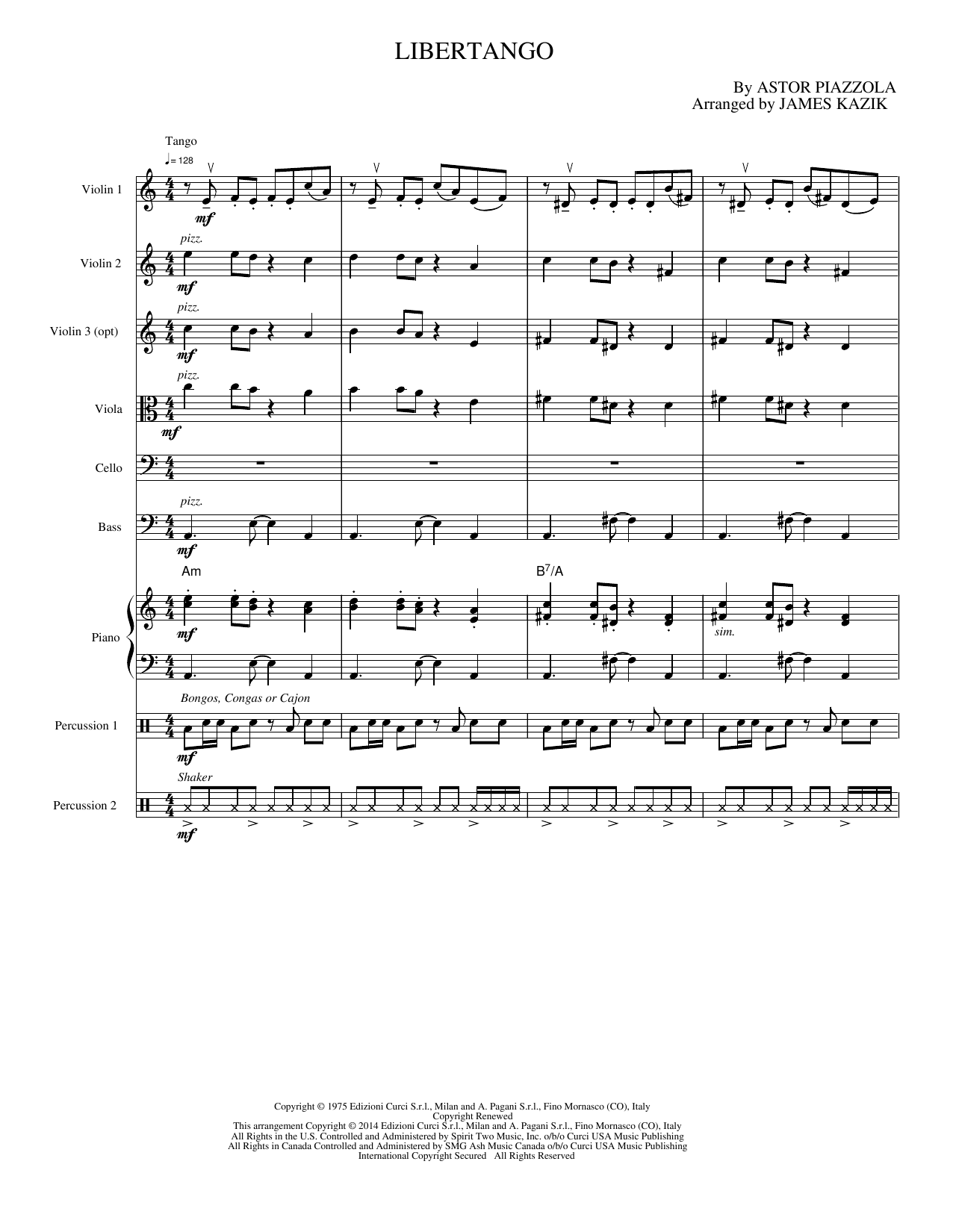
Libertango: String Orchestra Conductor Score & Parts

By Astor Piazzolla / Arranged by James Kazik

Grade: 3-4

Item: 35-PK00426383

Digital Download
$55.00

Buy Extra Parts (Digital PDF Download)

Product Price Quantity
Libertango - Full Score $55.00

Parts Added to Cart!

Description
Libertango

Libertango: String Orchestra Conductor Score & Parts isn't in MakeMusic Cloud just yet...but it could be. Let us know you'd like to see it, and you'll help shape what comes next. In the meantime, start a free trial and dive into thousands of interactive titles your students can play along with today.

Sample Audio
No sample audio found.
Sample Video
Additional Details
Publisher: Hal Leonard
SKU: 35-PK00426383

More about this title

About the Composer: Astor Piazzolla

Astor Piazzolla (1921–1992) revolutionized tango by fusing it with classical forms, jazz harmonies, and modernist techniques. Born in Argentina and trained in composition under Nadia Boulanger in Paris, he rejected the notion that tango belonged only to dance halls and nightclubs, insisting it deserved concert stages worldwide.

Piazzolla's compositional approach transformed how string players and wind musicians understood rhythmic vitality and harmonic sophistication. His works demand technical precision alongside interpretive sensitivity, making them invaluable for students learning that virtuosity and musicality are inseparable.

Why we love this

Libertango cuts through the standard string orchestra repertoire with genuine rhythmic swagger and harmonic bite. Your students will hear themselves as musicians the moment the bass line locks in, and that feeling of ensemble cohesion becomes instantly audible and deeply satisfying. The arrangement preserves Piazzolla's signature intensity while remaining accessible to developing orchestras.

What to expect

Libertango burns with restless intensity and sardonic elegance. The opening feels like stepping into a crowded Buenos Aires café where passion and precision coexist; textures alternate between intimate and explosive, and a subtle melancholy threads through even the most rhythmically exuberant moments. This is music that moves.

Who it's for

String orchestras at the intermediate level seeking repertoire that sounds professional and energetic without requiring advanced technical chops. Conductors wanting to program music from outside the European classical canon will find students remarkably engaged by tango's infectious rhythmic clarity. This is ideal for groups ready to explore extended tonality and syncopated figures without the complexity of full contemporary scoring.

How to get the most out of it

  • Keep the rhythm section (cellos and basses) locked tightly to the underlying tango pulse; any looseness in their coordination destabilizes the entire texture.
  • Balance the melody across first violins and second violins according to Piazzolla's part writing rather than defaulting to traditional tutti strength.
  • Shape the phrasing with forward harmonic motion rather than sitting on each chord; tango thrives on mild tension and release, not static warmth.
  • Attend to the bracketed divisi passages in the middle voices; clear separation between upper and lower string parts reveals the orchestration's sophistication.

How to use it

Pair Libertango with shorter classical works to create a concert that juggles tradition and reinvention, or program it as a second-half opener to reset audience energy after intermission. Many directors use it as the anchor of a Latin music thematic program, pairing it with Copland or contemporary pieces drawing from similar wellsprings. It also works beautifully in a showcase concert where multiple ensemble levels perform, because the piece translates convincingly at different technical capacities.

Skills your students will build

  • Reading and executing syncopated rhythmic figures in tango context
  • Balancing independence in divided string parts while maintaining ensemble blend
  • Responding to asymmetrical phrasing that resists four and eight-bar regularity
  • Intonation control in chromatic passages and chromatic voice leading
  • Ensemble coordination around a strong rhythmic pulse without metronomic rigidity

You May Also Like