
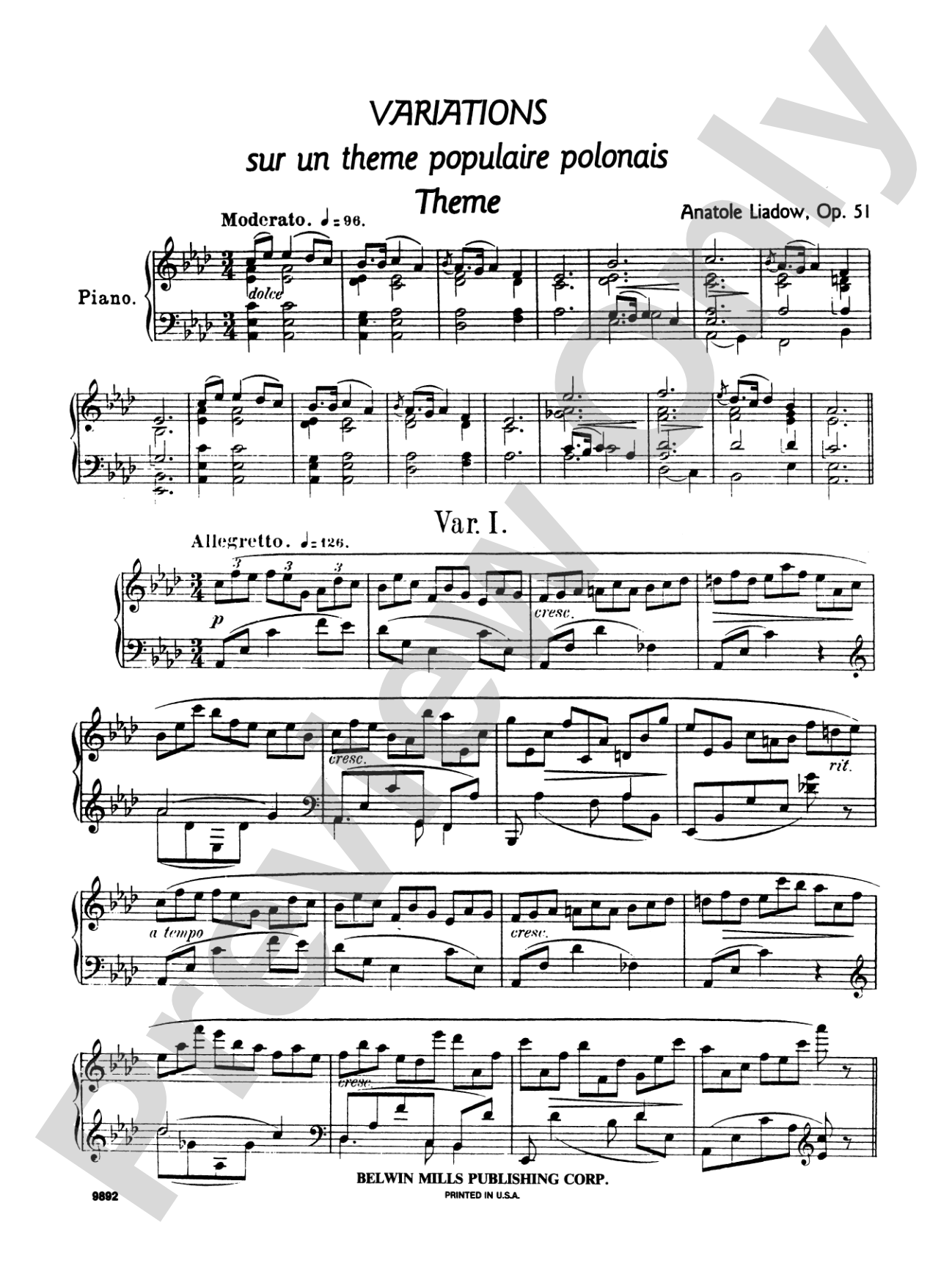

Liadov: Variations sur un Theme Populaire Polonais: Piano
By Anatol Liadov
Item: 00-PK-0003891

$7.99
Pickup currently not available
Buy Extra Parts (Digital PDF Download)
Parts Added to Cart!
Related Items
Variations sur un theme populaire Polonais, Opus 51: Piano |
$7.95
|
View |
Description


Don't just read it, hear it, play along with it, and watch your students grow with it. In MakeMusic Cloud, Liadov: Variations sur un Theme Populaire Polonais: Piano comes alive with professional accompaniment, adjustable tempo, and built-in practice tools that turn solo practice into real progress.
Open in the Player
Jump straight in and assign it today.
Start Your Free Trial
Open this title and explore the full library in minutes.
Sample Audio
No sample audio found.
Sample Video
No sample videos found.
Additional Details
Series:
Kalmus Edition
Publisher:
Alfred Music
Page Count:
20
SKU:
00-PK-0003891
More about this title
About the Composer: Anatol Liadov
Anatol Liadov (1855, 1914) was a Russian composer and conductor whose gift for orchestration and harmonic refinement made him a master of the miniature form. Though his output was modest, he was famously slow to complete works, every piece reveals meticulous craftsmanship and a deep connection to Russian musical traditions. His piano works demonstrate the same sophistication in texture and color that distinguished his orchestral scores.
Liadov's variations explore folk material with the refined sensibility of a late Romantic craftsman. Rather than showcase virtuosity for its own sake, his approach to variation form emphasizes subtle harmonic shifts, delicate textural transformations, and an almost impressionistic treatment of melodic material. This restraint and elegance make his works invaluable for pianists seeking substance beyond technical display.
Why we love this
Variations on folk themes sit at the heart of the Romantic piano repertoire, yet many standard examples feel predictable or overly virtuosic. Liadov's treatment of this Polish melody proves that architectural clarity and emotional depth need not sacrifice structural interest. Each variation unfolds logically, revealing new harmonic and textural possibilities without straining the pianist's technique, a rare balance that rewards both performer and listener.
What to expect
The opening melody feels intimate and songlike, almost like overhearing a folk tune transformed through a sophisticated musical lens. As variations accumulate, harmonic color deepens and textures multiply, yet the music never loses its sense of restraint and refinement, more interior monologue than public declaration.
Who it's for
Intermediate to advanced pianists seeking substantial repertoire beyond the standard Romantic cycle. This work rewards players who have secured solid technique and can balance structural awareness with expressive sensitivity. It appeals to pianists interested in Russian music and variation form as a compositional strategy.
How to get the most out of it
- Track how the theme transforms across each variation; resist playing them as isolated sections. The arc from simple statement to elaborate development should feel inevitable, not episodic.
- Balance clarity in the melody against the harmonic and textural enrichment in the accompaniment. Many students bury the tune under busy figuration.
- Listen for the brief moments of repose between variations. Liadov uses silence and simplicity strategically to reset the listener's ear before introducing the next layer of complexity.
- Shape individual variations by their harmonic rhythm, not just tempo. Some sections breathe more spaciously than others despite similar note patterns.
How to use it
Program this alongside other Russian piano works of the period to build a thematic concert. Alternatively, pair it with Brahms or Dvořák variations to create a study in how different composers approach the same form. It works well in a recital focused on 19th-century nationalism or as a centerpiece in a solo program demonstrating technical and musical maturity.
Skills your students will build
- variation form recognition and structural coherence
- maintaining melodic prominence across changing accompaniment textures
- harmonic analysis and functional tonality in extended passages
- independence between hands in dense, polyphonic writing
- phrasing and articulation choices that clarify theme transformation