Lewis Bridal Song Sheet Music Preview

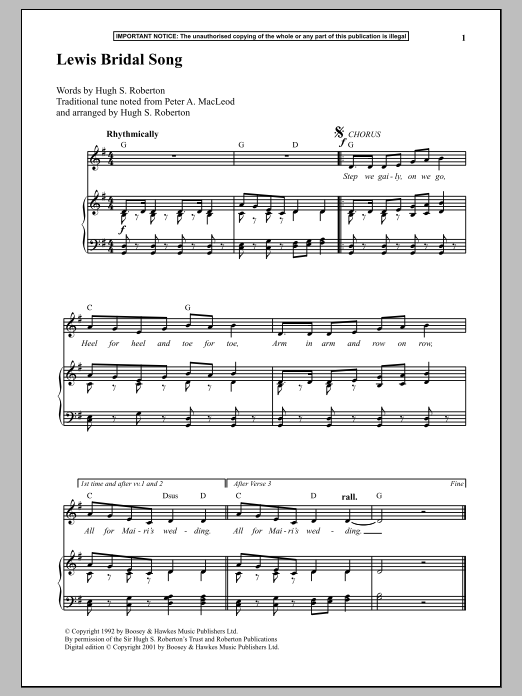
Lewis Bridal Song: Piano Vocal

As performed by Hugh S. Roberton

Item: 35-DS00236467

Digital Download
$5.99
Description

Lewis Bridal Song: Piano Vocal isn't in MakeMusic Cloud just yet...but it could be. Let us know you'd like to see it, and you'll help shape what comes next. In the meantime, start a free trial and dive into thousands of interactive titles your students can play along with today.

Sample Audio
No sample audio found.
Sample Video
Additional Details
Publisher: Hal Leonard
Page Count: 2
SKU: 35-DS00236467

More about this title

About the Artist: Hugh S. Roberton

Hugh S. Roberton (1874-1952) was a Scottish musician and conductor whose deep roots in traditional music shaped his approach to folk song arrangement. He founded the Glasgow Orpheus Choir in 1906 and became known for preserving and adapting Scottish songs with both scholarly respect and practical musicality for singers of all levels.

Roberton's gift lay in recognizing which traditional melodies could sustain simple, elegant harmonization without losing their character. His arrangements remain staples in choral and vocal programs because they honor the songs' origins while making them accessible to amateur musicians.

Why we love this

Roberton's setting treats this traditional Scottish bridal song with restraint and warmth. The piano writing supports rather than overshadows the vocal line, creating space for genuine expression while the two-page format makes it manageable for singers building confidence with art song repertoire.

What to expect

A moment of quiet reflection, intimate and heartfelt. The melody unfolds naturally with Roberton's uncluttered accompaniment, creating space for the emotional weight of the text to emerge without melodrama.

Who it's for

Intermediate vocalists exploring art song and traditional music, secondary choral programs seeking accessible solos with cultural substance, and voice students developing control in slower tempos.

How to get the most out of it

  • Observe the natural speech rhythms of the text; let phrase shapes follow the vowel flow rather than mechanical note values
  • Balance the voice forward in the overall texture, particularly in passages where the piano fills underneath
  • Explore the emotional arc across the entire two pages rather than treating individual phrases in isolation

How to use it

Pair this with other settings of traditional songs to explore how different arrangers approach similar material, or feature it as a solo in a concert celebrating Scottish heritage. Its compact length also makes it valuable as a recital opener.

Skills your students will build

  • Sustaining long vocal lines with consistent tone production
  • Coordinating with piano accompaniment in a transparent texture
  • Interpreting text underlay and phrasing in traditional melody

You May Also Like