
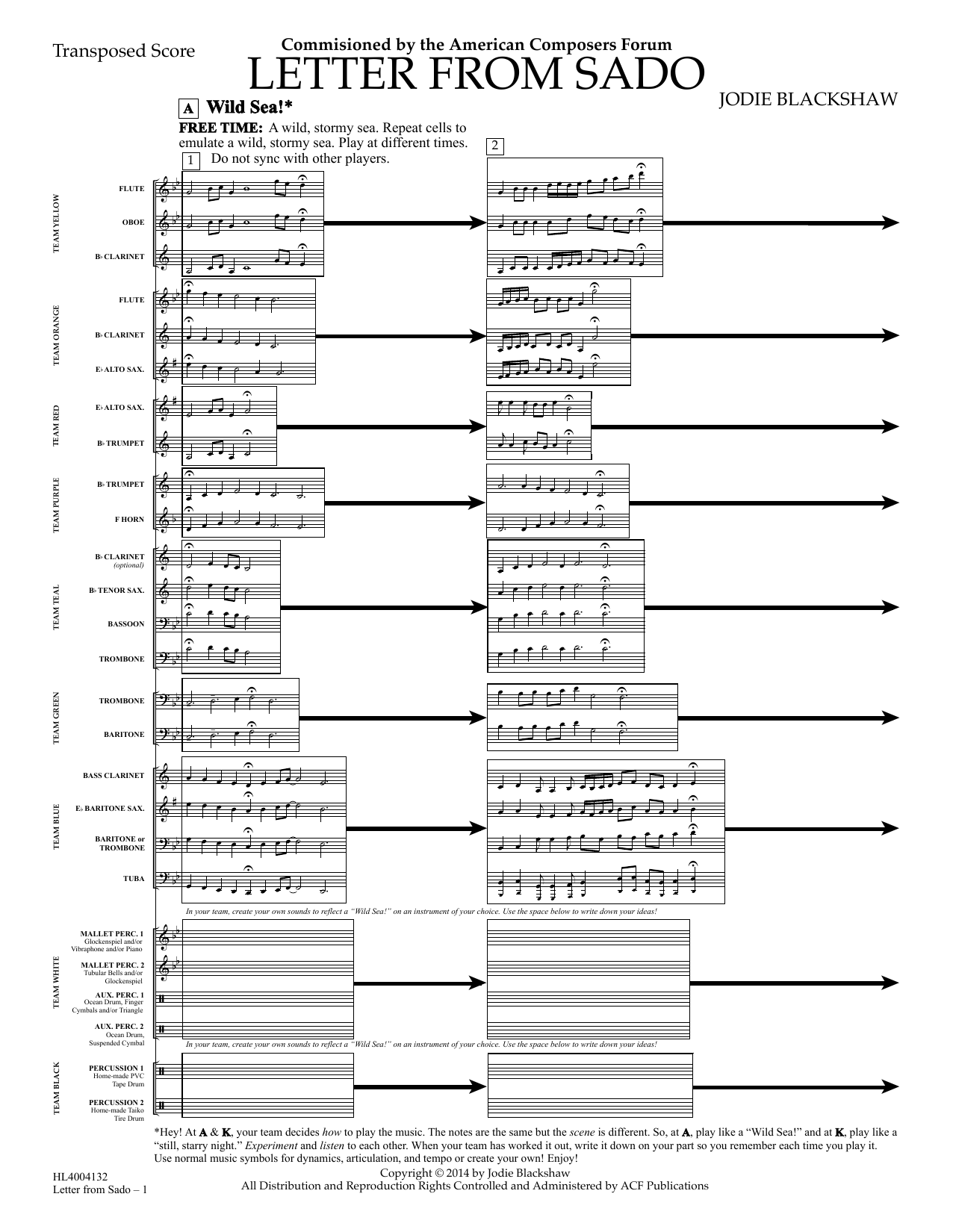

Letter From Sado: Concert Band Conductor Score & Parts
By Jodie Blackshaw
Grade: 3
Item: 35-PK00444371
$10.00
Pickup currently not available
Parts Added to Cart!
Description
"Letter from Sado" is an exciting piece for young band designed to draw out the musicality in young players. With a focus on interpretation of an ancient haiku poem with natural imagery, performers are invited to become decision makers about specific sections in the music. Their decisions include ideas regarding tempo, dynamics and articulation in order to represent a "wild stormy sea" and a "still starry night." Free interdisciplinary curriculum for teaching "Sado" is available at BandQuest.org: https://composersforum.org/bq-compositions/letter-from-sado
Dur: 5-7 minutes
Recorded by the University of Minnesota Wind Ensemble - Craig Kirchhoff, conductor
BandQuest, an exciting series of new music and accompanying curricula for band, is a program published by the American Composers Forum. The series was started as a response to feedback from music educators that there is a pressing need for new, fresh band music. The heart of this program is new works written by a diverse group of leading American composers who have created challenging pieces that are a true departure from standard middle school repertoire. Every BandQuest project includes a residency component in which the composer works collaboratively with a middle school as they create their new piece. Many BandQuest pieces are accompanied by an interdisciplinary curriculum designed to assist students as they learn the music and to integrate each piece with non-music studies. Visit www.bandquest.org to learn more about this innovative series, and email bandquest@composersforum.org to request a free downloadable audio catalog.


Discover MakeMusic Cloud: thousands of interactive titles your students can play along with today.
Sample Audio
No sample audio found.
Sample Video
No sample videos found.
Additional Details
Publisher:
Hal Leonard
SKU:
35-PK00444371
More about this title
About the Composer: Jodie Blackshaw
Jodie Blackshaw (b. 1971) is an Australian composer and educator whose work challenges the conventions of standard band repertoire. After completing her Bachelor of Music in composition at the Australian National University, she spent years as a peripatetic music tutor and band director, working across remote regional centers and urban Sydney. These early teaching experiences shaped her philosophy: she learned to compose with intention, crafting pieces that accommodated vast differences in ability and instrumentation within a single ensemble.
Blackshaw's compositional approach is informed by deep study in music education theory, including the Orff-Schulwerk method, Howard Gardner's Multiple Intelligence Theory, and Laban Movement Theory. She has become a sought-after voice in wind band composition, presenting at conferences and universities across North America, the UAE, and beyond. Her works are known for creating genuine musical decision-making opportunities for young players rather than passive note-reading, making her an important contributor to the BandQuest initiative.
Why we love this
This piece flips the typical rehearsal dynamic by positioning your students as interpreters with real agency. Rather than executing a fixed vision, they actively construct meaning through tempo, dynamics, and articulation choices that represent two contrasting images from a haiku. The accompanying interdisciplinary curriculum at BandQuest.org deepens the experience and gives you ready-made pathways to connect music with poetry and natural imagery.
What to expect
The piece oscillates between turbulent, driving energy and serene quietness, inviting players to feel the dramatic shift from tempestuous ocean to peaceful night sky. There is genuine lyricism here alongside rhythmic vitality, creating a satisfying arc that engages both the technical and artistic dimensions of young musicians.
Who it's for
Grade 3 concert bands ready to move beyond note-accuracy and into interpretive thinking. This works especially well for ensembles with solid foundational skills who are ready to grapple with musical decision-making and compositional structure.
How to get the most out of it
- Build consensus on the "wild stormy sea" section through sectional rehearsals where brass and woodwinds propose different articulation choices, then combine their ideas for full ensemble impact.
- Record multiple versions during rehearsals to let students hear how their interpretive choices actually reshape the piece; this auditory feedback accelerates ownership and musicality.
- Connect the haiku imagery to physical gesture during conducting to help younger players understand that tempo and dynamic shifts emerge from storytelling, not arbitrary markings.
How to use it
Pair this with the free BandQuest curriculum as a centerpiece for a concert that bridges music with literature and visual arts. It also works beautifully as a mid-year showcase piece where students can demonstrate their interpretive growth and creative thinking, or as a rehearsal focus during units on tone production and ensemble balance.
Skills your students will build
- Collaborative interpretation and decision-making about tempo, dynamics, and articulation
- Connecting abstract imagery and poetry to musical expression
- Sensitivity to ensemble balance across contrasting textural ideas
- Following a conductor's interpretive choices with focused attention
- Building unity within sections before integrating into full ensemble sound