

Letter from Sado: Concert Band Conductor Score & Parts
By Jodie Blackshaw
Grade: 3
Item: 35-PK00425922
$60.00
Pickup currently not available
Buy Extra Parts (Digital PDF Download)
Parts Added to Cart!
Description
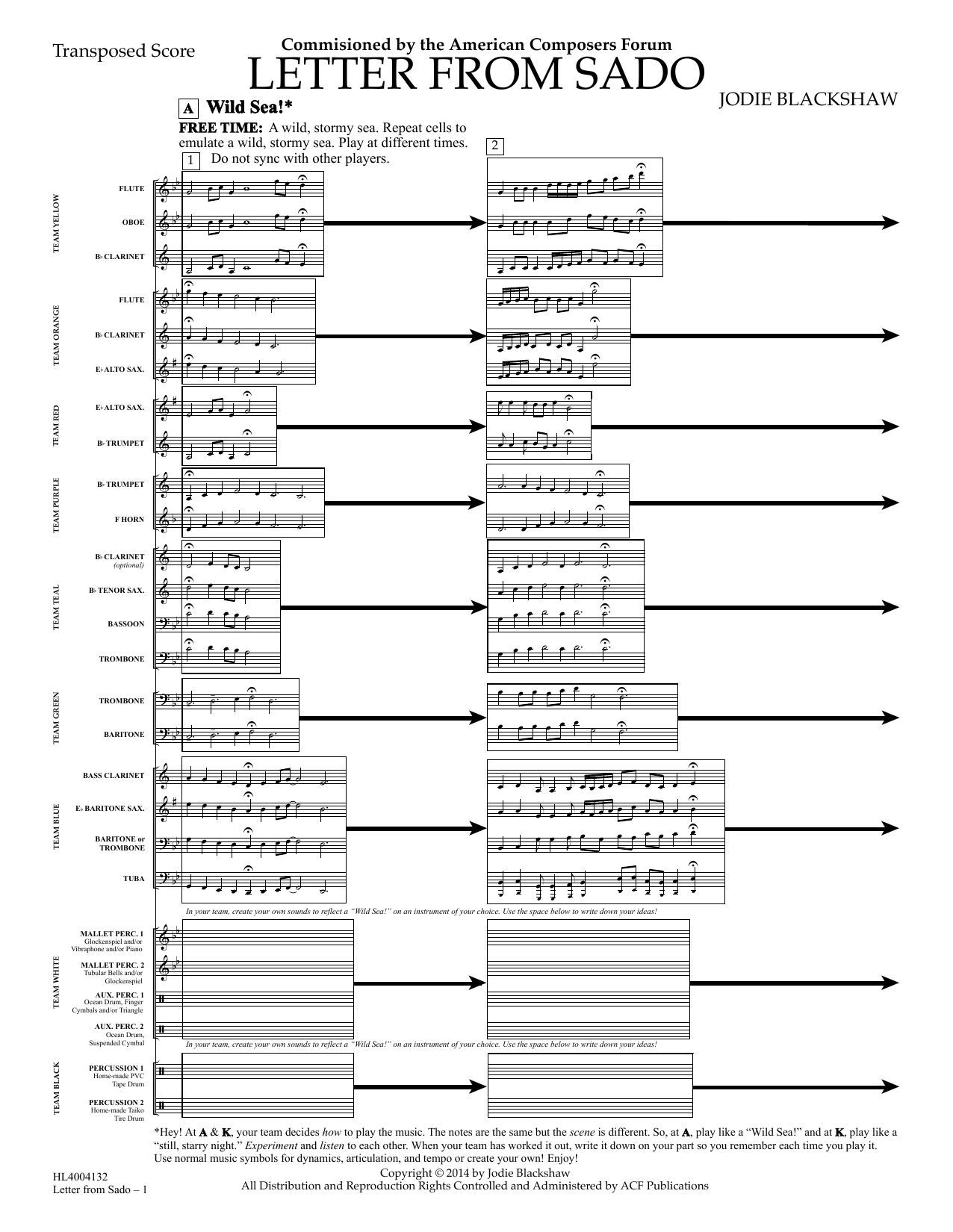
"Letter from Sado" is an exciting piece for young band designed to draw out the musicality in young players. With a focus on interpretation of an ancient haiku poem with natural imagery, performers are invited to become decision makers about specific sections in the music. Their decisions include ideas regarding tempo, dynamics and articulation in order to represent a "wild stormy sea" and a "still starry night." Free interdisciplinary curriculum for teaching "Sado" is available at BandQuest.org: https://composersforum.org/bq-compositions/letter-from-sado
Dur: 5-7 minutes
Recorded by the University of Minnesota Wind Ensemble - Craig Kirchhoff, conductor
BandQuest, an exciting series of new music and accompanying curricula for band, is a program published by the American Composers Forum. The series was started as a response to feedback from music educators that there is a pressing need for new, fresh band music. The heart of this program is new works written by a diverse group of leading American composers who have created challenging pieces that are a true departure from standard middle school repertoire. Every BandQuest project includes a residency component in which the composer works collaboratively with a middle school as they create their new piece. Many BandQuest pieces are accompanied by an interdisciplinary curriculum designed to assist students as they learn the music and to integrate each piece with non-music studies. Visit www.bandquest.org to learn more about this innovative series, and email bandquest@composersforum.org to request a free downloadable audio catalog.


Discover MakeMusic Cloud: thousands of interactive titles your students can play along with today.
Sample Audio
No sample audio found.
Sample Video
No sample videos found.
Additional Details
Publisher:
Hal Leonard
SKU:
35-PK00425922
More about this title
About the Composer: Jodie Blackshaw

Jodie Blackshaw brings a distinctive philosophy to wind band composition, one shaped by her dual expertise in composition and music education. After earning her degree in composition from the Australian National University, she spent formative years teaching music in remote Australian centers and Sydney, where she learned firsthand how students of different abilities think musically. This experience led her to compose works tailored to her ensembles' specific needs and constraints, a practice that remains central to her approach today.
Blackshaw's educational foundation extends well beyond the classroom. Her study of the Orff-Schulwerk method, Howard Gardner's Multiple Intelligences framework, contemporary brain-based learning principles, and Laban Movement Theory have all shaped how she constructs meaning into her scores. She is known for creating works that challenge conductors and players alike, inviting them into an active role in interpretation rather than passive execution. Her commissions span North America, the UAE, and beyond, reflecting growing recognition of her ability to write band music that is simultaneously accessible and intellectually engaging.
Why we love this
This piece treats interpretation as a learning tool, not an afterthought. Young players become decision makers about tempo, dynamics, and articulation as they respond to a haiku's imagery, which means every rehearsal becomes an exercise in musical agency and listening. Coupling the score with the free BandQuest curriculum transforms what could be a routine concert piece into an interdisciplinary experience that your musicians will actually remember.
What to expect
The piece captures two contrasting emotional landscapes drawn from nature: the turbulence of a wild stormy sea and the calm stillness of a starry night. Young players will navigate dynamic shifts and articulation changes that reflect these opposing images, creating moments of genuine drama alongside passages of quiet reflection. The experience feels collaborative rather than prescriptive, which gives performers permission to express musical intention through their choices.
Who it's for
Grade 3 concert bands ready to move beyond note reading into genuine musical collaboration. This works best with groups that have solid rhythmic foundation and enough maturity to discuss musical choices without devolving into chaos. It's equally suited to programs looking to complement academic humanities instruction or to conductors seeking fresh material that engages young players as thinking musicians.
How to get the most out of it
- Spend time with the haiku before teaching the music. Have students read the ancient poem aloud, discuss its imagery, and sketch what they see. This context makes their musical decisions feel grounded rather than arbitrary.
- Allocate rehearsal time for ensemble discussion about the sections marked for student choice. Let players propose interpretations, hear how they sound, and defend their choices. This builds ownership and listening skills that transfer to other repertoire.
- Reference the University of Minnesota Wind Ensemble recording not as the definitive version but as one possible interpretation. Play it once, then immediately ask your students what choices the conductor made differently than what they proposed.
- Balance freedom with cohesion. While sections invite flexibility, the ensemble must lock together once choices are made. Mark consensus decisions in parts clearly so execution stays unified across rehearsals.
How to use it
This works particularly well early in a concert alongside lighter fare, where its educational transparency and engaging concept can draw audiences into the creative process. It pairs naturally with other BandQuest commissions if your program includes multiple pieces from the series, or stand alone as a centerpiece for a concert themed around nature, poetry, or contemporary composition. Consider programming it when you have time to explore the curriculum resources, as the interdisciplinary angle strengthens both the music and the learning.
Skills your students will build
- Musical decision making based on programmatic and poetic content
- Interpreting performance directions (tempo, dynamics, articulation) as expressive choices rather than fixed rules
- Listening critically to ensemble choices and adjusting to match group consensus
- Translating imagery and emotion into sound production
- Collaborative problem solving during rehearsal discussions
- Ensemble cohesion while maintaining individual interpretive agency