
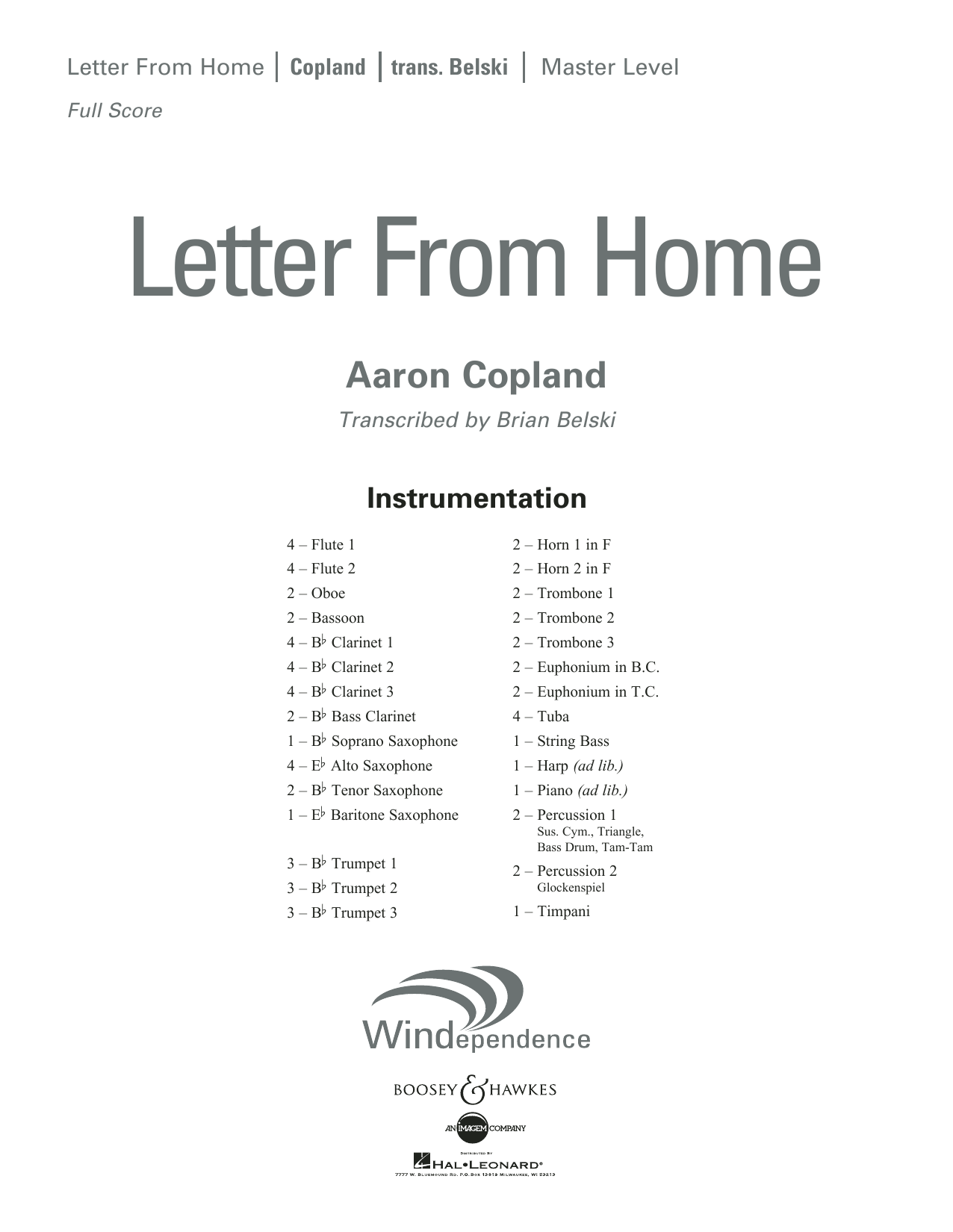

Letter from Home: Concert Band Conductor Score & Parts
By Aaron Copland / Arranged by Brian Belski
Grade: 4
Item: 35-PK00391151
$85.00
Pickup currently not available
Buy Extra Parts (Digital PDF Download)
Parts Added to Cart!
Description
"Letter from Home" was commissioned as a patriotic work in 1944 by Paul Whiteman and his Radio Hall of Fame Orchestra. Composed toward the end of the Second World War, this music suggests the emotions of a soldier reading a letter from home. The music has been described as Copland's most sentimental and reflects his own homesickness while visiting Mexico. This sensitive transcription by Brian Belski has produced another wonderful wind band setting from America's most iconic composer." Dur: 7:30


Letter from Home: Concert Band Conductor Score & Parts isn't in MakeMusic Cloud just yet...but it could be. Let us know you'd like to see it, and you'll help shape what comes next. In the meantime, start a free trial and dive into thousands of interactive titles your students can play along with today.
Request This Title
Tell us you want it.
Start Your Free Trial
Explore everything that's ready to play right now.
Sample Audio
No sample audio found.
Sample Video
No sample videos found.
Additional Details
Publisher:
Hal Leonard
SKU:
35-PK00391151
More about this title
About the Composer: Aaron Copland
Aaron Copland (1900–1990) shaped American classical music by developing a compositional voice rooted in folk melody, hymn tunes, and open harmonies that audiences immediately recognized as distinctly American. His ballets Appalachian Spring, Rodeo, and Billy the Kid became cornerstones of the national repertoire, and his gift for orchestration influenced generations of composers working in concert, film, and popular music. Beyond composition, Copland was a tireless advocate for American music through conducting, teaching, and writing; his openness to all musical forms from symphonies to film scores made him a bridge between concert hall and popular culture.
Why we love this
Copland's lyricism reaches its fullest expression here, and Belski's transcription respects every nuance of the original while letting the wind band sing with clarity and warmth. The seven and a half minutes unfold with genuine emotional weight rather than bombast, giving students a model of how restraint and simple melody can move an audience. Programming this alongside marches or fanfares creates a meaningful arc that reminds listeners why we make music.
What to expect
Quiet, reflective, and deeply human. The music evokes the ache of separation and the comfort of a connection held across distance, unfolding with the patience of someone reading a beloved letter again and again. There is no urgency here, only an honest tenderness.
Who it's for
Concert bands at the Grade 4 level who want to explore American repertoire beyond marches and fanfares. This work suits students learning to shape longer lyrical phrases and gives conductors a chance to teach accompaniment balance and sustained tone production.
How to get the most out of it
- Shape the primary melody with a long, unhurried breath; this is intimate music despite the ensemble size, so resist the impulse to push the tempo forward.
- Balance the accompaniment voices so they support rather than obscure the song. Too much weight in the inner parts drowns the tenderness Copland intended.
- Use the marked dynamics as emotional signposts. A single forte at the climax lands harder when everything before it has been genuinely soft.
How to use it
Place this in a concert after more energetic selections to give the audience a moment of reflection and connection. It works powerfully as a centerpiece in a program exploring American musical identity, or as an emotional anchor alongside Copland's other band transcriptions.
Skills your students will build
- Phrasing long, singing melodic lines over multiple phrases
- Balancing accompaniment with melody in mixed textures
- Sustaining soft dynamics with full tone rather than thinning sound
- Reading and executing marked dynamic shapes that convey emotional intent
- Intonation in sustained chords at moderate and soft volumes