
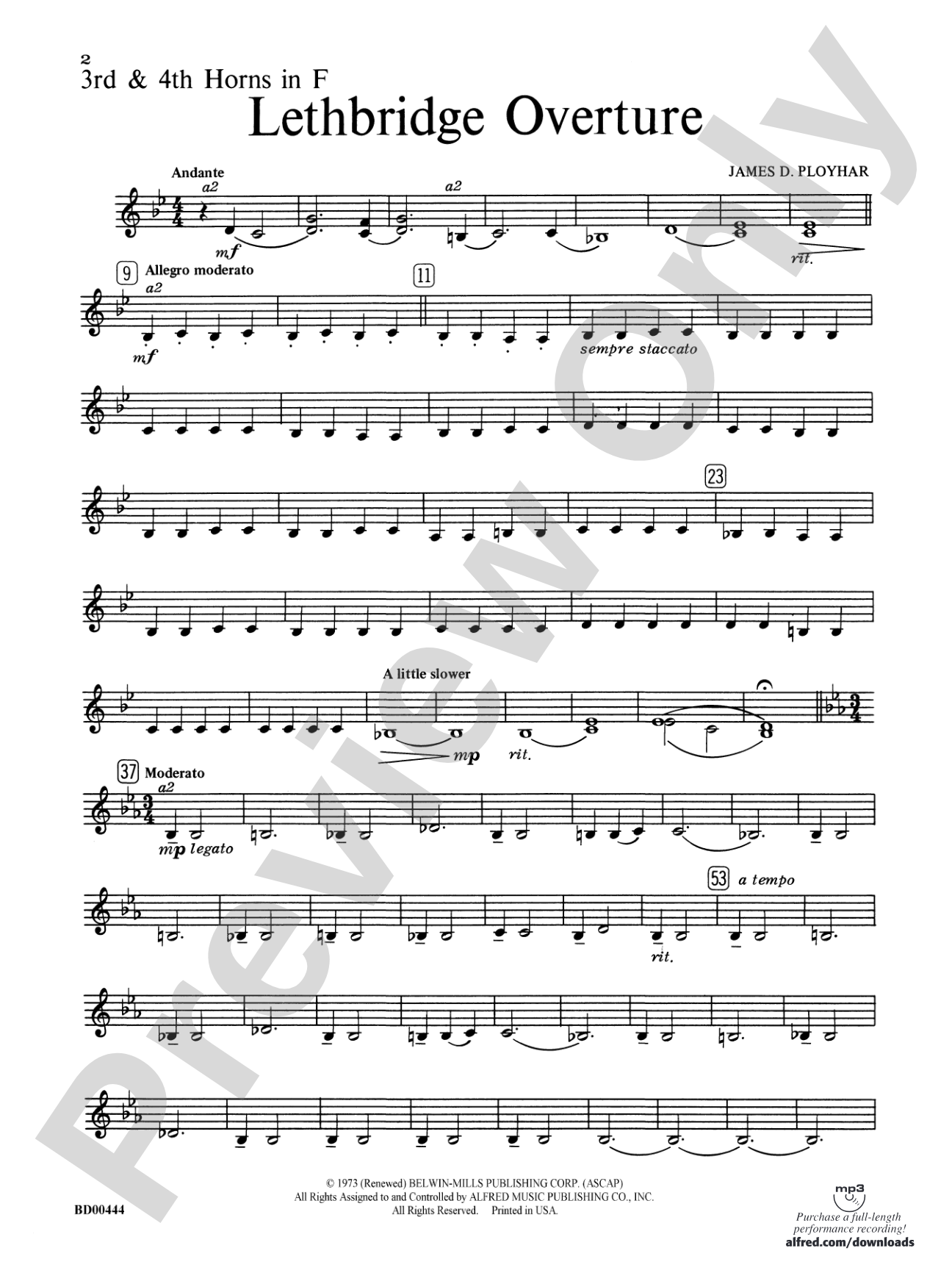

Lethbridge Overture: 3rd & 4th F Horns
By James D. Ployhar
Grade: 3 (Medium Easy)
Item: 00-PC-0015582_H34
$5.99
Pickup currently not available
Description
This concert overture is inspired by the beauty of one of the warmest and sunniest cities in Alberta, Canada, including its friendliness and community spirit. It is characterized with great melodic content and stirring rhythmic involvement. The solid scoring is sure to be well-received for both concert and contest.


Don't just read it, hear it, play along with it, and watch your students grow with it. In MakeMusic Cloud, Lethbridge Overture: 3rd & 4th F Horns comes alive with professional accompaniment, adjustable tempo, and built-in practice tools that turn solo practice into real progress.
Open in the Player
Jump straight in and assign it today.
Start Your Free Trial
Open this title and explore the full library in minutes.
Sample Audio
1
Audio File
--:--
0:00
0:00
Sample Video
No sample videos found.
Additional Details
Series:
Belwin Concert Band
Publisher:
Alfred Music
Page Count:
240
SKU:
00-PC-0015582_H34
More about this title
About the Composer: James D. Ployhar

James D. Ployhar stands among the most prolific and respected voices in band music education, with over 800 published compositions to his name. His pedagogical reach extends far beyond the concert hall: he authored the Contemporary Band Course, now published by Alfred Music and adopted in schools across Norway (where it has been translated into Norwegian). Ployhar's training in orchestration came through direct study with Knud Havalde of the Danish Royal Philharmonic Orchestra, grounding his compositional voice in professional orchestral practice.
His career spans nearly two decades of public school teaching alongside extensive clinical work at universities and colleges throughout North America and Europe. Ployhar has received the National Band Association Citation of Excellence and the Distinguished Alumnus Award from Valley City State University. His degrees include a BS from Valley City State University (North Dakota), an MA from the University of Northern Colorado, and graduate study in composition at California State University-Long Beach under Morris Hutchings Ruger. His music has been broadcast on network television and performed internationally across Europe, Japan, and the Pacific Rim.
Why we love this
Ployhar has mastered the art of writing Grade 3 overtures that never feel constrained by their grade level. The melodic generosity and rhythmic drive here give your band real substance to sink their teeth into, while the straightforward scoring lets you focus on musical execution rather than logistics. This sits squarely in the sweet spot for a contest piece: strong enough to impress adjudicators, accessible enough that your ensemble can achieve a polished performance without months of rehearsal.
What to expect
Lethbridge Overture captures something of the open, welcoming spirit its title suggests. The writing moves with sunlit energy and clear-eyed optimism, built on memorable melodies and driving rhythmic momentum that propels the piece forward. There's lightness here without being trivial; your band will feel the satisfaction of playing something spirited and genuinely tuneful.
Who it's for
Grade 3 concert bands preparing for festivals or building their contest repertoire will find this overture both musically substantial and achievable. Directors seeking a piece with genuine melodic appeal and energetic pacing that won't derail the spring concert schedule should consider this title.
How to get the most out of it
- Build ensemble clarity around the main melodic statements early in rehearsals; Ployhar's scoring gives each section moments to shine, so highlight those passages during sectional work before full band rehearsals.
- Pay attention to rhythmic precision in the accompaniment figures. The solid rhythmic involvement that defines the piece only lands with confidence if your sections lock in together.
- Shape the melodic content with phrase direction and dynamics. Even at this level, warm, singing lines transform a competent reading into a convincing performance.
- Approach the balance between woodwinds and brass with intention. Ployhar's orchestration is clean and transparent, so clarity of individual lines matters more than volume.
How to use it
Use this as a festival or contest centerpiece. Its Grade 3 difficulty pairs well with a lighter opening number and a more technically demanding closer, giving your program shape and variety. Alternatively, place it early in a concert where its cheerful character and accessibility energize the audience for deeper repertoire to follow.
Skills your students will build
- Balancing melody and accompaniment in multi-part textures
- Executing syncopated rhythmic figures with precision
- Reading and maintaining alignment across concert band instrumentation
- Shaping melodic phrases with direction and dynamic contour
- Responding to changes in tempo and rhythmic intensity