
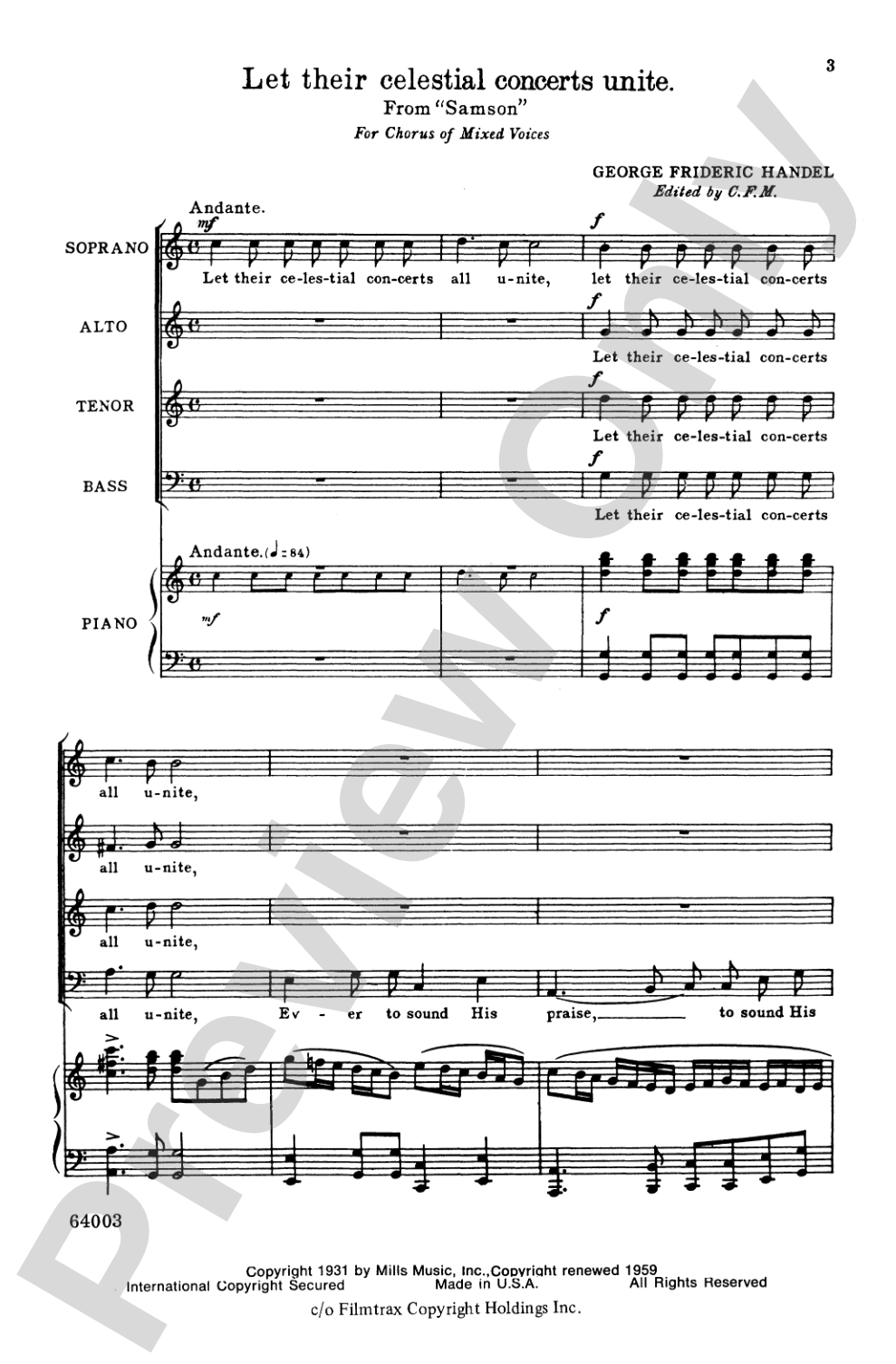
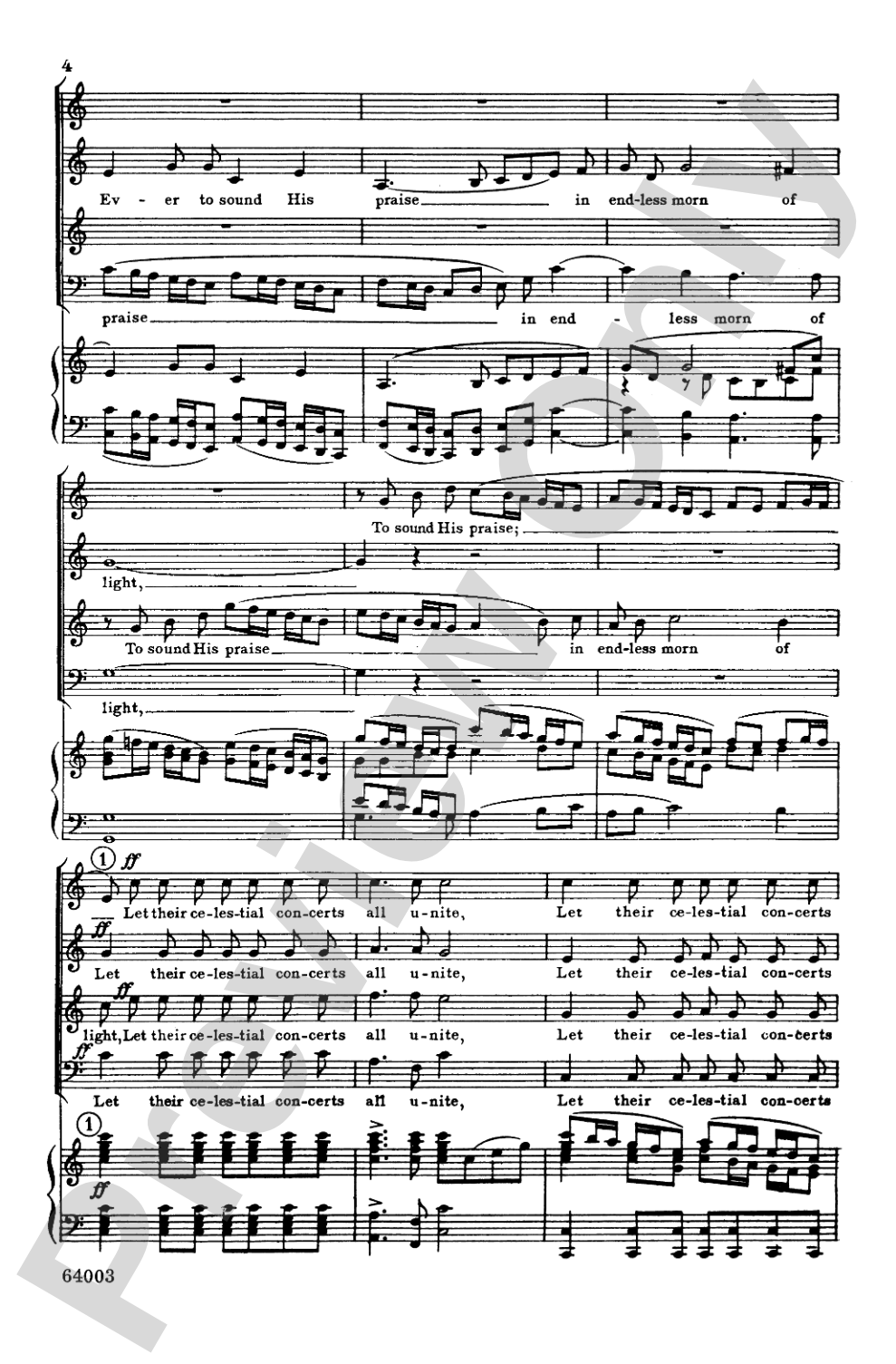

Let Their Celestial Concerts Unite (from Samson): SATB Choral Octavo
From Samson
By George Frideric Handel / ed. Charles Manney
Level: Difficult
Item: 00-PO-0004524
$2.25
Minimum order quantity: 20 copies
Pickup currently not available
Related Items
Let Their Celestial Concerts Unite: SATB Choral Octavo |
$2.25
|
View |
Description


Let Their Celestial Concerts Unite (from Samson): SATB Choral Octavo isn't in MakeMusic Cloud just yet...but it could be. Let us know you'd like to see it, and you'll help shape what comes next. In the meantime, start a free trial and dive into thousands of interactive titles your students can play along with today.
Request This Title
Tell us you want it.
Start Your Free Trial
Explore everything that's ready to play right now.
Sample Audio
No sample audio found.
Sample Video
No sample videos found.
Additional Details
Series:
Alfred Archive Edition: Belwin Sacred Choral Series
Publisher:
Alfred Music
Page Count:
12
SKU:
00-PO-0004524
More about this title
About the Composer: George Frideric Handel
George Frideric Handel (1685-1759) was a German-born composer who spent much of his career in England, where he became a dominant force in Baroque vocal music. His mastery of the oratorio form, particularly works like Messiah and Samson, established him as one of the most performed composers in the English-speaking world for over two centuries. Handel's choral writing combines Italian melodic invention with English Protestant sensibilities, creating music that is both dramatically powerful and deeply singable.
Handel's approach to choral composition influenced generations of composers and remains central to the choral canon. His ability to craft memorable, accessible melodies without sacrificing harmonic sophistication makes his work ideal for teaching choral excellence at the highest levels. Directors return to Handel again and again because his music rewards both meticulous preparation and genuine musical expression.
Why we love this
This Handel excerpt sits perfectly at the intersection of accessibility and artistic challenge. The melody is singable and immediately rewarding, yet the harmonic language and part-writing demand real sophistication from your singers. It's a piece that sounds impressive from measure one while teaching your choir how to navigate Baroque phrasing, period-appropriate ornamentation, and the kind of sustained vocal line that builds genuine musicianship.
What to expect
The music radiates reverence and grandeur. Handel's lines soar with confident elegance, supported by harmonies that shift between moments of clear major tonality and richer chromatic color. Singing this feels like stepping into something noble and timeless; the text is lifted by music that refuses to rush or diminish the weight of what's being said.
Who it's for
This octavo serves conductors preparing advanced high school or collegiate choirs for festival or contest performance. The difficulty level demands singers with solid reading skills, secure pitch, and the vocal maturity to sustain long lines with control and expression. It works equally well for community choirs or festival ensembles with experienced singers looking for substantive repertoire.
How to get the most out of it
- Balance the soprano line without letting it overwhelm the other voices; Handel's inner parts carry equal musical weight and deserve audibility throughout.
- Shape each phrase as a unit rather than pushing through to the next phrase mark. Baroque music breathes at the musical ideas, not the barlines.
- Pay special attention to the text underlay and where vowel changes fall on longer note values; clarity of diction will make the harmonic progressions land more effectively.
- Release chords cleanly and deliberately, particularly in cadential moments. The silence is part of the architecture.
How to use it
Program this as a centerpiece of a Baroque or sacred music concert, or use it to represent the English oratorio tradition in a thematic festival program. It pairs naturally with other Handel selections or creates a compelling contrast when programmed alongside later choral masterworks. The piece stands confidently on its own without requiring programming partners.
Skills your students will build
- Sustaining long melodic lines with consistent breath support and vocal line integrity
- Reading and interpreting Baroque ornamentation and articulation style
- Balancing SATB voices where all four parts carry thematic or harmonic significance
- Tuning and voice leading through chromatic and unexpected harmonic movement
- Shaping musical phrases according to text and harmonic structure rather than barlines
- Maintaining clarity of diction while singing sustained vowels and complex syllables