

Let the Music Dance: 3-Part Mixed / SAB, a cappella Choral Octavo
Words and music by Sally K. Albrecht
Item: 00-PO-0000863
$1.75
Minimum order quantity: 20 copies
Pickup currently not available
Related Items
Let the Music Dance: 3-Part Mixed / SAB, a cappella Choral Octavo |
$1.75
|
View |
Description
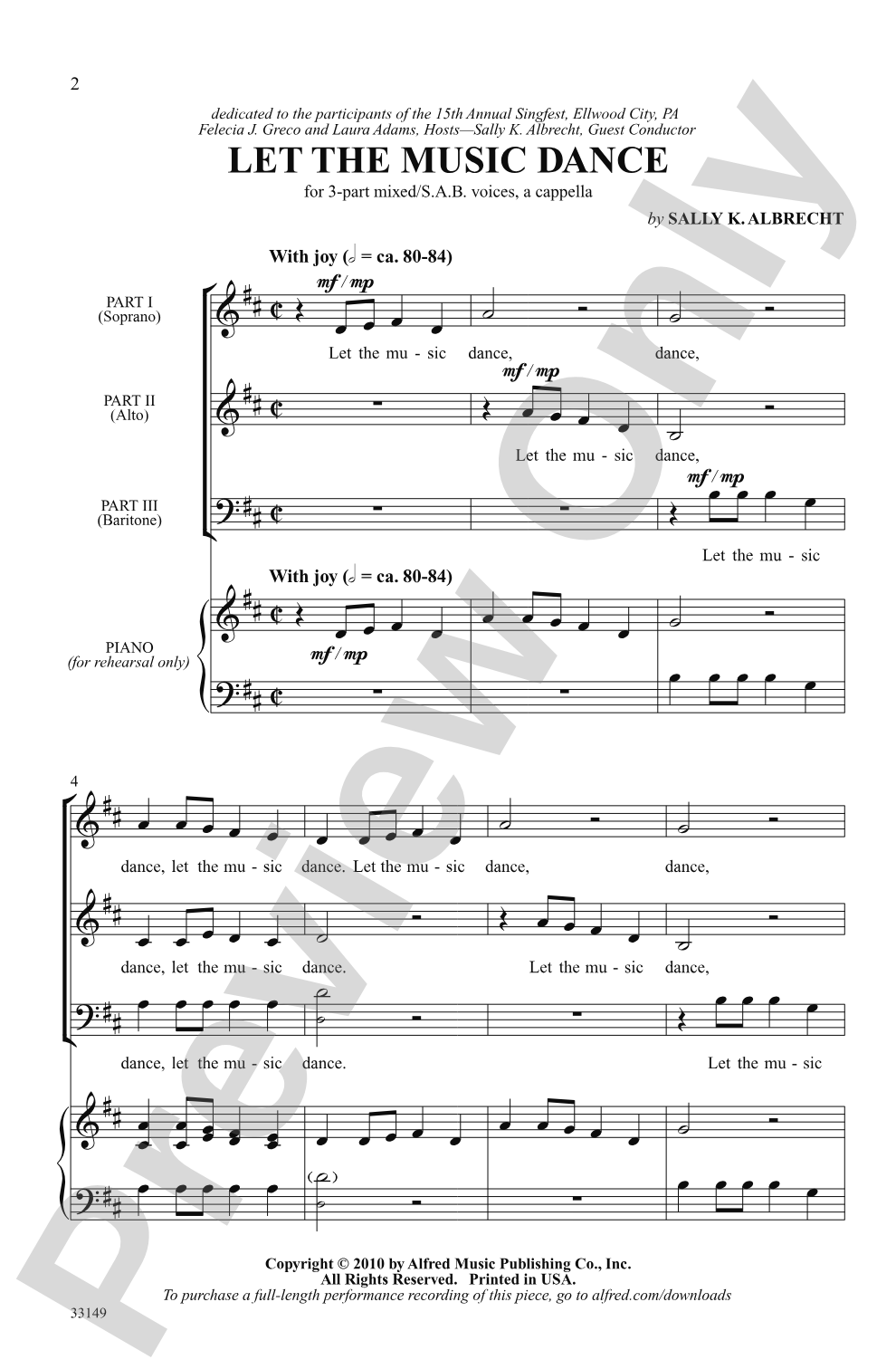
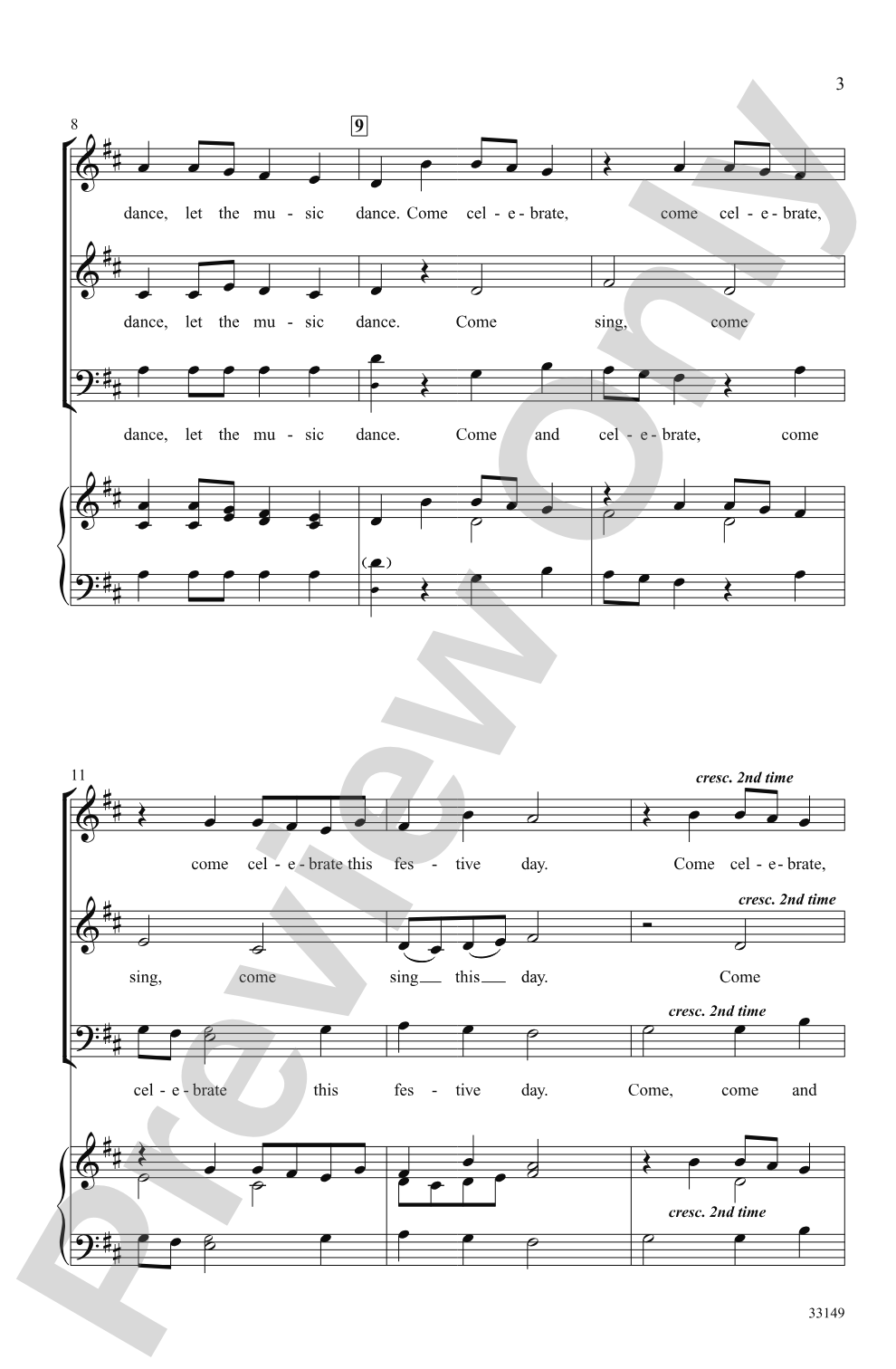
Introduce your singers to the marvelous world of madrigals. A trio of easy-to-sing, effective counterpoint melodies work together in this light, dancing choral, appropriate for general or seasonal use.


Let the Music Dance: 3-Part Mixed / SAB, a cappella Choral Octavo isn't in MakeMusic Cloud just yet...but it could be. Let us know you'd like to see it, and you'll help shape what comes next. In the meantime, start a free trial and dive into thousands of interactive titles your students can play along with today.
Request This Title
Tell us you want it.
Start Your Free Trial
Explore everything that's ready to play right now.
Sample Audio
1
Audio File
--:--
0:00
0:00
Sample Video
No sample videos found.
Additional Details
Series:
Alfred Choral Designs
Publisher:
Alfred Music
Page Count:
8
SKU:
00-PO-0000863
More about this title
About the Composer: Sally K. Albrecht

Sally K. Albrecht has shaped American choral music for over three decades as a composer, conductor, and clinician with a distinctive focus on movement-integrated choral experiences. Her catalog exceeds 600 published works, and she has received the ASCAP Special Music Award annually since 1987. She conducted honor choirs at major venues including Lincoln Center, Carnegie Hall, and The Kennedy Center, and served as Director of School Choral, Vocal, and Elementary Publications for Alfred Music and another leading educational publisher.
Albrecht holds degrees from Rollins College (B.A. in Music and Theater, 1976), the University of Miami (M.A. in Drama, 1977; M.M. in Accompanying, 1979), and has taught at Oakland University, Jersey City State College, and Meredith College. In 2021, she received the Distinguished Alumna Award from both Rollins College and the University of Miami Frost School of Music. She lives in Wake Forest, North Carolina, with her husband, composer and arranger Jay Althouse.
Why we love this
Albrecht writes with genuine understanding of what middle school and early high school singers can execute with confidence. The counterpoint here is genuinely musical—not simplified to the point of blandness—and the a cappella setting forces your choir to listen to each other and lock in their parts. It's the kind of piece that makes singers feel smart because they're actually doing something skillful.
What to expect
The piece has the character of a Renaissance madrigal reimagined for modern singers: playful, light-footed, and alive with gentle wit. Three independent melodic lines weave together in a pattern that feels both structured and spontaneous, like dancers moving in and out of formation. There's an effortless joy to it.
Who it's for
This piece works beautifully for singers developing ensemble skills and choral literacy. It suits mixed choirs at the middle school through early high school level, as well as adult community choirs seeking accessible yet musically rewarding secular work.
How to get the most out of it
- Shape each melodic line as if it were a solo voice, even when singing in thirds or sixths. This independence prevents the piece from sounding homophonic and honors the madrigal tradition it references.
- Balance the three parts by ear rather than by volume. The soprano and alto lines will naturally project; use this rehearsal to train your tenor section to sing with full resonance without overshadowing.
- Think of the piece as a conversation between three equally important characters. Encourage singers to listen across all parts during rehearsal, not just within their own section.
- Build the tempo gradually in performance. A cappella pieces can drift if there's no harmonic anchor; a gentle lift in energy as you move through the piece maintains forward motion without feeling rushed.
How to use it
This works well as a seasonal offering during spring concerts, where its dancing character and a cappella simplicity provide welcome contrast to larger arrangements. It also serves as an excellent anchor for a madrigal-themed concert or an introduction to modal harmony and counterpoint in a thematic programming structure.
Skills your students will build
- Reading and singing independent melodic lines within an a cappella texture
- Understanding basic counterpoint and how three parts fit together harmonically
- Balancing blend and blend while maintaining individual line clarity
- Developing ear training and intonation accuracy without harmonic instruments
- Phrasing and shaping secular choral music with textual awareness