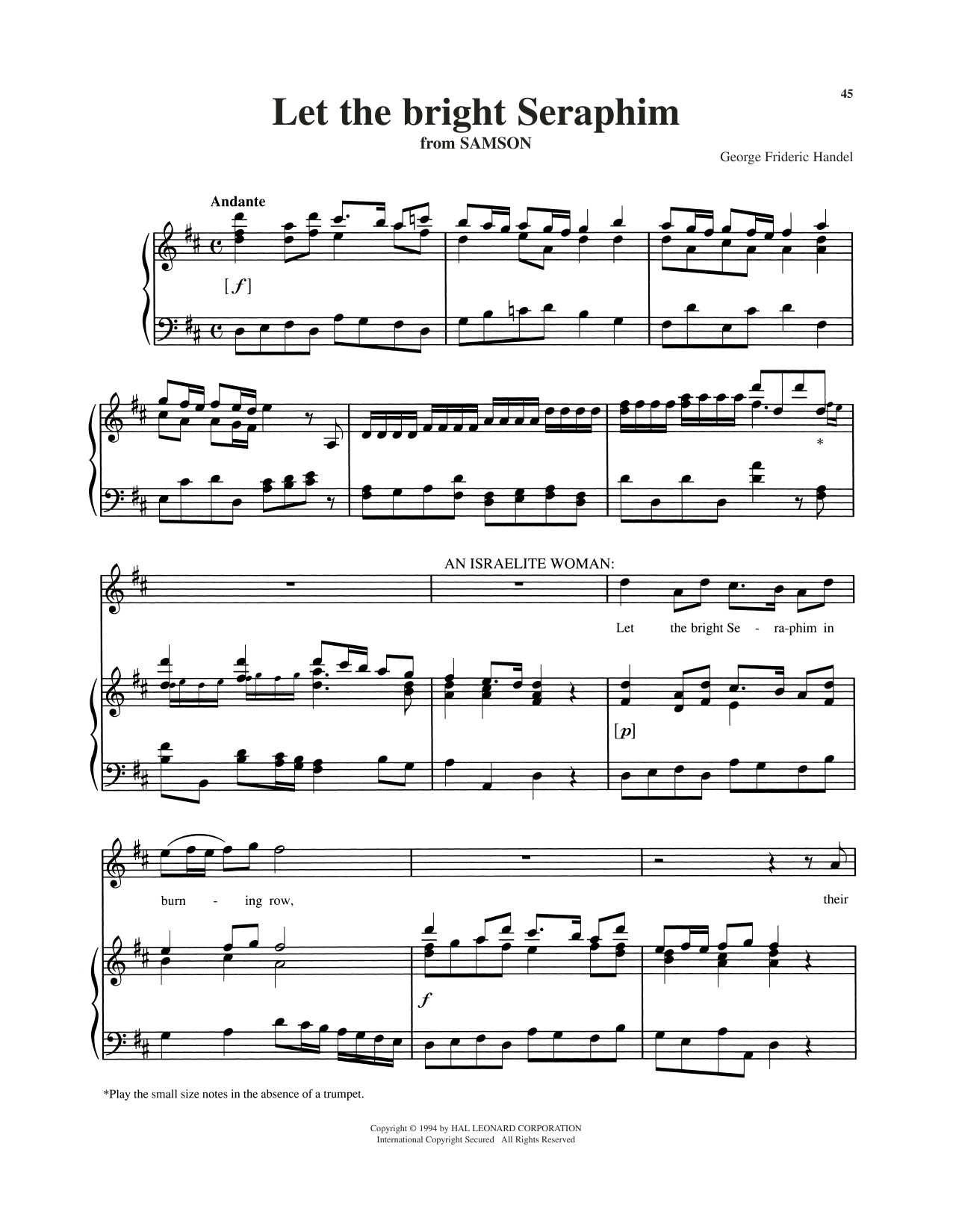
Let The Bright Seraphim Sheet Music Preview

Let The Bright Seraphim: Piano Vocal

As performed by George Frideric Handel / Edited by Richard Walters

Item: 35-DS01827473

Digital Download
$5.99
Description

Let The Bright Seraphim: Piano Vocal isn't in MakeMusic Cloud just yet...but it could be. Let us know you'd like to see it, and you'll help shape what comes next. In the meantime, start a free trial and dive into thousands of interactive titles your students can play along with today.

Sample Audio
No sample audio found.
Sample Video
Additional Details
Publisher: Hal Leonard
Page Count: 8
SKU: 35-DS01827473

More about this title

About the Artist: George Frideric Handel

George Frideric Handel (1685-1759) was a German-born composer who spent most of his career in London, where he became the dominant figure in English musical life. His gift for memorable melody and dramatic gesture made him a master of both instrumental and vocal music, from operas to oratorios to instrumental concertos. His works remain central to the vocal repertoire because they combine technical brilliance with emotional directness.

Handel's output shaped the trajectory of English music for generations. He understood the human voice intuitively and wrote for singers across the full range of abilities, which is why his arias continue to serve as foundational repertoire in voice studios and on recital stages worldwide.

Why we love this

This aria sits in that rare sweet spot where it sounds effortless but demands real control. The ornamental writing feels natural rather than showy, the tessitura sits comfortably for high voices, and the text gives singers an actual character to inhabit. It's substantial enough to anchor a recital, yet manageable enough that talented high school soloists can succeed with it.

What to expect

Bright and hymn-like, with an almost ethereal quality in the upper register. The music radiates confidence and clarity without coldness, inviting the listener into a moment of spiritual uplift. There's a gentle grandeur here that feels both accessible and noble.

Who it's for

Soprano or high tenor soloists with solid technique and enough experience to shape longer phrases. This works well for advanced high school singers, college voice students, and professional singers preparing a wedding or special event recital. Directors programming a classical vocal solo should consider this for singers who need something substantial but not operatic in scope.

How to get the most out of it

  • Shape the melody through the ornaments rather than treating them as decoration. Each scalar passage should serve the phrase architecture, not interrupt it.
  • Balance the text intelligently. High voices sometimes get caught in the sparkle of the upper range and lose the meaning of the words. Practice the recitative sections with particular care for diction.
  • Let the piano part breathe. This accompaniment isn't just filler; it has its own musical life and deserves attention in rehearsal so singer and pianist move together.

How to use it

Program this in mixed recitals where you need a classical solo that bridges sacred and secular contexts. The eight pages give you a piece that feels complete without demanding extensive rehearsal time. It pairs naturally with other eighteenth-century Italian or English repertoire, or it stands alone as a feature moment on a broader vocal program.

Skills your students will build

  • Ornamental writing interpretation and articulation
  • Legit singing technique in the upper register
  • Text clarity and phrasing across sustained vocal lines
  • Partnership with keyboard accompaniment
  • Managing extended phrases without breath compromise

You May Also Like