
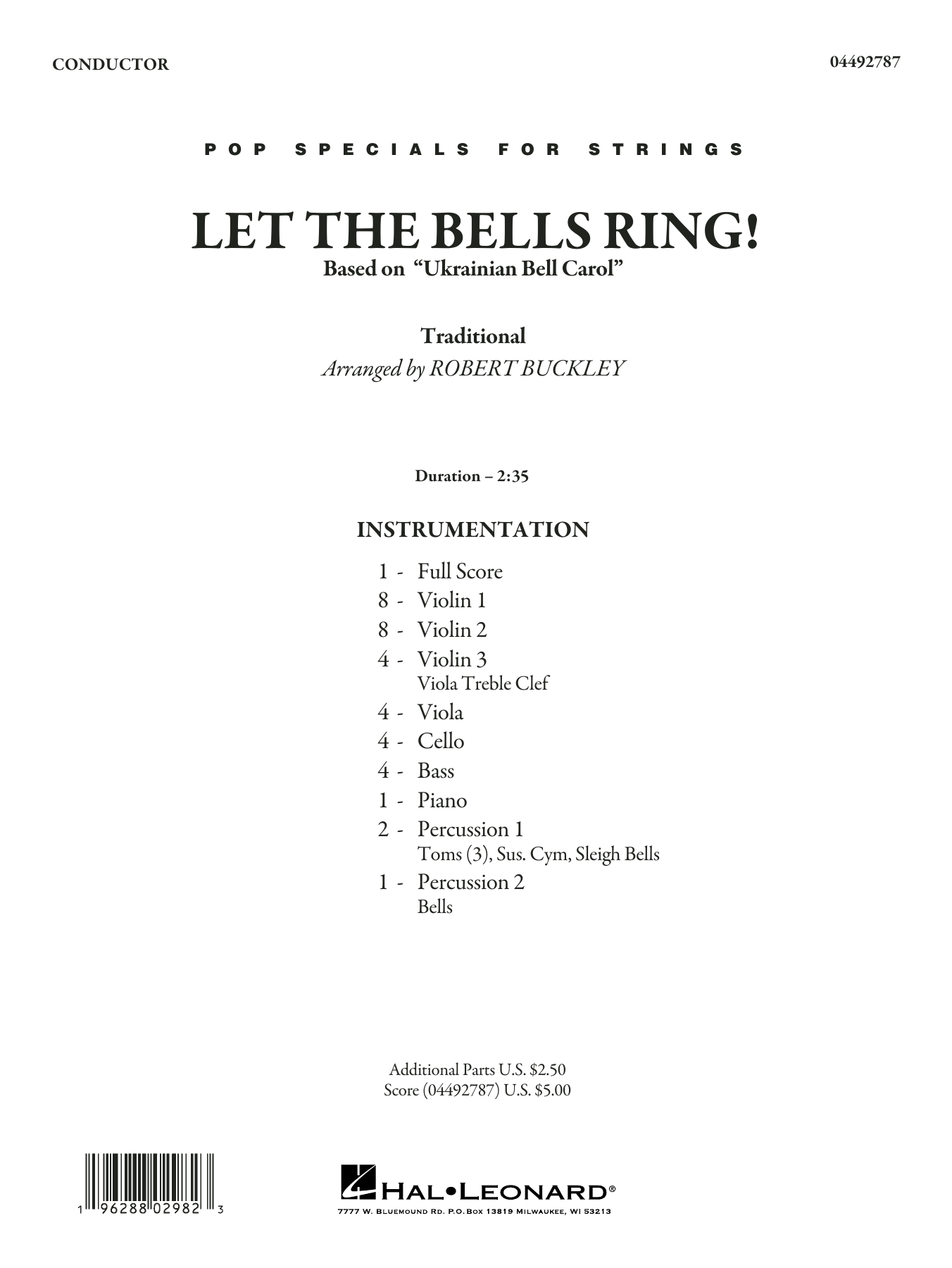

Let The Bells Ring! (arr. Robert Buckley): String Orchestra Conductor Score & Parts
Arranged by Robert Buckley
Grade: 3-4
Item: 35-PK01120061
$55.00
Pickup currently not available
Buy Extra Parts (Digital PDF Download)
| Product | Price | Quantity |
|---|---|---|
| Let The Bells Ring! - Conductor Score (Full Score) | $6.00 | |
| Let The Bells Ring! - Violin 1 | $7.00 | |
| Let The Bells Ring! - Violin 2 | $7.00 | |
| Let The Bells Ring! - Violin 3 (Viola Treble Clef) | $7.00 | |
| Let The Bells Ring! - Viola | $7.00 | |
| Let The Bells Ring! - Cello | $7.00 | |
| Let The Bells Ring! - Bass | $7.00 | |
| Let The Bells Ring! - Piano | $7.00 | |
| Let The Bells Ring! - Percussion 1 | $7.00 | |
| Let The Bells Ring! - Percussion 2 | $7.00 |
Parts Added to Cart!
Description
This up-tempo arrangement of the traditional Ukrainian Bell Carol adds new excitement to an audience favorite! In E minor, both the key and the range work well for young string players. This sparkling rendition brings satisfying challenges to young musicians, and will impress your audience!


Let The Bells Ring! (arr. Robert Buckley): String Orchestra Conductor Score & Parts isn't in MakeMusic Cloud just yet...but it could be. Let us know you'd like to see it, and you'll help shape what comes next. In the meantime, start a free trial and dive into thousands of interactive titles your students can play along with today.
Request This Title
Tell us you want it.
Start Your Free Trial
Explore everything that's ready to play right now.
Sample Audio
No sample audio found.
Sample Video
No sample videos found.
Additional Details
Publisher:
Hal Leonard
SKU:
35-PK01120061
More about this title
Why we love this
Buckley respects the carol's melodic integrity while reshaping it for young string players with genuine musical substance. The arrangement sits perfectly in E minor and avoids the register extremes that derail developing orchestras, yet still delivers the brightness and momentum that makes this carol so beloved at holiday concerts.
What to expect
Crisp and celebratory, with the kind of controlled energy that makes audiences lean forward. The arrangement sparkles without feeling overwrought; it honors the carol's quiet dignity while infusing it with the drive that string players find genuinely rewarding to execute.
Who it's for
String orchestra conductors programming holiday concerts for grades 3 through 4 students who want authentic seasonal repertoire without resorting to simplistic transcriptions. This works equally well for beginning orchestras seeking a structured challenge and for more experienced young ensembles looking for music that sounds mature.
How to get the most out of it
- Maintain rhythmic clarity in the accompaniment figures. Young musicians tend to rush the repeated note patterns, so conduct with precision and lock the rhythm section's pulse before layering in the melody.
- Shape the melodic line with long-phrase breathing rather than phrase-by-phrase stops. This arrangement sings best when the soloists treat the tune as one flowing arc.
- Balance the divisi passages carefully. Mark which players carry the melody and which provide harmonic support so the texture remains transparent rather than muddy.
- Let the tempo lift naturally in the faster sections without losing control. Young orchestras often sacrifice articulation when they chase tempo; prioritize clean bowing and clear rhythmic attacks.
How to use it
Pair this with a slow, reverent arrangement elsewhere on the concert to create tonal variety within a holiday set. It also serves as an excellent closing piece for a winter concert when audience energy is flagging; the tempo and texture will lift the room without overshadowing other repertoire.
Skills your students will build
- Sustaining tone quality through repeated note figures
- Balancing melody and accompaniment across divisi parts
- Maintaining rhythmic precision in up-tempo material
- Phrasing across bow changes to preserve melodic contour
- Playing in E minor with secure intonation in the extended range