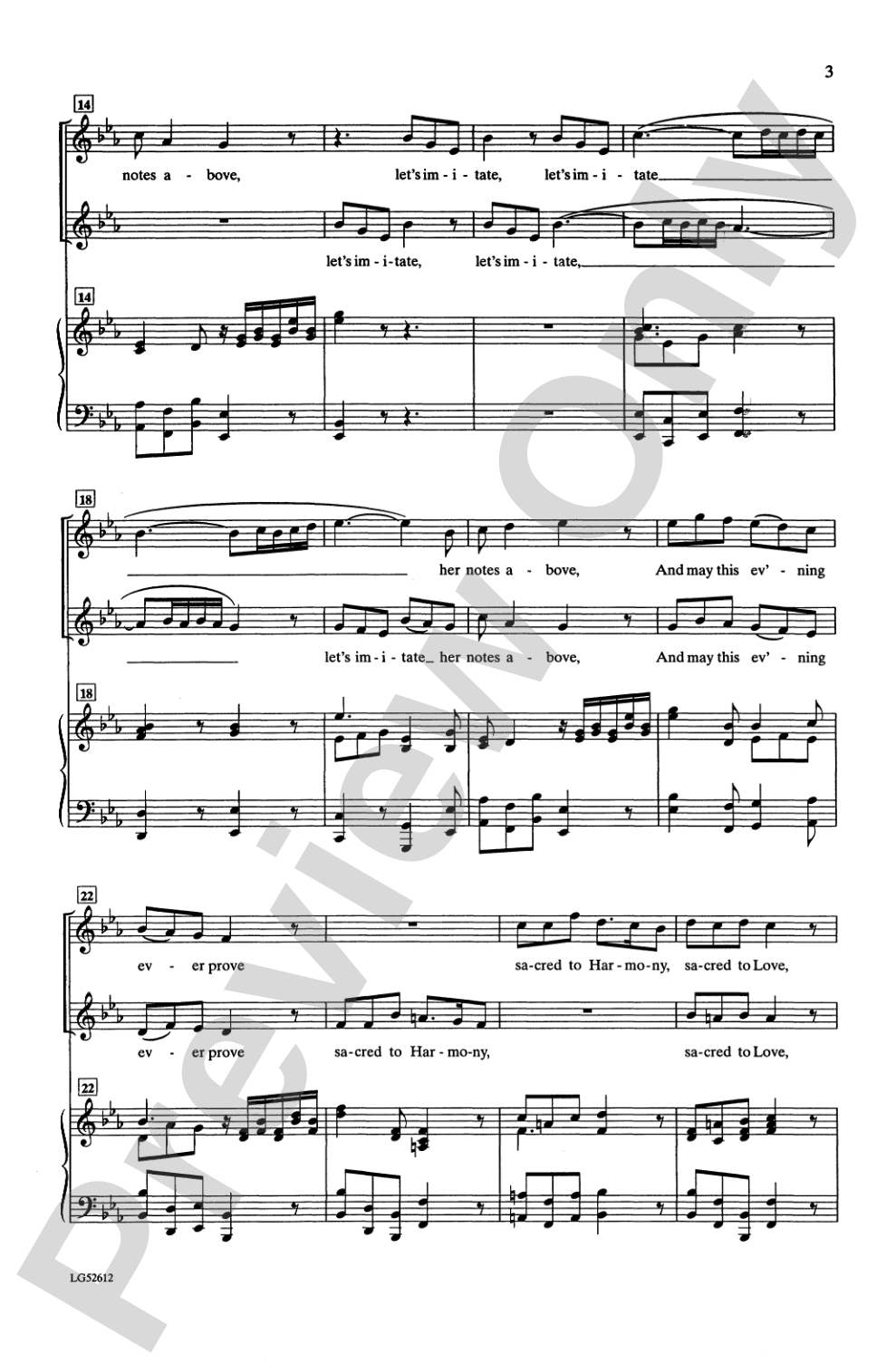
Let's Imitate Her Notes (from <I>Alexander's Feast</I>) Sheet Music Preview

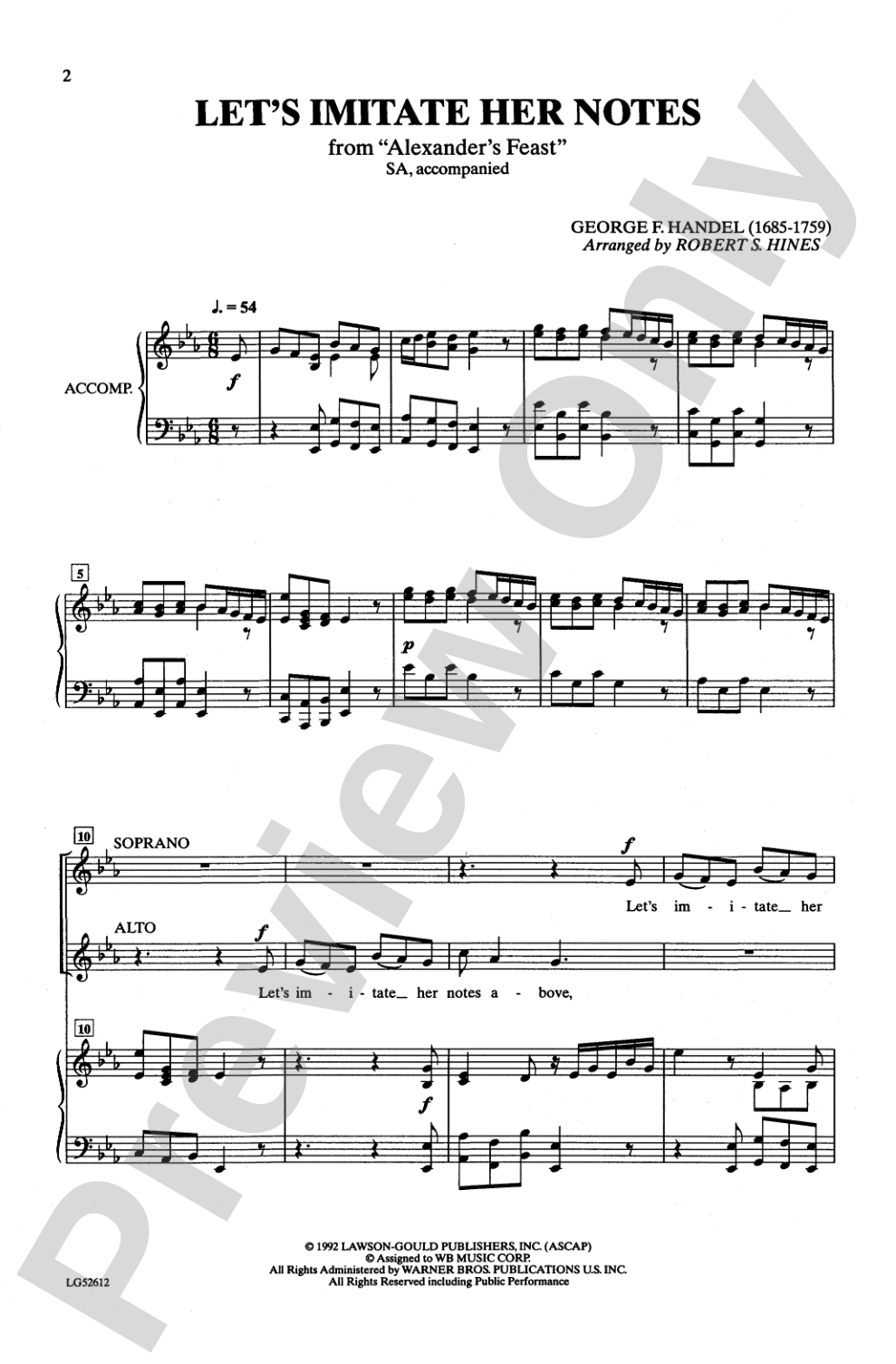
Let's Imitate Her Notes (from Alexander's Feast): 2-Part Choral Octavo

From Alexander's Feast

By George Frideric Handel / arr. Robert S. Hines

Item: 00-PO-0003030

Digital Download
$2.25

Minimum order quantity: 20 copies

Description

Let's Imitate Her Notes (from Alexander's Feast): 2-Part Choral Octavo isn't in MakeMusic Cloud just yet...but it could be. Let us know you'd like to see it, and you'll help shape what comes next. In the meantime, start a free trial and dive into thousands of interactive titles your students can play along with today.

Sample Audio
No sample audio found.
Sample Video
Additional Details
Series: Alfred Archive Edition: Lawson-Gould Music Publishers
Publisher: Alfred Music
Page Count: 8
SKU: 00-PO-0003030

More about this title

About the Composer: George Frideric Handel

George Frideric Handel (1685-1759) dominated the musical landscape of Baroque Europe and England, composing operas, oratorios, concerti grossi, and instrumental works that shaped the sound of an era. Born in Halle, Germany, he spent much of his career in Italy and England, where he became a naturalized citizen and gained the patronage of the English court. His compositional legacy rests on his gift for memorable melody, dramatic pacing, and the ability to write music that moves both the concert hall and the theater.

Handel's choral writing remains central to music education because it combines structural clarity with emotional directness. His works reward singers who understand Baroque phrasing and harmonic language, and they sit comfortably for ensembles ranging from children's choirs to advanced singers. Teachers return to Handel again and again because his music teaches itself: the lines are logical, the harmonies are sensible, and the dramatic intent is never obscured.

Why we love this

This excerpt from <i>Alexander's Feast</i> brings Baroque grandeur into reach for developing choirs without sacrificing musical integrity. Robert S. Hines's 2-part arrangement preserves Handel's harmonic sophistication and the piece's theatrical energy while creating a manageable texture that allows singers to experience a masterwork on their own terms. The result is a piece that sounds substantial and rewarding to perform, not simplified.

What to expect

The piece carries the ceremonial grandeur and spirited confidence of <i>Alexander's Feast</i>, a secular oratorio celebrating triumph and joy. The music propels forward with Baroque energy; singers feel the momentum of period style without the weight of complex counterpoint. There's a lift to the harmonic progressions and an elegance in the melodic contours that makes this feel like the real thing.

Who it's for

This octavo works for middle school through adult choirs seeking authentic Baroque repertoire that doesn't overwhelm developing singers. It's equally valuable for treble choirs, lower voice choirs, or mixed choirs divided into two parts, making it genuinely flexible for multiple ensemble configurations.

How to get the most out of it

  • Shape the melodic line with long phrases rather than stopping at bar lines. Handel's melodies breathe across measures, so identify the arc of each section and let it build naturally to its peak.
  • Keep the harmonic movement clear by balancing the two voice parts. Neither line should disappear; they're equal partners in creating the chord progression that drives the piece forward.
  • Attend to the text setting. Handel matches musical gestures to words precisely, so sing through the text with intention and let the word-painting guide your interpretation of rhythm and dynamics.
  • Maintain steady pulse in the rhythmic figures without letting them become mechanical. Baroque style allows flexibility within structure, not rigidity.

How to use it

Feature this on a concert pairing Baroque choral works, or use it as an accessible entry point to secular oratorio in a survey of choral literature. The modest page count makes it feasible to include alongside larger works in the same concert without disrupting balance. It also works well as a standalone showcase piece that demonstrates your choir's command of period style.

Skills your students will build

  • Baroque phrasing and breathing across bar lines
  • Two-part harmonic awareness and balance
  • Text expression and word-painting
  • Familiarity with Baroque musical language and style conventions
  • Sustained musical line without modern vibrato techniques

You May Also Like