
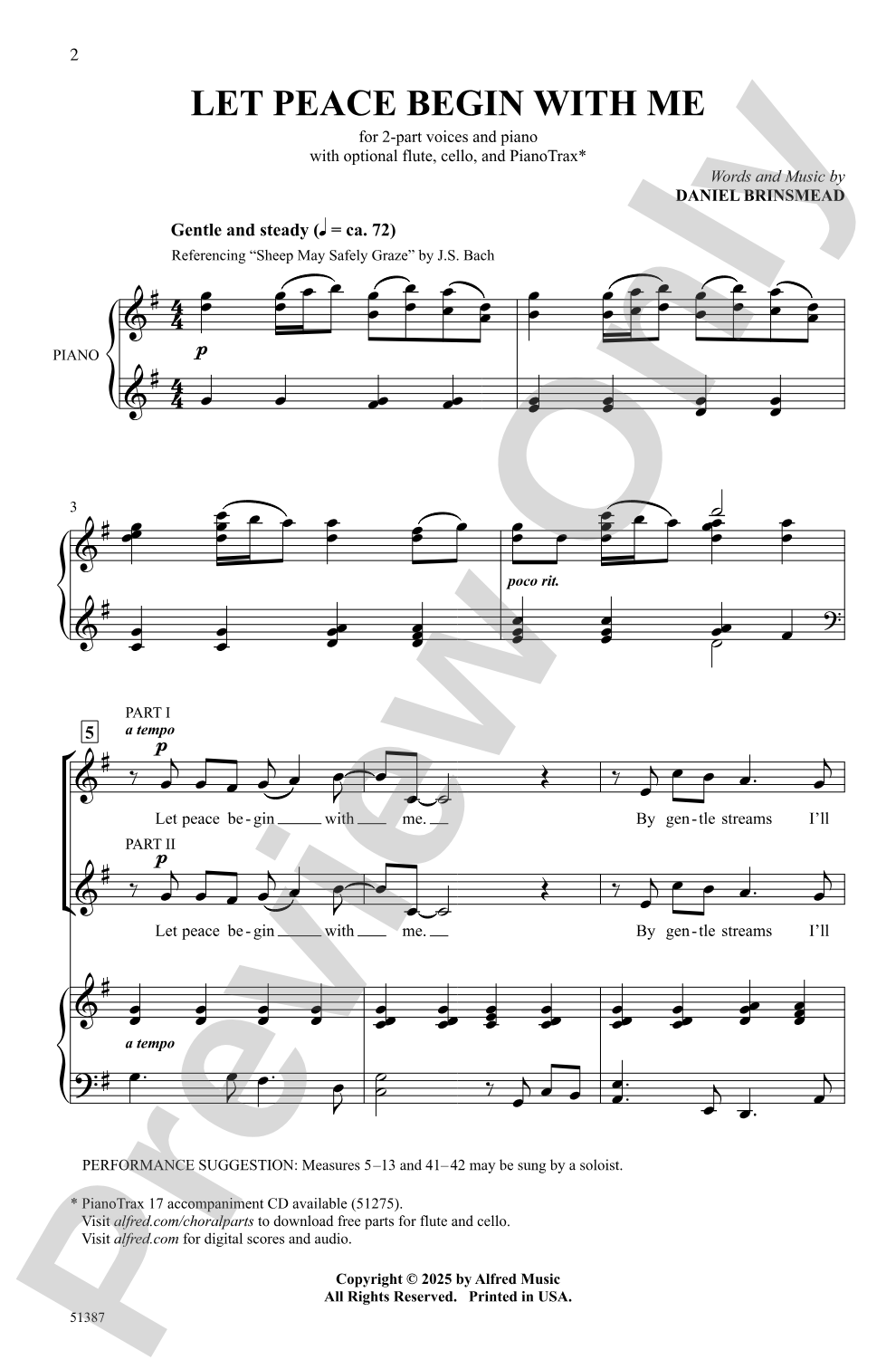
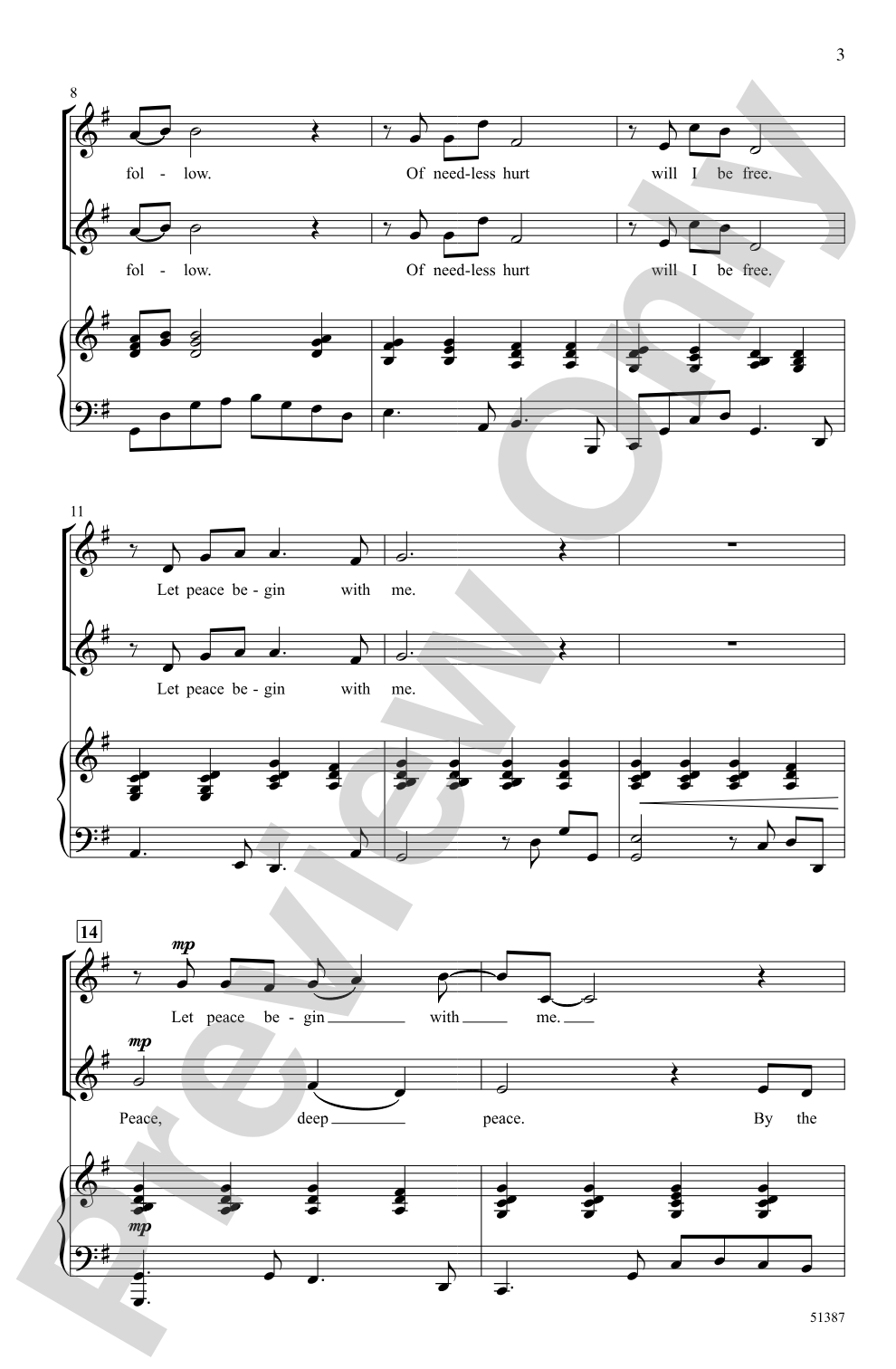

Let Peace Begin with Me: 2-Part Choral Octavo
Words and music by Daniel Brinsmead
Item: 00-PO-0007416
$2.20
Minimum order quantity: 20 copies
Pickup currently not available
Description
A warm accompaniment and legato vocal lines enhance this text which reminds us to choose peace and goodwill over doubt and despair. Showcasing a variety of harmonic colors and subtle tempo changes, this artful song opens and closes with a nod to J.S. Bach. Equally effective with piano alone or with the free parts for flute and/or cello.


Discover MakeMusic Cloud: thousands of interactive titles your students can play along with today.
Sample Audio
1
Audio File
--:--
0:00
0:00
Sample Video
Additional Details
Series:
Alfred Choral Designs
Publisher:
Alfred Music
Page Count:
8
SKU:
00-PO-0007416
More about this title
About the Composer: Daniel Brinsmead

Daniel Brinsmead studied classical voice at the Australian National University's School of Music, earning his Bachelor of Music with Honours in performance studies. He went on to complete a Master of Music in Choral Conducting at the Royal Welsh College of Music and Drama in Cardiff, where he deepened his understanding of choral writing and ensemble direction.
Brinsmead's compositions have earned international recognition, including selection as one of eight winners in the Abbey Road Anthem Competition (2011), where his piece Come Sleep was recorded by Eric Whitacre and his ensemble. Based in Melbourne, Australia, he serves as Artistic Director for multiple choirs, including The Australian Children's Choir and Choristry, while maintaining an active career as a composer, arranger, orchestrator, and vocal coach.
Why we love this
Brinsmead balances accessibility with musical sophistication in a way that rewards both singers and audiences. The legato vocal writing sits naturally for developing singers, while the harmonic language and structural choices (especially the Bach-inspired bookends) give the piece genuine artistic weight. It's a piece that sounds mature without demanding advanced technique.
What to expect
Warm and reflective, with a legato quality that encourages singers into sustained, mindful singing. The Bach-inspired framing gives it a classical sensibility, while the harmonic colors and tempo flexibility keep it modern and engaged. There's an underlying hopefulness here, grounded in straightforward conviction rather than sentimentality.
Who it's for
Two-part choirs of any age seeking repertoire with genuine musical substance and a message that resonates. This works equally well for middle school and high school ensembles, community choirs, and church programs where singers want something contemporary but not trendy.
How to get the most out of it
- Explore the harmonic colors as an interpretive guide. The shift in harmonic palette signals emotional moments, so encourage singers to listen for where the accompaniment changes color and match that awareness with their own dynamic shaping.
- Consider the optional flute and cello parts not as enhancements but as choices for different performance contexts. Piano alone works beautifully for smaller ensembles or intimate settings; add instruments when you want fuller texture and want to spotlight the parts in rehearsal.
- Give specific attention to the tempo changes. These aren't arbitrary; they're compositional moves that shape the arc. Mark them clearly in scores and conduct them with intention so singers understand the expressive reason behind each shift.
How to use it
This works beautifully as a set piece in a concert built around themes of social responsibility or peace, or as a standalone selection for assembly performances, peace vigils, and interfaith events. It also functions well as a closing piece on a mixed concert, offering a moment of reflection before the program ends.
Skills your students will build
- Sustained legato singing across phrases with consistent breath support
- Listening for and responding to harmonic color changes in the accompaniment
- Following and executing subtle tempo changes with conductor direction
- Blending in two-part voicing while maintaining individual part integrity
- Text expression and connecting emotional content to musical phrasing